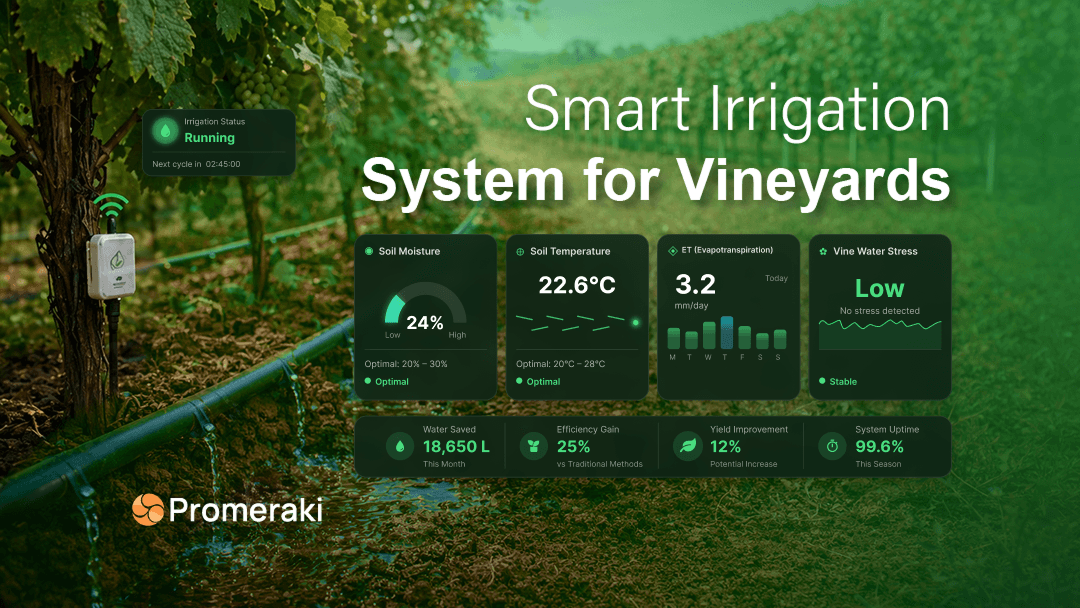
TLD;R - Traditional irrigation is costing vineyards water, money, and crop quality. IoT-powered smart irrigation gives managers real-time control, cutting water usage by up to 30%, improving grape yield, and reducing costs significantly.
Introduction
Water is the most important input in a vineyard. Get it right, and your vines thrive. Get it wrong too much or too little, and you risk losing an entire season potential before you even realize there's a problem.
For decades, vineyard managers have relied on experience, observation, and fixed irrigation schedules to make water decisions. These methods worked when conditions were predictable. But today, with climate patterns becoming increasingly erratic and water regulations tightening across major wine-producing regions, that approach simply isn't reliable enough.
Worldwide, agriculture accounts for roughly 70% of freshwater withdrawals, and vineyards are among the most water-sensitive crops within that number. Grapevine water needs to change by the week, by the growth stage, and even by the specific row in your vineyard. Managing that complexity manually is where most inefficiency begins.
Smart irrigation management, powered by IoT, changes this entirely. Instead of guessing, you get data. Instead of reacting, you get control. This blog explains exactly how IoT is enabling smarter water decisions in vineyards and what it means for your operation.
The Problem with Traditional Vineyard Irrigation
If you are still running irrigation on a fixed schedule or relying on manual checks, you are not alone. Most vineyards around the world still operate this way. But it comes with real costs.
The over-irrigation and under-irrigation trap
Traditional irrigation methods are built on averages, like average temperature, average rainfall, and average soil moisture. But vines don't grow on average. Over-Irrigation dilutes sugar concentration in grapes, promotes fungal disease, and weakens root systems. Under-irrigation creates vineyard water stress, stunts growth during critical periods, and directly reduces yield and fruit quality.
Both problems are expensive. And with manual monitoring, you often detect them too late.
The labour cost of watching and waiting
Manual irrigation management means someone physically walking in the vineyard, checking soil, reading the weather, and making judgment calls. That takes time, time that compounds over a full growing season. And even the most experienced vineyard manager cannot be everywhere at once. Variation across rows, elevations, and soil types means water waste in vineyards is almost built into the traditional process.
Weather unpredictability makes it worse
Climate change has made rainfall patterns less reliable. A forecast that showed rain on Thursday may not be delivered. A heat spike in October was not in last year's model. Inefficient irrigation decisions made on outdated assumptions are now a real business risk, not just an operational inconvenience.
With 40% of the total water usage in agriculture being wasted every year, improving methods in this industry is vital. Vineyards cannot afford to carry that kind of loss forward.
What Smart Irrigation Actually Means in a Vineyard Context
"Smart irrigation" is a term used broadly and sometimes loosely. In the context of viticulture, it means something very specific.
Smart irrigation management is the ability to deliver the right amount of water to the right part of the vineyard at the right time based on what the data actually says, not what a calendar suggests.
It is worth separating two ideas that are often confused:
- Automated irrigation runs on pre-programmed schedules. It removes some manual effort, but it still runs on assumptions.
- Smart irrigation responds to real conditions of soil moisture, plant stress signals, weather forecasts, and evapotranspiration rates and adjusts water delivery accordingly.
Smart irrigation technology makes the second model possible. And for vineyards, where microclimates vary dramatically across even small plots, this distinction translates directly into crop quality and cost savings.
How IoT Enables Smart Irrigation: The Technology Behind It
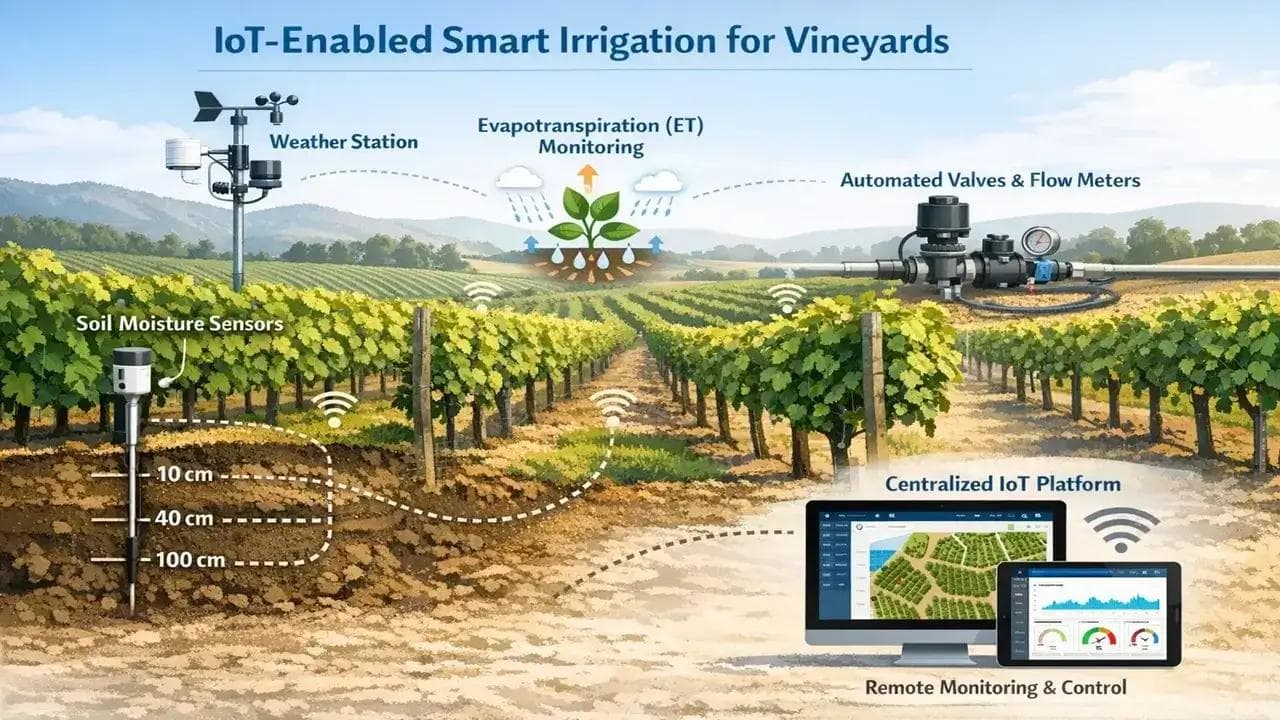
The infrastructure behind IoT-driven smart irrigation in agriculture is more accessible than most vineyard managers expect. Here is how it works in practice.
Soil moisture sensors
Sensors placed at root depth, typically at multiple depths from 10 cm to 120 cm, continuously monitor the volumetric water content of the soil. This data tells you exactly when the root zone is approaching stress levels, long before a vine shows visible signs. No more walking the rows hoping to spot the problem in time.
Microclimate weather stations
Weather stations positioned across the vineyard collect hyperlocal data on temperature, humidity, wind speed, and solar radiation that generic regional forecasts simply cannot provide. Your north-facing block and your south-facing slope may need completely different irrigation responses on the same afternoon. IoT makes that precision possible.
Evapotranspiration (ET) calculations
One of the most valuable inputs in smart irrigation management is evapotranspiration of the combined water lost from soil and plant surfaces. IoT platforms calculate ET in real time, giving you a direct picture of actual vine water demand, not a theoretical estimate. Precision water delivery based on ET is one of the clearest differentiators between traditional and smart irrigation.
Flow meters and automated valve controllers
Once the data is processed, automated valve controllers adjust irrigation in real time. Water runs where it is needed for as long as it is needed and stops. No manual intervention. No unnecessary water waste in vineyards from zones that are already adequately hydrated.
Centralized IoT platform and dashboard
All these data sensors, weather, ET calculations, and irrigation logs feed into a centralized platform. Vineyard managers get a single view of the entire operation, with alerts, remote control, and historical trends. Decisions that used to require physical presence now happen from a phone or desktop, anywhere.
Impact: What Changes When Vineyards Go Smart
The outcomes of smart irrigation management for vineyards are well-documented, and they are significant.
Water consumption reduction
Research indicates that IoT-connected smart irrigation systems can reduce water usage by up to 30% compared to conventional methods, while promoting healthy crop growth. For large vineyards operating under water allocation limits or in water-stressed regions, that number is transformational.
Crop yield improvement and grape quality
Grape vineyards in California reported a 20% increase in yield after implementing smart irrigation technology, while simultaneously reducing water usage by 30%. Beyond volume, precise water delivery during key growth stages of flowering, berry set, and veraison directly influences sugar levels, acidity balance, and overall grape quality.
Irrigation cost savings
Automated irrigation benefits extend beyond water bills. When irrigation runs only, when necessary, energy costs for pump operation drop. Labour hours spent on monitoring and manual adjustments decrease sharply. The smart irrigation ROI case builds quickly, especially for mid-to-large vineyards.
Early detection of vineyard water stress
IoT systems flag anomalies before they become visible problems. A moisture drops in a specific zone, an unexpected ET spike, a sensor reading that breaks from the Pattern all these surfaces in your dashboard before they show up in the vine. Early intervention protects yield.
Better regulatory compliance
Water use regulations are tightening in key wine regions across Europe, Australia, and California. IoT irrigation management platforms generate the usage logs and compliance documentation that manual systems cannot easily produce.
Key Considerations Before Implementing IoT Irrigation
Smart irrigation technology delivers strong results, but the right implementation matters. Here is what to evaluate before getting started.
Vineyard size and terrain complexity
Larger vineyards with varied elevation, soil types, or sun exposure benefit most from IoT because the data differences across zones are significant enough to justify sensor coverage. Smaller, uniform plots may need fewer sensors but still benefit from automation and remote monitoring.
Existing infrastructure compatibility
Many vineyards already have drip or micro-spray systems in place. IoT controllers can often be retrofitted onto existing infrastructure valve controllers, flow meters, and sensors to integrate without requiring a full irrigation to rebuild. The evaluation is worth doing before assuming a full replacement is needed.
Connectivity in rural settings
This is a practical consideration that is often overlooked. IoT sensors need to transmit data, and rural vineyards may not have reliable Wi-Fi coverage. Technologies like LoRaWAN and cellular (4G/5G) networks are specifically designed for wide-area, low-power agricultural deployments and work well across large vineyard estates.
Choosing the right IoT platform partner
The platform layer where all your sensor data lives is visualized, and triggers action is where the real value is created or lost. Look for a platform built for agriculture-specific use cases, with scalable architecture, real-time alerting, and iintegration of flexibility. A good IoT platform partner will also help you move from raw data to actionable irrigation management decisions.
ROI timeline
The smart irrigation market is expected to grow from $1.8 billion in 2024 to $3 billion by 2029, growing at a CAGR of 11.2%. Early adopters are already building cost and quality advantages. For most vineyard operators, the combination of water savings, reduced labour, and yield improvement puts the ROI timeline well within two to three growing seasons.
Why Now is the Right Time to Adopt
The conversation around smart irrigation in agriculture has shifted. It is no longer a question of whether the technology works; the evidence is clear. The real question is how soon your vineyard adopts it relative to your competitors.
Three factors make right now the most practical window:
Water scarcity is becoming a regulatory reality
Irrigation restrictions and water allocation frameworks are expanding across wine regions globally. Building a smart irrigation management system today means your operation is already compliant and documented when new requirements land.
IoT hardware costs have dropped significantly
Manufacturers are now offering low-cost sensors that can be connected to nodes to implement affordable systems for irrigation management. The hardware barrier that once made IoT viable only for large estates is largely gone.
The agriculture IoT market is scaling fast
The global agriculture IoT market is projected to expand from USD 11.4 billion in 2021 to USD 18.1 billion by 2026, at a CAGR of 9.8%. That growth reflects both falling costs and rising adoption, which means the ecosystem of platforms, integrations, and expertise is maturing rapidly, making implementation smoother than it was even three years ago.
Vineyard managers who wait for the "perfect time" will find their peers have already closed the gap.
Conclusion
Smart irrigation management for vineyards is no longer an innovation on the horizon. It is a practical, proven shift in how water decisions get made, and it is already delivering measurable results across yield, quality, cost, and compliance.
The core change is simple: instead of irrigating a schedule, you irrigate data. IoT sensors, real-time platforms, and automated controls give you the visibility and precision that traditional irrigation methods were never designed to offer.
Your vineyard's water decisions are too important and too consequential to leave to guesswork.
Ready to build a smarter irrigation system for your vineyard operation?
Promeraki helps agri-tech companies and OEMs design and deploy IoT platforms built for precision agriculture.