Introduction
Most people think viticulture means growing grapes. And yes, at its core, that is exactly what it is.
But spend a week in a working vineyard, and you quickly realize that growing grapes is not one job. There are seven jobs happening at the same time, across the same piece of land, all influencing each other in ways that are not always obvious until something goes wrong.
A vineyard manager is not just a farmer. On any given day, they are a soil scientist, a water engineer, a disease monitor, a data analyst, and a harvest strategist all rolled into one. Understanding viticulture practices across all these areas is what separates a good vineyard manager from a great one.
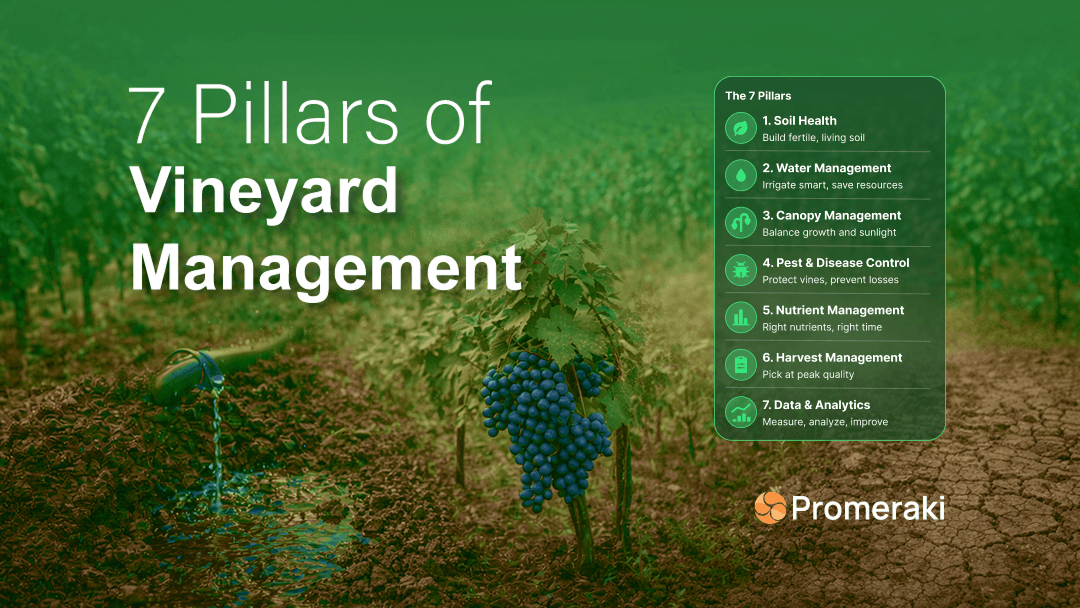
Modern viticulture has evolved to reflect this complexity. Today, the field is organized around seven core disciplines, each one focused on a different part of managing a healthy, productive vineyard. These seven pillars of vineyard management are what separate a vineyard that consistently produces great wine from one that is always reacting to problems it could have seen coming.
This blog breaks down all seven, what each one means, why it matters, and where smart vineyard technology is making the biggest difference for vineyard managers, winery owners, and agri-tech companies building solutions for this space.
What is Vineyard Management?
Vineyard management covers everything that happens in the field. It is the science and practice of managing the land, the vines, the soil, the water, and the growing environment to produce the best possible grapes. Winemaking starts where vineyard management ends at the moment the grapes leave the vine.
Good vineyard management is the foundation of good wine.
Modern vineyard management techniques have evolved significantly over the last two decades. What was once guided entirely by experience and seasonal intuition is now supported by vineyard sensor technology, real-time data platforms, and precision viticulture tools that give managers a level of visibility that simply was not possible before.
But the fundamentals have not changed. There are still seven core disciplines in seven pillars that every vineyard manager must get right, season after season.
Viticulture Works as a System, Here is How
For a long time, vineyard management was treated as a single craft. One person, one property, one set of decisions made by feel and experience.
That model still exists, and it has produced some of the world's greatest wines. But it does not scale. And in a world where climate pressures are rising, labour is expensive, and consumers demand consistent quality year after year, vineyard managers need more than instinct. They need a process.
Think of a vineyard like a living system. The soil feeds the roots. The roots feed the vine. The vine feeds the fruit. The fruit becomes a wine. Every part of that system is connected, and every part needs to be actively managed.
That is where modern viticulture comes in. It breaks vineyard management down into focused disciplines, each one covering a specific part of that living system. Each discipline has its own tools, its own data, and its own role in the final outcome.
TLD;R
- Growing grapes is not one job, it's seven. And today's vineyard managers need data, sensors, and smart systems to get all seven right, every single season.
Here is how that process breaks down:
The 7 Pillars of Vineyard Management at a Glance
| Pillar | What It Covers | Smart Device & System | IoT Relevance |
|---|---|---|---|
| Precision Viticulture | Managing vineyard zones individually using sensors and data | IoT soil sensors, weather stations, centralized data platform | IoT is the core engine |
| Irrigation Management | Deciding when, where, and how much to water | Soil moisture probes, automated irrigation controllers, fertigation systems | Real-time data drives every watering decision |
| Disease & Pest Management | Predicting and preventing outbreaks before they spread | Microclimate sensors, leaf wetness sensors, AI-powered alert systems | Live sensor data makes early alerts possible |
| Soil Science & Mapping | Understanding soil texture, drainage, and mineral content | EC mapping sensors, in-ground soil probes, soil health dashboards | IoT adds live monitoring on top of periodic mapping |
| Canopy Management | Managing vine leaves and shoots to optimize sunlight on grapes | Multispectral drones, NDVI imaging systems, canopy vigour maps | Drone imaging replaces days of manual scouting |
| Harvest Optimization | Picking grapes at exactly the right moment based on ripeness data | Brix sensors, NIR ripeness sensors, harvest prediction models | Sensor data removes guesswork from harvest decisions |
| Cellar & Winery Monitoring | Monitoring fermentation and storage conditions after harvest | Temperature and humidity sensors, tank monitoring systems, barrel room controllers | Remote monitoring ensures quality control at scale |
Precision Viticulture
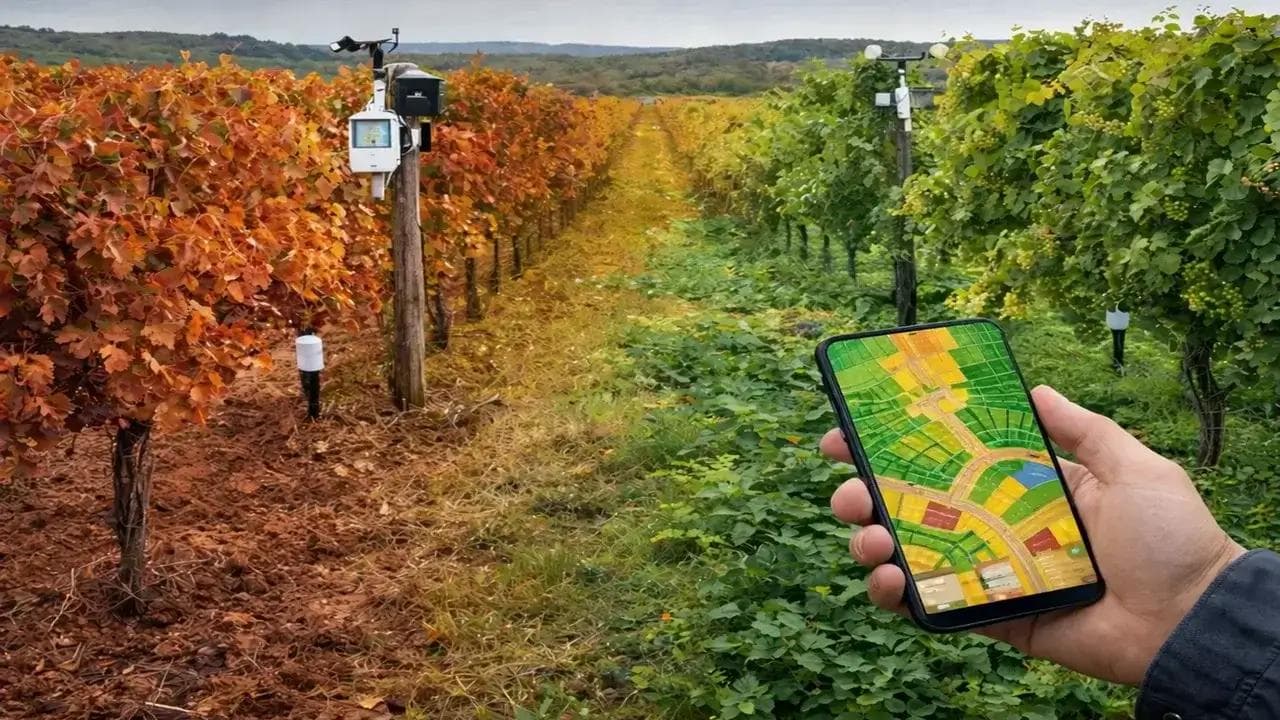
Precision viticulture is the practice of managing the vineyard zone by zone rather than treating the whole property as one uniform piece of land. Every section of a vineyard has its own soil type, drainage pattern, and microclimate. Precision viticulture uses sensors and data to understand these differences and respond to each zone individually.
Why it matters?
Traditional viticulture practices apply the same water, the same spray, and the same treatment across the entire vineyard regardless of what each zone actually needs. This wastes resources and produces uneven results. When one section of the vineyard is over-irrigated while another is under-treated for disease, the quality gap shows directly in the final wine.
How IoT fits?
IoT soil sensors, weather stations, and leaf wetness monitors placed across the vineyard feed continuous data into a central vineyard decision support system. Managers see exactly what is happening in every zone in real time and act on it immediately.
Vineyard Irrigation Management
Vineyard irrigation management is the discipline of deciding when to water, how much to apply, and which areas of the vineyard need it most. It is one of the most consequential vineyard management techniques available because water directly controls how the grape develops from flowering all the way to harvest.
Why it matters?
Water is the only major environmental input that a vineyard manager can control. Too much water causes grape berries to swell and dilute, weakening flavour and reducing sugar concentration. Too little water at the wrong growth stage stresses the vine, stunted fruit development, and in severe cases causes permanent root damage. The margin between too much and too little is narrow, and it changes throughout the season.
How IoT fits?
Soil moisture probes are placed at multiple depths across different vineyard zones to measure exactly how much water is available to the vine's roots at any given moment. This data feeds directly into automated irrigation controllers that adjust watering schedules in real time, delivering the right amount of water to the right zone without any manual intervention. These are vineyard automation systems working at their most practical level.
In water-stressed regions like South Australia, California, and parts of South Africa, where water access is increasingly restricted and regulations are tightening every season. Vineyard irrigation management powered by IoT has become a business necessity.
Vineyard Disease Control & Pest Management
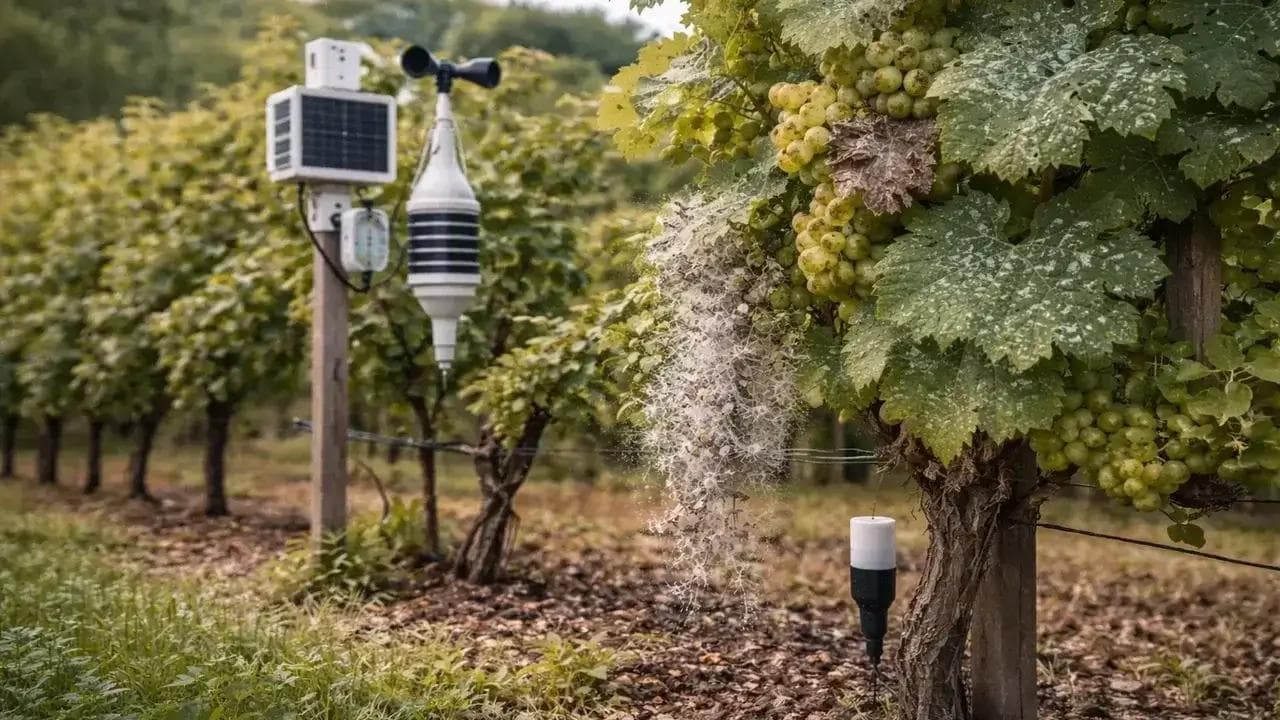
Vineyard disease control is the discipline of monitoring conditions to detect, predict, and prevent disease and pest outbreaks before they cause crop damage. It covers fungal diseases like powdery mildew, downy mildew, and Botrytis grey rot, as well as root-attacking pests like phylloxera that can devastate an entire block if left unchecked.
Why it matters?
Under the right conditions, warm days, cool nights, and high humidity fungal diseases can spread across an entire vineyard block within 48 to 72 hours. By the time damage is visible to a walking scout, a significant portion of the crop may already be lost. Spraying on a fixed calendar schedule is expensive, environmentally damaging, and still leaves the vineyard exposed between spray dates.
How IoT fits?
Microclimate sensors placed across the vineyard track temperature, humidity, leaf wetness, and wind speed continuously. When readings cross a known disease risk threshold, the system raises an alert immediately, giving the manager time to act before the outbreak takes hold. This is vineyard climate management working as a true early warning system.
Vineyard Soil Management & Mapping
Vineyard soil management is the discipline of understanding what is happening beneath the surface soil texture, water retention, mineral composition, and drainage capacity and actively managing soil health over time to support vine performance and sustainable viticulture practices.
Why it matters?
Everything in the grape-growing lifecycle starts with the soil. It determines how water moves through the root zone, what nutrients are available, and how deeply roots can be established. Soil health changes seasonally, and a vineyard with poor soil will always underperform regardless of how well the other pillars are managed.
How IoT fits?
Modern soil management starts with electrical conductivity (EC) mapping sensors towed across the vineyard that reveal soil texture, clay content, and water-holding capacity in one pass. Permanent in-ground soil sensors then provide continuous real-time data on moisture, temperature, and salinity throughout the growing season, giving managers a live picture of what is always happening beneath the surface.
Research published in the Precision Agriculture journal confirms that soil variability is the primary driver of yield and quality differences across vineyard zones, making soil mapping the essential starting point for any precision viticulture program.
Vineyard Canopy Management
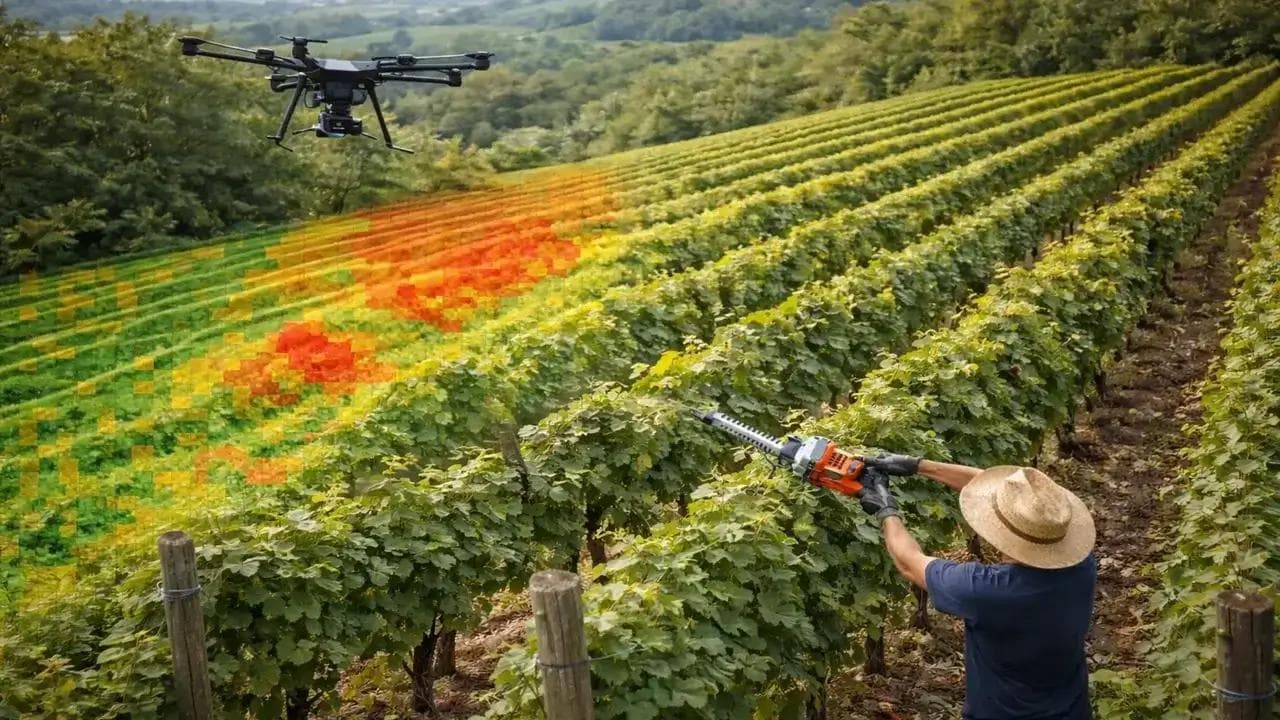
Vineyard canopy management is the ongoing process of trimming, thinning, and training the leafy upper part of the vine to control how much sunlight and airflow reaches the grapes throughout the growing season.
Why it matters?
Too many leaves create shade, slowing ripening, increasing humidity around the fruit, and raising disease risk. Too little shade in a hot climate can scorch the grapes and spike sugar levels before other flavour compounds are ready. Getting this balance right is one of the most labor-intensive disciplines of the entire season.
How IoT fits?
Drones equipped with multispectral cameras capture NDVI imagery colour-coded maps showing vine vigour levels across the entire property in a single flight. Over-vigorous zones and stressed areas are immediately visible. What once took days of manual scouting can now be identified in hours, and the vineyard team goes into the field knowing exactly where to focus.
Harvest Optimization & Vineyard Yield Optimization
Harvest optimization is the discipline of determining the exact right moment to pick the grapes block by block based on sugar content, acidity, pH, and phenolic ripeness data collected in the final weeks of the growing season.
Why it matters?
Harvest timing is the one decision that cannot be undone. Pick too early, and the fruit lacks ripeness and depth. Pick too late, and sugar spikes, acidity drops, and grapes begin to deteriorate on the vine. The margin between these two outcomes can be as narrow as five to seven days, and it varies across different blocks of the same vineyard.
How IoT fits?
Brix sensors measure sugar content from multiple vineyard locations every few days as harvest approaches. Vineyard data analytics platforms combine these readings with acidity measurements and weather forecasts to generate a harvest prediction model recommending the optimal picking window for each individual block. Some operations are also deploying NIR sensors on harvesting machinery to measure ripeness in real time as the machine moves through the rows.
Better raw material going into the winery means fewer corrections needed in the cellar, translating directly to lower production costs and more consistent wine quality vintage after vintage.
Cellar & Winery Monitoring
Cellar and winery monitoring is the discipline of tracking and maintaining the right conditions inside the winery after harvest, covering fermentation tanks, barrel aging rooms, and storage facilities throughout the winemaking process.
Why it matters?
Fermentation is sensitive to temperature. If conditions rise too quickly, yeast activity is disrupted, halting fermentation and altering the wine character in ways that cannot be corrected. Barrel aging rooms require consistent humidity and temperature over months or years for the chemical reactions that build wine complexity to proceed properly.
How IoT fits?
Temperature and humidity sensors placed in fermentation areas and barrel rooms feed into the same centralized monitoring system used to manage the vineyard. Alerts notify winery managers at the moment a reading moves outside the acceptable range, day or night, whether anyone is physically present or not.
Smart Vineyards Run on Smart Platforms
Promeraki builds the IoT infrastructure behind precision viticulture faster to deploy, build to scale, and ready for production.
Conclusion
Vineyard management has always been complex.
Each of the seven pillars now has purpose-built vineyard sensor technology, automation systems, and data analytics tools designed to support it. And when those tools are connected through a well-engineered platform, vineyard managers gain something that was genuinely not possible before a real-time, complete view of everything happening on their land, from soil to cellar.
The vineyards winning today are not necessarily the ones with the best terroir. They are the ones with the best systems.
Promeraki builds the IoT platforms that connect vineyard sensor technology, automation systems, and vineyard data analytics into one production-ready system purpose-built for OEMs and agri-tech companies working in precision agriculture and smart vineyard technology.