Introduction
Over the last decade, physical products have begun to behave more like software systems. Machines, appliances, vehicles, and industrial equipment are no longer isolated devices. They are becoming connected systems that generate data, communicate continuously, and improve performance over time.
This shift is driven by the Internet of Things, commonly referred to as IoT.
Today, companies across manufacturing, agriculture, healthcare, logistics, and infrastructure use IoT to improve efficiency, reduce downtime, and create new digital services. As industries become more data-driven, connected devices are becoming part of daily business operations.
Modern IoT platforms for smart devices support real-world monitoring, automation, remote management, and long-term system scalability across connected product ecosystems.
However, many businesses still misunderstand what IoT actually includes. Some think IoT only means connecting devices to the internet. Others believe it only refers to dashboards or data collection tools. IoT is a complete ecosystem that connects hardware, software, connectivity, automation, and analytics into one system.
In this blog, we explore what IoT means in practical business terms, how IoT systems work, why adoption is growing globally, and how companies use IoT to build scalable connected products.
What is IoT?
The Internet of Things (IoT) is a network of physical devices connected to the internet that collect, share, and act on data using sensors, software, and automation systems. These devices communicate with cloud or edge platforms to enable monitoring, remote control, analytics, and automated decision-making.
IoT technology supports everything from smart homes and wearable devices to industrial automation and smart city infrastructure.
Companies building connected products often invest in smart device platform development services to ensure device reliability, monitoring, and automation at scale.
What Does IoT Stand For?
IoT stands for Internet of Things.
The idea is simple. Physical objects become smart when they can sense information, communicate with systems, and trigger automated responses.
For example, a smart irrigation system can detect soil moisture levels and automatically start watering. A connected factory machine can detect vibration changes and send maintenance alerts before a breakdown occurs.
IoT enables businesses to move from reactive operations to predictive and automated operations.
Why IoT Matters More Than Ever in 2026
IoT is now central to digital transformation strategies across industries.
According to IMARC Group, the global IoT market is expected to grow from about $1.02 trillion to nearly $3.49 trillion by 2033.
As device deployments increase, businesses are shifting toward full lifecycle of IoT solutions for smart device manufacturers that support connectivity, monitoring, automation, and long-term device management.
How Does IoT Work?
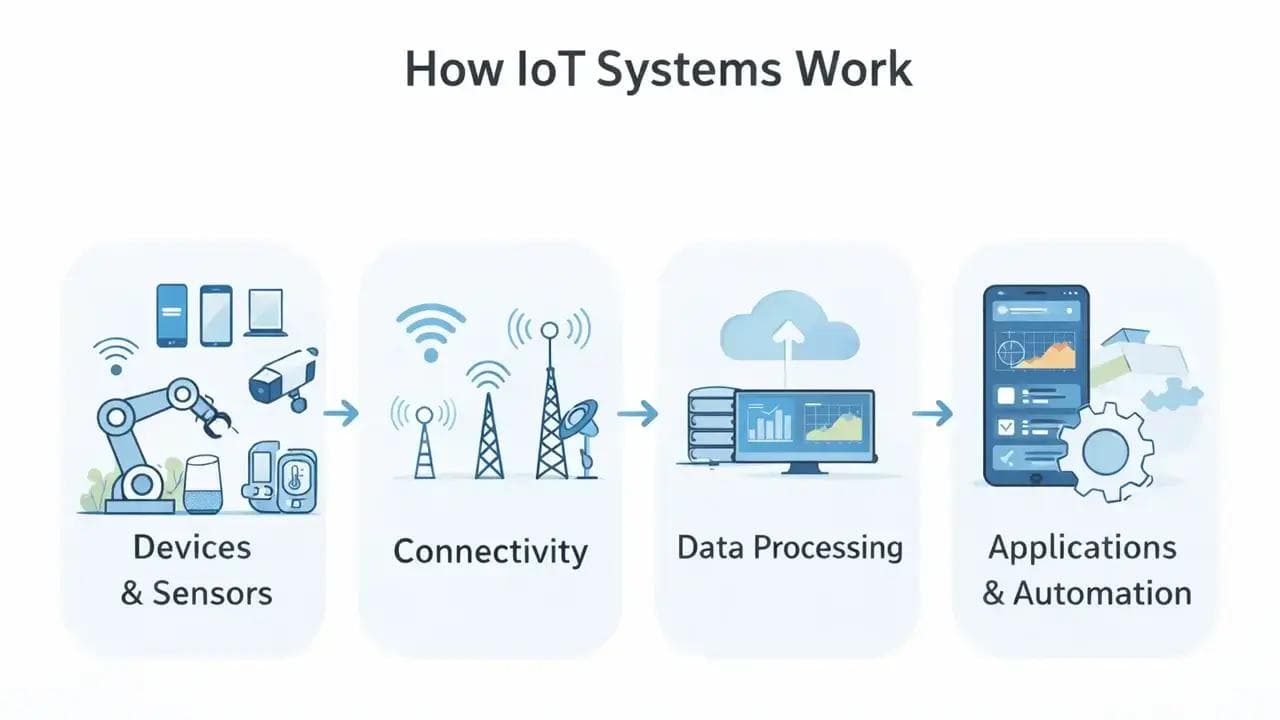
IoT systems operate through multiple connected layers.
Devices and Sensors
Devices collect real-world data such as temperature, pressure, vibration, or movement. Sensors convert physical signals into digital information.
Connectivity
Devices transmit data using WiFi, cellular networks, LoRaWAN, NB-IoT, or Ethernet connections.
Data Processing
Data is processed using cloud platforms or edge computing systems to generate insights.
Applications and Automation
Dashboards and automation systems convert raw data into reports, alerts, and automated workflows.
Below is a simplified breakdown of how IoT systems are structured in real-world deployments.
IoT System Layers Explained
| Devices & Sensors | Collect real-world data | Temperature sensor, vibration sensor |
|---|---|---|
| Connectivity | Transfers device data | WiFi, 4G, LoRaWAN, NB-IoT |
| Data Processing | Stores and processes data | Cloud platforms, Edge computing |
| Application Layer | Shows insights and controls devices | Web dashboards, Mobile apps |
| Automation Layer | Triggers actions automatically | Auto shutdown, Alerts |
These layers work together to create reliable connected systems that support monitoring, control, and automation.
IoT Architecture Explained
A complete IoT ecosystem includes multiple technical layers:
- Device Layer includes embedded systems and sensors.
- The gateway Layer manages local aggregation and filtering.
- The cloud layer handles large-scale storage and analytics.
- The application layer provides user interfaces and APIs.
- Automation Layer enables rules, triggers, and predictive logic.
Many companies design scalable enterprise IoT platform architecture to support product lifecycle operations from device onboarding to retirement.
How Businesses Use IoT Across Industries in 2026
IoT is deeply embedded across industries.
- Smart homes use IoT devices like thermostats and smart locks.
- Smart agriculture uses sensors to optimize irrigation.
- Smart manufacturing uses predictive maintenance systems.
- Healthcare IoT enables remote patient monitoring.
- Smart cities use environmental and traffic sensors.
- Industrial IoT supports factory automation and asset tracking.
Industrial IoT alone is expected to exceed $2 trillion by 2034.
What Are the Different Types of IoT?
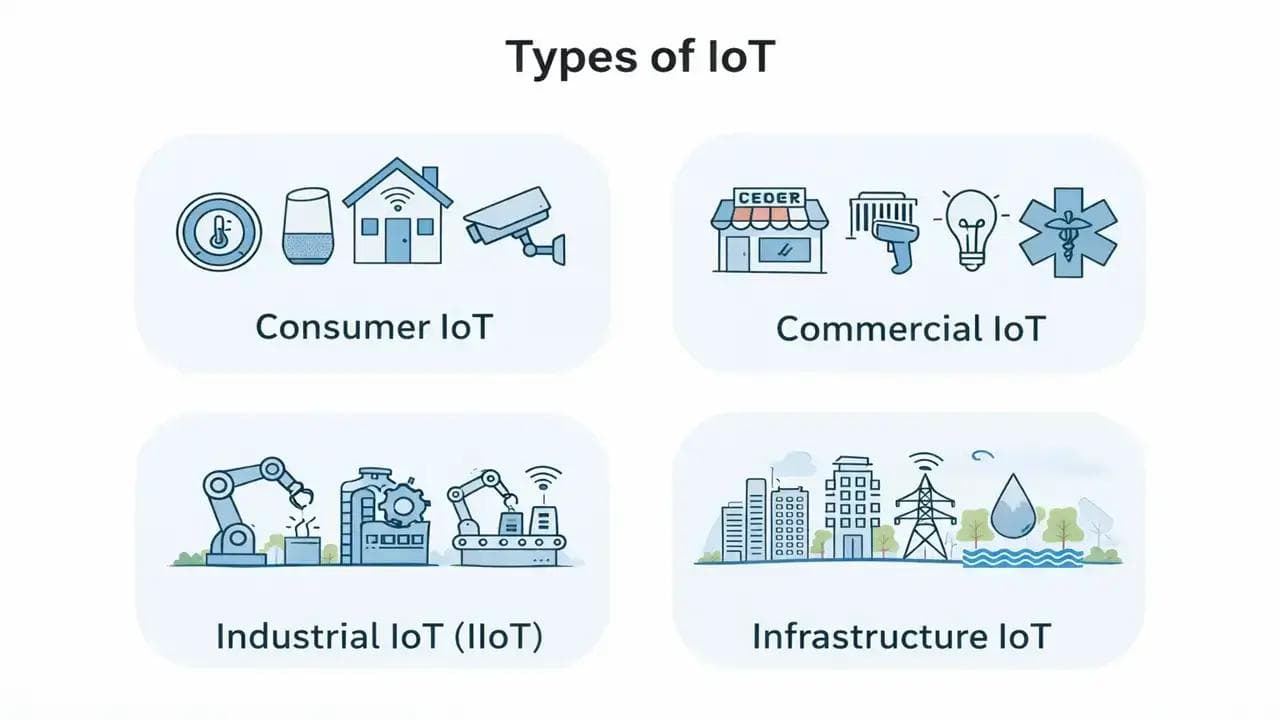
IoT is not a single technology used in one environment. It operates across industries and uses cases depending on how connected devices are deployed and managed. Understanding the different types of IoT helps businesses choose the right architecture and operational strategy.
Consumer IoT
Consumer IoT includes connected devices used in homes and personal environments. These devices focus on convenience, comfort, and user experience.
Examples include smart thermostats, wearable fitness trackers, smart speakers, connected security cameras, and home automation systems. These devices collect user data and provide remote access through mobile applications.
In Consumer IoT, ease of installation, data privacy, and seamless integration are critical factors. Devices must be intuitive and secure while offering real-time visibility and control.
Industrial IoT (IIoT)
Industrial IoT, or IIoT, focuses on manufacturing, heavy machinery, energy systems, and industrial automation. It connects industrial equipment to monitor performance, track asset health, and enable predictive maintenance.
Factories use IIoT to reduce downtime, improve safety, and optimize production output. Equipment sensors detect performance changes and alert teams before failures occur.
Because industrial environments operate at scale, IIoT requires strong lifecycle management and scalable architecture. This is where full-scale IoT solutions for smart device manufacturers become essential.
Commercial IoT
Commercial IoT supports business environments such as retail stores, office buildings, hospitals, and hotels.
Retail businesses use IoT for inventory tracking and customer analytics. Office buildings use smart lighting and occupancy sensors to reduce energy costs. Healthcare facilities use IoT devices for equipment monitoring and operational tracking.
The focus of Commercial IoT is operational efficiency and improved customer experience.
Infrastructure IoT
Infrastructure IoT supports large-scale public systems like utilities, transportation networks, smart grids, and environmental monitoring systems.
Examples include smart water management systems, intelligent traffic signals, and power distribution monitoring. These systems require high reliability and strong cybersecurity because they support critical infrastructure.
IoT Types across Industries
- Personal & Home: Consumer IoT, Healthcare & Medical IoT
- Business & Industrial: Manufacturing IIoT, Agriculture & AgriTech IoT, Retail IoT, Smart Buildings IoT
- Logistics & Operations: Fleet & Supply Chain IoT, Oil, Gas & Mining IoT
- Public & Critical Systems: Smart Cities IoT, Energy & Utilities IoT, Smart Grid IoT
What Are the Key Benefits of IoT for Businesses?
IoT delivers measurable operational and strategic benefits when implemented properly.
- IoT enables automation. Systems can monitor performance continuously and trigger automated responses without manual effort.
- IoT provides real-time visibility. Managers gain instant insights into equipment health, asset performance, and operational conditions.
- Reduces downtime. Predictive maintenance systems detect early warning signs before failures occur, reducing repair costs and operational interruptions.
- Improves decision-making. Real-time data allows businesses to make faster and more informed operational decisions.
- IoT creates new revenue opportunities. Businesses can offer monitoring-as-a-service, subscription-based analytics, or data-driven optimization services.
Companies implementing custom IoT software solutions often experience improved efficiency, lower support costs, and better device ecosystem control.
IoT is more than a technology investment. It has become a long-term competitive advantage.
What Are the Main Challenges of IoT Adoption?
While IoT offers strong benefits, it also introduces operational complexity.
- Security is one of the biggest concerns. Every connected device increases the potential attack surface. Strong encryption, authentication, and secure firmware update processes are essential.
- Data management is another challenge. Continuous sensor data can overwhelm systems if not filtered and structured properly. Edge computing often helps reduce unnecessary data flow.
- Scalability becomes difficult as deployments grow. A system that works for 100 devices may struggle at 10,000 devices without proper infrastructure planning.
- Integration with legacy systems can also slow down adoption. Many industries operate older systems not originally designed for connectivity.
Addressing these challenges early improves long-term stability and prevents costly redesign later.
Why Do Many IoT Projects Fail After Deployment?
Many IoT projects show success during pilot stages but struggle when scaled.
During pilots, device counts are low, and monitoring is often manual. This creates a temporary sense of stability.
When deployment expands, hidden weaknesses appear. Connectivity inconsistencies increase. Manual monitoring is inefficient. Firmware updates become risky.
Teams often focus only on connectivity and dashboards while ignoring lifecycle management and automation workflows.
Modern businesses are moving toward full lifecycle IoT platforms for smart devices to manage monitoring, automation, firmware updates, and device health at scale.
Successful IoT strategies treat post-deployment operations as seriously as product development.
Only Dashboards are not Enough!
Scaling IoT means managing firmware, health, and automation - not just dashboards. We built a platform for exactly that.
What Role Does an IoT Platform Play in Connected Systems?
An IoT platform acts as the operational backbone of connected device ecosystems.
It securely connects devices, manages data flow, stores historical information, and enables automation workflows. It also controls user roles and permissions across teams and customers.
Without a strong platform, IoT deployments become difficult to manage as device numbers grow. Monitoring becomes fragmented. Firmware updates have become complex. Automation becomes inconsistent.
A robust IoT platform supports:
- Device onboarding and provisioning
- Remote firmware updates
- Centralized monitoring dashboards
- Automation rules and workflows
- Secure device-to-cloud communication
- Data analytics and reporting
Connected product companies treat IoT platforms as core infrastructure. The platform determines whether a system can scale smoothly or struggle under operational pressure.
In modern connected ecosystems, the IoT platform becomes as important as the hardware itself.
Business ROI of IoT
IoT improves efficiency and reduces operational costs.
Predictive maintenance can reduce maintenance costs by up to 30 percent and downtime by up to 45 percent.
IoT improves resource utilization and customer satisfaction.
Below is how IoT delivers business value.
Business Impact of IoT
| Maintenance | Detects issues before failure | Lower downtime |
|---|---|---|
| Operations | Automates monitoring | Reduced manual workload |
| Customer Experience | Real-time visibility | Higher satisfaction |
| Data Insights | Usage analytics | Better decisions |
| Energy Efficiency | Smart monitoring | Reduced costs |
This measurable impact is why IoT adoption continues to grow across industries.
What Is the Future of IoT? AI, Edge Computing, and Digital Twins
The future of IoT is moving beyond simple device connectivity toward intelligent automation and real-time decision-making.
Artificial Intelligence (AI) makes IoT systems smarter by analyzing device data and predicting issues before they happen. Instead of just monitoring performance, AI enables predictive maintenance and automated optimization.
Edge computing improves speed and reliability by processing data closer to the device. This reduces latency and allows systems to respond instantly, even when internet connectivity is unstable.
Digital twins create virtual replicas of physical devices or systems. These models use real-time IoT data to simulate performance, test scenarios, and improve operational planning without affecting real-world assets.
Together, AI, edge computing, and digital twins are transforming IoT from a monitoring system into an intelligent, adaptive ecosystem.
Final Thoughts
IoT is reshaping industries and redefining how modern products operate. Connected devices are creating smarter systems, faster decision-making, and more efficient operations across sectors.
As connected ecosystems expand, IoT platforms, automation systems, and lifecycle management tools are enabling businesses to scale with confidence. Strong IoT architecture allows companies to build reliable, secure, and future-ready connected products that continue to evolve over time.
Organizations that invest early in well-designed IoT systems position themselves for long-term growth. They gain better visibility, improved operational control, and the ability to innovate faster than competitors.
Working with experienced teams that specialize in IoT platforms for smart devices and custom IoT software solutions helps transform connected ideas into scalable, high-performance ecosystems.
It is enabling smarter businesses, stronger products, and sustainable digital transformation.