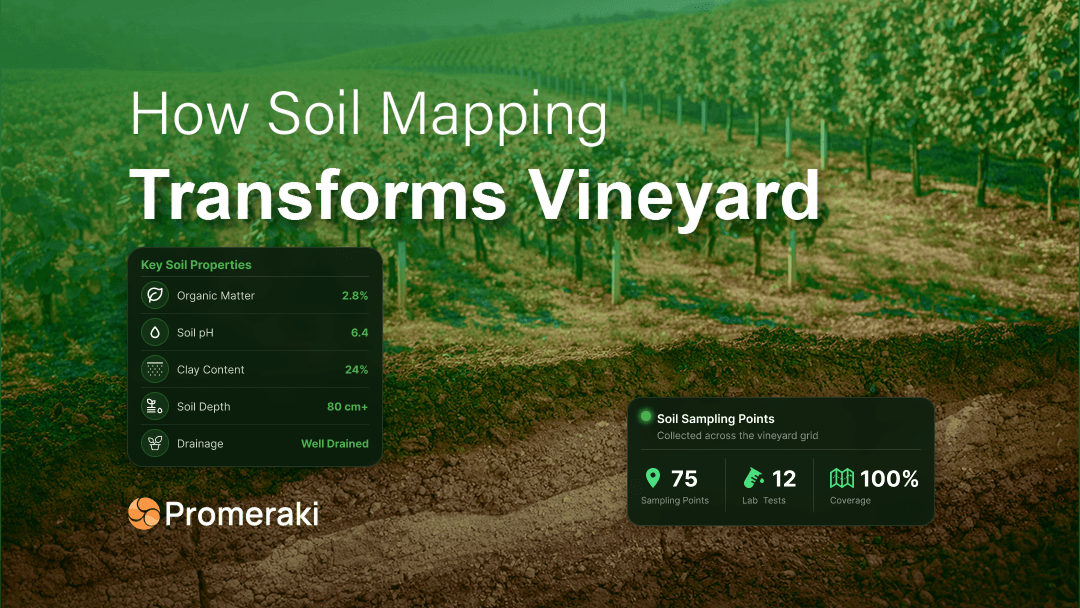
Introduction
Two vines planted 50 meters apart. Same variety. Same rootstock. Same season. One produces concentrated, deeply colored grapes that ripen evenly. The other delivers thinner, less consistent berries that lag behind.
How does soil affect wine quality? Often, the answer is right beneath the surface.
Soil varies. Within a single vineyard block, texture, depth, drainage, and nutrient availability can change dramatically over short distances. A pocket of heavy clay sits next to a sandy stretch. A well-drained ridge borders a low-lying zone that holds moisture for days. These differences directly shape how each vine grows, how each cluster ripens, and how the wine ultimately tastes.
Vineyard soil mapping is the practice of systematically surveying, sampling, and digitally mapping these soil properties across a vineyard, turning hidden variability into a spatial picture that growers can see, understand, and act on.
This is not a new concept, but the way it is done has changed. Precision viticulture soil analysis, powered by sensor networks, GPS sampling, and GIS platforms, has made it possible to map vineyard soils at a resolution and speed that was not practical even a decade ago. Precision agriculture tools for viticulture are now accessible to operations of all sizes, and the vineyards that adopt them are making sharper decisions at every stage of the growing season.
This blog walks through everything you need to know, from what vineyard soil testing and mapping involve to the tools that make it work and the decisions it directly improves.
TLD;R
- Soil mapping helps vineyards uncover hidden variability and make precise, zone-based decisions that improve yield, quality, and efficiency.
What Is Vineyard Soil Mapping?
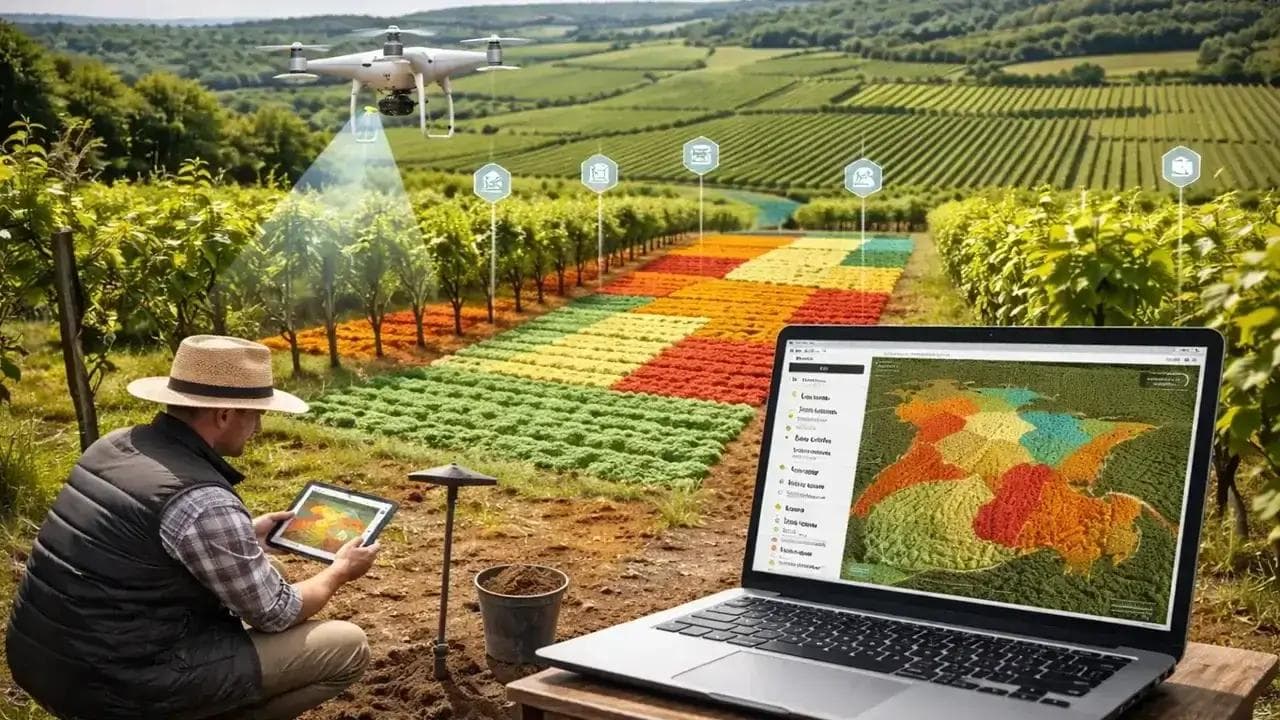
Vineyard soil mapping is the process of collecting, analyzing, and spatially representing soil data across a vineyard at a scale fine enough to reveal meaningful differences between zones.
Rather than relying on a handful of grab samples and assuming the whole property is the same, soil mapping vineyard workflows use GPS-referenced sampling, sensor surveys, and laboratory analysis to build a detailed spatial picture. The output is a set of maps; one for each measured soil property shows exactly where conditions change and by how much.
The goal is straightforward: replace assumptions with data. When a vineyard manager knows where the clay is deeper, where the pH is drifting, where drainage is restricted, and where organic matter is lowest, every subsequent decision from planting to harvest becomes more targeted and more effective.
Why Vineyard Soil Variability Matters
Vineyards are variable. That is not an opinion; it is one of the most well-documented findings in modern viticulture research.
Trials in Australian vineyards using spatial mapping techniques found yield-equivalent variations from 1 to 30 tonnes per hectare within a single block. Sugar concentration varied by as much as 21% from the mean, with a total range of 37% across the same block. Phenolic and anthocyanin levels often used as indicators of grape quality showed significant spatial variation as well.
This level of vineyard soil variability means that a single management approach same water, same fertilizer, same harvest timing applied uniformly across the block will inevitably over-serve some zones and under-serve others.
Soil texture in a vineyard is a primary driver of this variability. Clay-dominant zones retain moisture longer and restrict root spread. Sandy patches drain quickly and force roots deeper. Loam areas offer a balance between retention and aeration. Each texture creates a distinctly different growing environment for the vine.
Soil drainage in a vineyard plays an equally critical role. Zones with restricted drainage hold water longer, increasing the risk of root zone saturation. Well-drained areas allow growers more control over vine stress, which is one of the most important levers for shaping grape quality.
Vineyard soil water-holding capacity connects directly to irrigation decisions. Soils with high water-holding capacity may need far less irrigation than neighboring zones with low retention. Without mapping these differences, a uniform irrigation schedule will almost certainly deliver too much water to some areas and too little to others.
Understanding this variability and making it visible is the entire purpose of soil mapping.
How Does Soil Mapping Improve Vineyard Decisions?
The real value of a soil map is not the map itself. It is the decisions the map enables.
Smarter Site Selection Before Planting
For new vineyard developments, vineyard site selection and soil analysis are some of the highest-return investments a grower can make. Before a single vine goes into the ground, a detailed soil map reveals which areas are best suited for specific grape varieties and rootstocks. Deep, well-drained soils may support vigorous rootstocks. Shallow, clay-heavy zones may call for drought-tolerant or low-vigour selections.
Getting this right at planting avoids decades of management challenges. The rootstock-soil match made in year one shapes vine performance for the next 25 to 40 years.
From Uniform Blocks to Targeted Management Zones
One of the most practical outcomes of soil mapping is the creation of vineyard management zones, discrete areas within a vineyard grouped by similar soil characteristics.
Zonal management for grapes replaces blanket approaches with zone-specific irrigation, fertilization, and canopy management. A high-vigour zone on deep, fertile soil may need reduced irrigation and more aggressive canopy trimming. A low-vigour zone on shallow, rocky ground may need supplemental nutrition and careful water scheduling.
Research published in Springer's Precision Agriculture journal confirmed that soil depth, clay fraction, and organic matter were closely and linearly correlated with vine vigour and yield parameters. Small variations in sand fractions alone were sufficient to shift sites from high-vigour to low-vigour zones. This is precisely the kind of variability that management zones are designed to capture and respond to.
Precision Inputs Through Variable Rate Application
With management zones clearly defined, variable rate application in a vineyard becomes practical. Instead of spreading lime, gypsum, compost, or fertilizer at a flat rate across every row, VRA technology adjusts application rates zone by zone based on mapped soil data.
This reduces total input costs by applying amendments only where they are needed. It also makes vineyard operations better for the environment by reducing runoff, over-application, and nutrient cycling.
Harvest Segregation and Quality Tiering
Soil maps guide harvest planning directly. Growers who understand the soil variability across their vineyard can harvest different zones separately, routing premium grapes into higher-tier wines and grapes from less consistent zones into blends or secondary labels.
Australian vineyards using precision mapping for selective harvesting reported financial savings of up to $400 per tonne, or approximately $3,150 per hectare. Those are meaningful numbers, especially when they compound across an entire estate over multiple vintages.
Vineyard Soil Analysis: What Gets Measured and Why
Soil mapping starts with soil analysis. Here is what gets measured and why each property matters for grape production.
Soil pH and Its Influence on Nutrient Availability
Vineyard soil pH management is fundamental because pH controls how effectively a vine absorbs nutrients from the soil. Most wine grape varieties perform best in a pH range of 5.5 to 7.5. When pH drifts outside this window, essential nutrients like phosphorus, iron, and zinc become less accessible to the vine, even if they are physically present in the soil.
Mapping pH across a vineyard reveals zones that need lime to raise pH or sulfur to lower it, enabling targeted correction rather than uniform application.
Soil Organic Matter and Biological Health
Soil organic matter in a vineyard is one of the most reliable indicators of long-term soil health. Higher organic matter levels improve water retention, support beneficial microbial communities, enhance soil structure, and contribute to slow-release nutrient cycling.
Zones with low organic matter can be targeted with cover cropping, composting, or mulching rather than applying amendments uniformly across areas that may not need them.
Texture, Structure, and Drainage
Soil texture in a vineyard, with the relative proportions of sand, silt, and clay shape most of the soil's physical behaviors. Clay-heavy soils retain water and nutrients well but can restrict root penetration and reduce aeration. Sandy soils drain quickly and warm up faster but hold fewer nutrients. Loam provides a middle ground.
Soil drainage in a vineyard depends on texture, structure, subsoil layering, slope, and compaction. Mapping drainage characteristics identifies zones where waterlogging risk is high and where interventions like subsurface drainage or raised beds may be warranted.
Understanding Vineyard Terroir Through Soil Data
Vineyard terroir mapping brings a measurable, data-driven dimension to the concept of terroir. When growers map pH, texture, drainage, organic matter, and mineral content across their vineyard, they are quantifying the soil component of what provides each zone with its distinctive character.
The relationship between terroir and soil in viticulture is not abstract. A vine on limestone-rich, well-drained soil at elevation will produce different grapes than one on alluvial clay in a valley floor. Soil mapping research from the Soil Inventory of Catalonia validated this by developing vineyard-scale (1:5000) mapping methods specifically designed to define terroir units and management zones, showing that fine-scale soil discrimination directly supports both terroir characterization and practical decision-making.
When Should Vineyards Do Soil Testing?
For new vineyard developments, a comprehensive soil survey of vineyard assessment should be completed before planting, ideally 12 to 18 months before ground preparation begins, allowing time for pre-plant amendments to take effect.
Established vineyards benefit from periodic retests every three to five years. Additional targeted testing is warranted before major amendment applications, after extreme weather events such as flooding or prolonged drought, or when vine performance in specific zones shifts unexpectedly.
The traditional soil survey vineyard approach of walking the block, digging inspection pits, and collecting grab samples still holds value, particularly for assessing subsoil structure and root zone conditions. Modern sensor-driven approaches complement rather than replace this hands-on fieldwork.
Why Is Soil Mapping Important in Viticulture?
The case for vineyard soil mapping comes down to three practical arguments.
Return on investment
Mapped vineyards reduce input waste by applying water, fertilizer, and amendments only where needed. They improve yield consistency across zones and enable harvest segregation that directly impacts revenue. Australian precision viticulture trials have documented savings of up to $3,150 per hectare through selective harvesting alone.
Risk reduction
Soil mapping identifies problem zones of salinity, compaction, poor drainage, and extreme pH before they cause visible vine damage. Early identification means earlier intervention and lower remediation costs.
Long-term vineyard health
Soil maps provide a spatial baseline that supports data-driven replanting decisions, long-term amendment planning, and continuous improvement of vineyard performance over decades. In a sector where a single vineyard block may produce grapes for 30 to 50 years, that long-term perspective matters.
Conclusion
Vineyard soil mapping is no longer a luxury reserved for the largest estates. It is a practical, proven approach to managing one of the most fundamental variables in grape production in the soil itself.
The shift is clear: instead of managing a vineyard as one block, the most effective operations manage it as a collection of zones, each with its soil character, its own water behavior, and its own quality potential. Soil mapping is what makes that shift possible.
For vineyards that use soil maps, the benefits are clear: they get more consistent grapes, use resources more efficiently, make better choices at harvest time, and create a stronger link between how they farm and the quality of the wine.
For technology companies building platforms, sensors, and decision systems that support this approach, the opportunity is equally clear.
Manage Soil Smarter. Grow Grapes Better.
The platform behind your vineyard decisions matters. Promeraki builds it from sensors to dashboards, ready to scale.