Introduction
Every farmer knows how unpredictable the weather can be; some days, you’re praying for rain, and on others, you wish it would stop. In traditional irrigation, this uncertainty often means wasting water, energy, and time. But today’s farmers have a better option: smart irrigation setups.
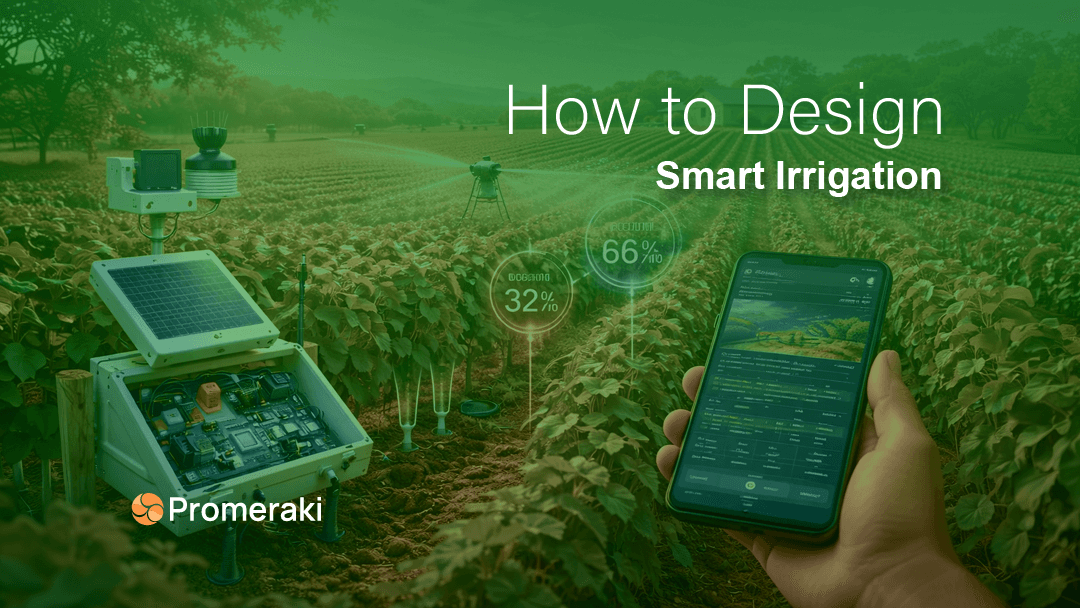
A smart irrigation setup uses sensors, automation, and real-time data to water your fields precisely when needed. Instead of relying on guesswork, the system thinks for you. It measures soil moisture, reads weather conditions, and automatically decides when to irrigate, all while you monitor it from your phone or dashboard.
According to a 2025 report published on ResearchGate, smart irrigation systems have reduced water use by up to 47.8% compared to traditional methods. That’s a huge difference for both the planet and your pocket.
In this blog, we’ll walk you through exactly how to design a smart irrigation setup step by step from sensors to dashboard, using Promeraki’s tried-and-tested smart approach that’s transforming farms across Australia, Canada, etc.
What Is a Smart Irrigation System?
A smart irrigation setup is an automated system that uses data from sensors to manage watering efficiently. It’s the bridge between technology and agriculture, a combination of hardware, software, and logic that helps farmers use water intelligently. But it doesn’t stop there. Modern smart irrigation systems go beyond just watering. They also help manage fertilizer applications, detect early signs of crop disease or germ growth, and even provide data-driven forecasting for soil health and irrigation planning.
Think of it like a “digital irrigation assistant” that never forgets, never gets tired, and never misses a watering schedule.
In simple terms:
- Sensors measure soil and weather conditions.
- Controllers analyze the data.
- Pumps and valves automatically deliver water.
- Dashboards let you monitor everything remotely.
The result? Less waste, healthier crops, and peace of mind.
Why Smart Irrigation Matters
The world’s agriculture sector consumes nearly 70% of global freshwater resources, and much of it goes to waste due to over-irrigation.
Smart irrigation can change that. Studies by Energy.gov show that advanced irrigation systems save around 30% water and 15–25% energy compared to manual systems.
By switching to automation, farmers can:
- Reduce water waste and irrigation costs.
- Improve crop yields through consistent soil moisture.
- Lower labour dependency.
- Track every drop of water in real time.
At Promeraki, we’ve seen this transformation firsthand; farms using smart irrigation setups often achieve payback in just one or two seasons.
The Building Blocks of a Smart Irrigation Setup
To design an effective system, you need to combine four key components that work together seamlessly: sensors, connectivity, actuators, and dashboards.
Sensors & Actuators: The Core of Smart Irrigation
Every smart irrigation setup begins with its hardware in the parts that sense, decide, and act. Sensors gather live data from the field, while actuators turn that data into action. Together, they make your irrigation system truly intelligent.
Key Components:
- Soil Moisture Sensors: Track how wet or dry the soil is and alert when irrigation is needed.
- Weather Sensors: Measure rainfall, temperature, and humidity to adjust watering automatically.
- Flow & Pressure Sensors: Detect leaks, blockages, or abnormal pressure to prevent water loss.
- Tank Level Sensors: Monitor storage levels and ensure pumps don’t run dry.
- Valves: Solenoid or motorized, opening and closing automatically to control water flow per zone.
- Pumps: Electric or solar-powered, managed by controllers or VFDs for variable speed and energy efficiency.
- Safety Devices: Include pressure relief valves and dry-run protection to avoid damage and downtime.
By integrating sensor-based modules, you can monitor, control, and optimize irrigation in real time through a unified dashboard. Every system we deploy includes valve automation and live flow feedback, ensuring that every drop of water is used efficiently, and no irrigation cycle goes untracked.
Connectivity: Bringing the Field Online
Once sensors collect data, it must be transmitted securely to your controller and cloud dashboard.
Common connectivity types:
- LoRaWAN: Best for large fields with long-range and low power use.
- NB-IoT or 4G: Perfect for farms with strong mobile network coverage.
- Wi-Fi: Works well for greenhouses or small setups near infrastructure.
- MQTT (Message Queuing Telemetry Transport): A lightweight IoT protocol for quick, reliable, and low-power data exchange, ideal for frequent updates like soil moisture or pump activity.
At Promeraki’s IoT Solutions, we prefer hybrid connectivity edge control (local decision-making) plus cloud monitoring for maximum reliability. This ensures your irrigation system keeps running even when the internet is unavailable.
Dashboard: Your Digital Farm Command Center
The dashboard is where technology meets simplicity.
It turns raw data into clear insights with visuals and notifications.
You can:
- View soil moisture and water flow in real time.
- See which zones were watered and how much water was used.
- Set thresholds, schedules, and alerts directly from your phone.
- Track daily, weekly, and seasonal irrigation reports.
Example: If a valve doesn’t respond or a flow reading is abnormal, Promeraki’s platform instantly notifies you, helping prevent water loss before it becomes a problem.
How It All Connects:
- Sense it. Connect it. Control it. Your smart irrigation system is only as good as these four layers working together: sensors, connectivity, actuators, and your dashboard.
Step-by-Step: Designing Your Smart Irrigation System
Here’s how to bring your system to life.
Step 1: Assess Your Land and Crop Needs
Start by dividing your land into irrigation zones. Map soil types, crop varieties, and slopes. Identify which areas dry fastest and where water tends to collect.
This helps decide how many sensors and which types you’ll need.
Step 2: Choose and Install Sensors
Select reliable sensors based on your crop’s water sensitivity and soil texture.
- Use soil moisture sensors for real-time soil data.
- Add rain or humidity sensors for outdoor farms.
- Integrate flow meters to measure precise water use.
Step 3: Plan Connectivity and Control
Decide how your data travels from field to dashboard.
- For open-field farms, LoRaWAN offers affordable long-distance communication.
- For remote areas, NB-IoT or 4G ensures reliable cloud sync.
- Add an edge controller that keeps irrigation running offline.
Step 4: Select Pumps and Valves
Pick equipment based on zone size and pressure requirements.
- VFD pumps help control speed and cut energy bills.
- Smart solenoid valves ensure precise zone-wise irrigation.
- Manual overrides provide flexibility in emergencies.
Step 5: Configure Your Dashboard
Set up your IoT dashboard to display:
- Moisture levels by zone
- Pump and valve status
- Flow analytics and pressure logs
- Water usage history
- Alerts for faults, leaks, or low moisture
This is your system’s “control tower,” keeping you in charge of every zone, no matter where you are.
Step 6: Test and Calibrate
Before going live, test each zone individually.
Run short cycles, verify readings, and cross-check with manual measurements. Adjust thresholds as per soil type and crop water needs.
Step 7: Maintain Regularly
A smart system is only as reliable as its maintenance.
- Clean sensors once a month.
- Check pressure and flow sensors for clogging.
- Update firmware and recalibrate after every season.
Common Mistakes to Avoid
- Installing too many sensors without analyzing initial data.
- Placing soil sensors too close to emitters.
- Relying entirely on Wi-Fi for remote fields.
- Ignoring periodic calibration.
- Forgetting power backups (especially for solar setups).
Avoiding these pitfalls ensures your system runs smoothly year-round.
How Much Does It Cost, and What’s the ROI?
Cost depends on land size, number of zones, and equipment type, but the return is fast.
| Water Efficiency | 30–47% saved |
|---|---|
| Energy Savings | 15–25% lower usage |
| Labour Reduction | 50–70% less manual work |
| Yield Increase | 5–15% better output |
Most Promeraki clients report ROI within one to two growing seasons.
Most farms recover costs in one to two seasons!
Rebuilding irrigation systems after launch wastes time and money. Promeraki gets it right before your first sensor ships.
Final Thoughts
Designing a smart irrigation system isn’t just about technology; it’s about building a future where every drop of water counts.
Whether you’re a smallholder farmer in Australia or managing a commercial greenhouse in Canada, integrating sensors, automation, and data can completely transform your irrigation efficiency.
If you’re ready to bring smart irrigation to your farm, our experts at Promeraki can help you design a solution tailored to your soil, crops, and budget.