Here is the thing.
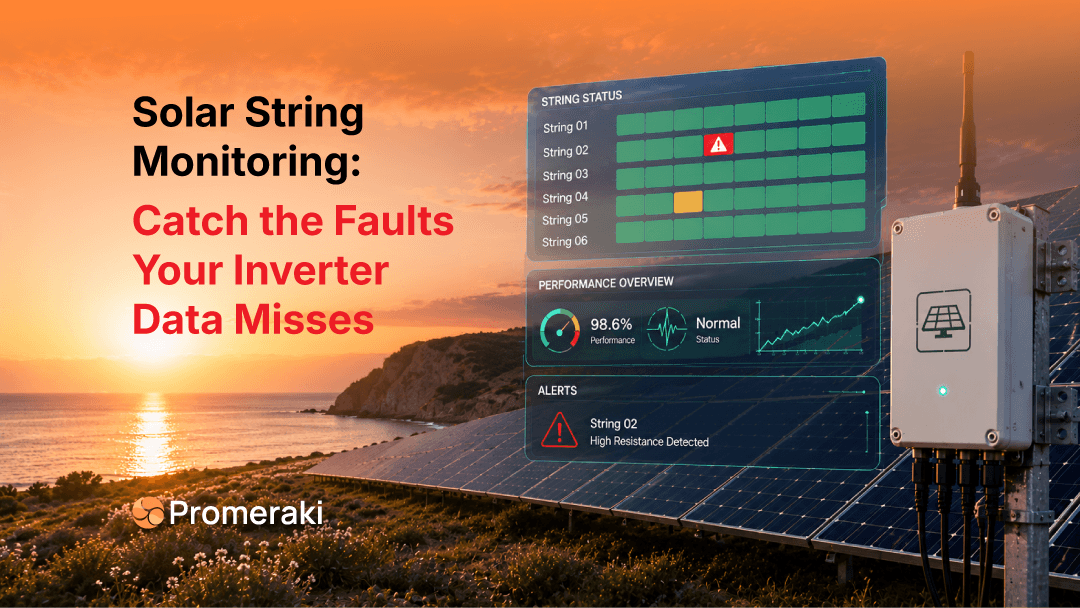
A solar plant with 300 strings. Twenty of them are underperforming. The inverter dashboard? Still green. The performance ratio is still above the threshold.
How is that possible?
Because the inverter aggregates all 300 strings into one total. Twenty strings each produce the threshold. Less output barely moves the needle at the inverter level. The losses are real. The revenue is gone. But nothing in the inverter data pointed to it.
This is not a system failure. This is a visibility gap. And solar string monitoring is the layer that closes it.
Inverter monitoring is excellent at catching what happens inside the inverter box. But strings sit between the panels and the inverter, and that layer has its own failures that the inverter data simply cannot see.
In this guide, you will find out what solar string monitoring tracks, what faults it catches that inverter data misses, and what to look for in a platform built to deliver it.
Key Takeaways
- Inverter data hides individual string losses. Solar string monitoring tracks per-string current and voltage to catch faults that inverter totals miss entirely.
What Is Solar String Monitoring?
Solar string monitoring is the continuous, real-time tracking of individual string performance, measuring current and voltage at each string, not just at the inverter output.
Here is how the layers break down:
| Term | What It Means |
|---|---|
| Solar panel | A single module that converts sunlight into DC electricity |
| String | A group of 8–20 panels connected in series |
| MPPT channel | The inverter input that manages one or more strings |
| Inverter output | The aggregated total from all strings connected to it |
The inverter gives you the total. String monitoring gives you a breakdown. And the breakdown is where the losses live.
Why Inverter Data Alone Creates a Blind Spot
Here is the core problem.
When an inverter processes output from 20 strings and one underperforms by 15%, the total drops by 0.75%. That sits well within normal variation. No alert fires. Nothing looks wrong on the dashboard.
That underperforming string disappears into the average.
The series connection makes it worse. Panels in a string are wired in series. When one panel underperforms due to soiling, a cracked cell, or a failed bypass diode, it drags every other panel in that string. The entire string suffers from one panel's problem.
The inverter sees a slightly lower MPPT channel total. Nothing flags as a fault. But the revenue impact starts immediately and keeps running.
Inverter monitoring catches what happens inside the inverter. It cannot catch what happens in the strings feeding it.
What Does Solar String Monitoring Track?
String Current Per MPPT Channel
Each string has an expected current output based on two things the irradiance hitting the panels right now and the panel rating. String monitoring measures the actual current per string continuously and compares it against that expected value.
A string pulling 4.2A when it should be pulling 5.0A is a clear signal. Something is wrong. And the inverter has no idea.
String Voltage and Open Circuit Voltage
String voltage deviations of signal panel-level issues, wiring problems, or bypass diode failures. Open-circuit voltage checks identify broken strings or fully disconnected panels.
These readings are captured at the string's connection point before the data ever reaches the inverter.
String Deviation from Expected Output
This is where real intelligence sits. The platform compares each string against three baselines simultaneously:
| Baseline | What It Shows |
|---|---|
| Other strings on the same MPPT channel | Catches relative underperformance across matched strings |
| Expected output based on current irradiance | Separates weather effects from genuine equipment faults |
| Historical performance of that specific string | Catches gradual degradation trends over weeks and months |
Running all three comparisons continuously is what separates string monitoring from a basic current meter.
Irradiance-Adjusted String Performance
Weather-corrected comparisons are critical. A string producing less output during a cloudy afternoon is not underperforming. A string producing less output than the other strings under the same cloud cover is.
String monitoring platforms apply irradiance data to every comparison so operators are never chasing weather events instead of real faults.
What Faults Does String Monitoring Detect That Inverter Data Misses?
These are the faults that generate real revenue losses and stay completely invisible in inverter-level data.
| Fault | Why the Inverter Misses It | What String Monitoring Catches |
|---|---|---|
| Soiling on specific strings | Dust on one row drops that string's output. MPPT total barely moves. | String current deviation flags into the affected string immediately. |
| Partial shading on individual strings | One shaded string looks like normal variation in the MPPT total. | String comparison shows exactly which string is losing output and when. |
| Bypass diode failure | Panels still produce power at reduced output. No alarm fires. | String current drops subtly over days caught by historical deviation tracking. |
| Panel microcracks | Invisible for visual inspection. Develops slowly under thermal cycling | String output gradually declines over weeks, caught by trend analysis. |
| Loose string connectors | Intermittent resistance causes current fluctuation in one string only. | String-level current variation flags the connection issue precisely. |
| Combiner box fuse failure | One string disconnects entirely. Inverter keeps running on the remaining strings. | String current drops to zero on one channel flagged as critical immediately. |
| PID (Potential Induced Degradation) | Affects specific strings based on voltage differentials. Lost in inverter aggregate | String-level voltage and current trends reveal PID before it becomes severe |
And that is just one string. Most plants have hundreds.
Catching these faults early is part of a predictive approach across the full plant.
How Solar String Monitoring Works
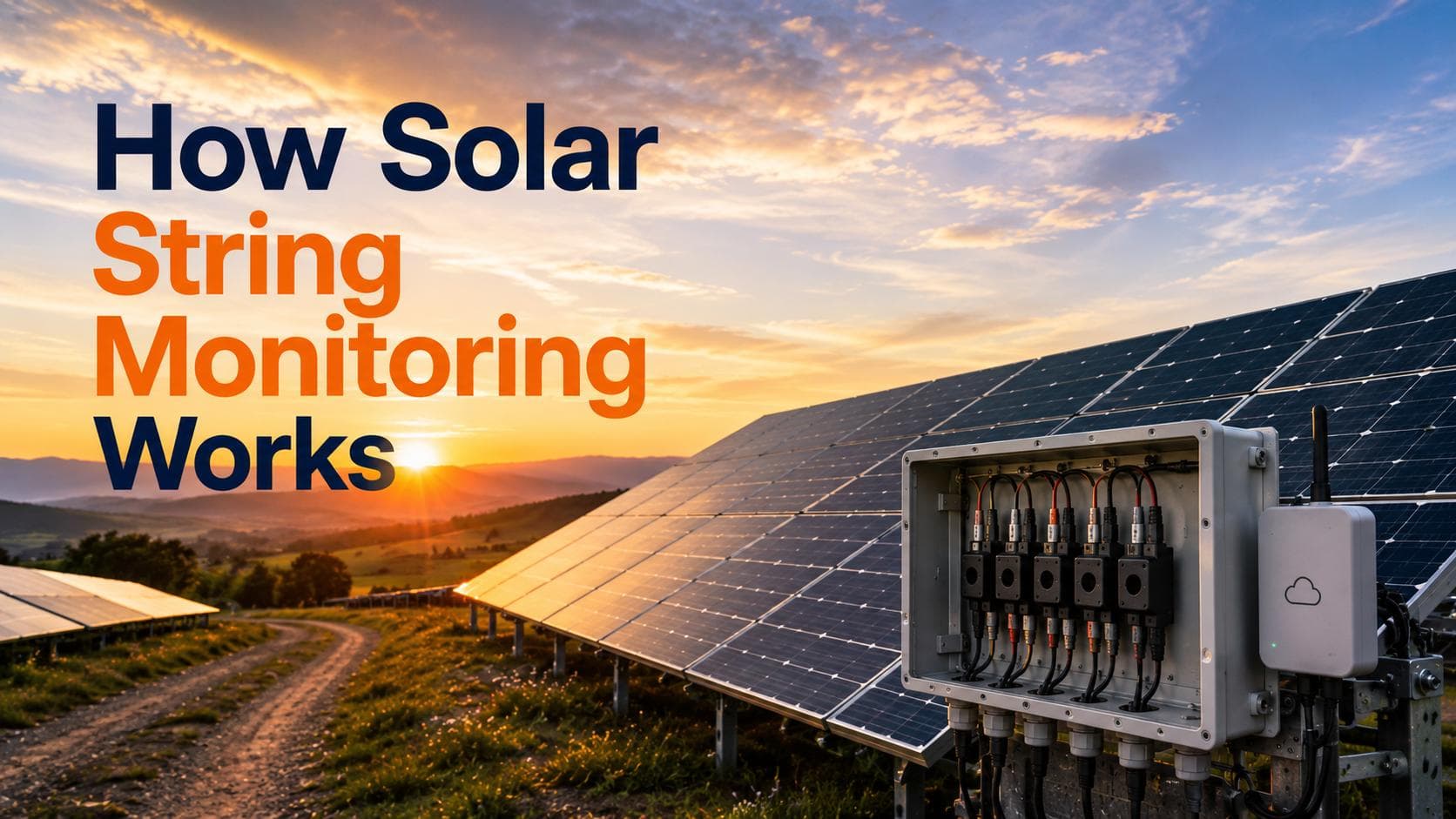
String Current Sensors and Combiner Boxes
Current sensors sit at combiner boxes or string connection points. They measure DC per string before it reaches the inverter. Readings are collected every few seconds and sent continuously to a cloud platform via MQTT or Modbus.
For plants using multi-MPPT string inverters, some per-string granularity is already available at the inverter. But dedicated string sensors at the combiner box level give finer resolution, catching issues that MPPT channel data still averages away.
Getting this data from the field into a resolution-monitoring platform is where cloud integration does the heavy lifting, handling protocol translation and data routing from string sensors to one system without touching existing hardware.
MPPT-Level Data Analysis
Modern multi-MPPT inverters provide per-MPPT channel data. That is a genuine step forward from single-channel totals. But one MPPT channel can still aggregate three, five, or eight strings. Individual string underperformance still gets averaged.
Dedicated string monitoring adds one more layer of granularity below the MPPT channel. That extra layer is where the blind spot finally closes.
Deviation Alerts and String Comparison
Once string data flows into the monitoring platform, deviation detection runs continuously. Every string is compared against its three baselines, and faults are ranked by severity; critical issues like a fully disconnected string get flagged for immediate same-day response, while gradual drifts of 8-12% below expected output get queued for planned maintenance that week.
Field teams receive a prioritized alert that tells them exactly which string needs attention and what the likely fault is before they leave the office. No guess. No wasted site visits.
Benefits of Solar String Monitoring for Plant Operators and OEMs
- Revenue that stops bleeding silently
String losses running undetected for weeks are not recoverable. String monitoring stops them before they compound. On a portfolio of 20 sites, catching even one underperforming string per site per month adds up to significant protected revenue across the year.
- Field teams that arrive knowing exactly where to go
Without string monitoring, a technician gets sent to investigate a site. With string monitoring, they get sent to inspect string 14 on combiner box 3 of inverter 7. That specificity cuts visit time, eliminates guesswork, and converts wasted callouts into targeted fixes.
- Panels that last longer
Bypass diode failures and developing hotspots caught at the string current level prevent permanent cell damage. A panel that might have degraded irreversibly over two seasons stays productive for the full 25-year asset life.
- Warranty claims that hold up
An auditable string performance record proves exactly when underperformance started. That matters when a panel warranty claim requires documented evidence that the fault existed during the coverage period, not just when someone finally noticed it.
- String-level proof for investor reporting
Portfolio investors and lenders want confidence that the monitoring data is granular enough to catch real losses. String-level monitoring provides an evidence layer.
- One view across every string on every site
Operators managing multiple plants see string deviation alerts across the entire portfolio from one dashboard, not one portal per site, not one spreadsheet per week.
What to Look for in a Solar String Monitoring Platform
Not every platform delivers genuine string-level visibility. Before choosing one, check out these five things.
1. Per-string data resolution, not just MPPT totals
If the platform only shows MPPT channel data, it is not true for string monitoring. You need per-string current and voltage readings to catch what MPPT aggregation hides. This is the most important capability to verify it is also the one most platforms quietly skip.
2. Continuous real-time data, not polled snapshots
Platforms that update every 15 minutes miss intermittent faults. Bypass diode failures and loose connectors come and go between polling cycles and never appear in the record. String monitoring needs continuous real-time data.
3. Irradiance-adjusted deviation detection
Raw current comparisons without weather correction generate false alerts on cloudy days and miss real faults on partly cloudy ones. The platform must apply irradiance data to every string comparison, not just compare raw current numbers.
4. Multi-brand hardware compatibility
The platform must work with any inverter brand or combiner box already on site. A solution tied to one manufacturer's hardware limits your options immediately and leaves OEMs unable to serve customers running mixed equipment.
5. Portfolio-wide string visibility
Individual site dashboards requiring manual data exports are not a string monitoring solution. The right platform shows string-level deviation alerts across every site in the portfolio inside one unified system.
For OEM manufacturers building solar monitoring hardware, adding genuine string monitoring capability is what closes the gap inverter data leaves open.
Conclusion
Your inverter dashboard shows you the total. String monitoring shows you the breakdown.
That distinction matters more than most solar operators realize until they see what the breakdown was hiding.
A solar plant can run for weeks looking perfectly healthy at the inverter level while string faults quietly compound across dozens of rows. The generation is being lost. The revenue is gone. And the inverter never raised an alert because it was never designed to catch this.
String-level visibility is the layer that closes that gap. Per-string current tracking, irradiance-adjusted deviation detection, and granular fault isolation give operators the data that inverter monitoring alone cannot provide.
The plants that protect revenue in the years ahead will be the ones monitoring at the right granularity, not just the inverter total, but every string behind it.
Promeraki helps OEM manufacturers build this string monitoring capability into their IoT platform, connecting sensor data from combiner boxes and inverters into one unified system, without hardware lock-in, scalable across any portfolio size.
Talk to the Promeraki team to see what string-level solar monitoring looks like in practice.