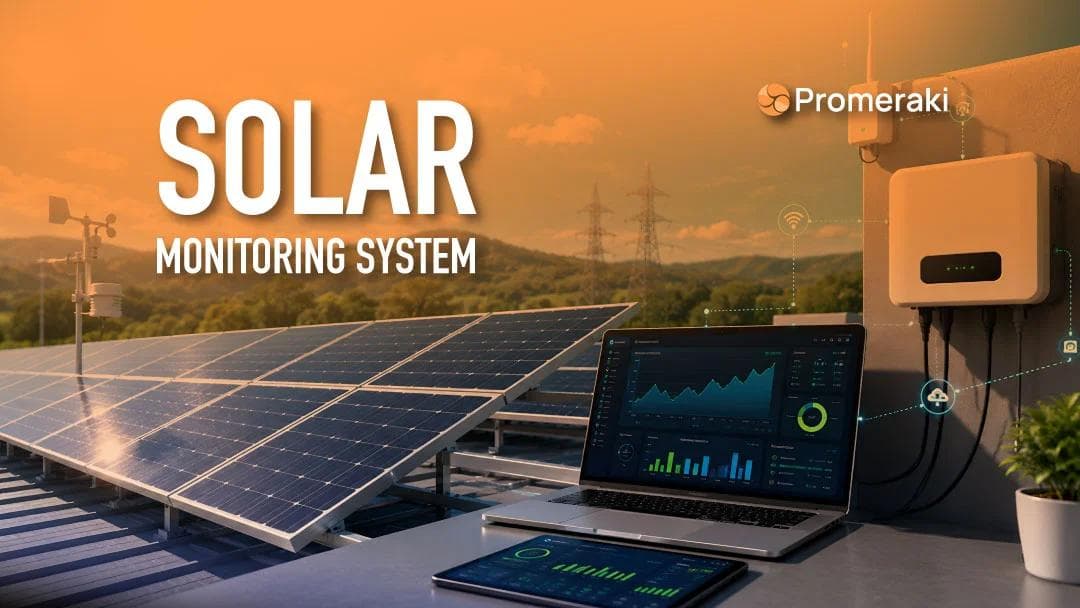
Imagine a solar plant losing three days of energy generation.
No alarm went off. Nobody got a call. The inverter recorded the fault, but nothing was acting on it in time.
By the time the team found out, the revenue was already gone.
This happens more often than you think. And it happens because solar panels and inverters alone cannot run a plant efficiently. You need something more.
That is solar monitoring.
This guide covers everything you need to know. What solar monitoring is. How it works. The types of systems available. The problems it solves. And what to look for if you manufacture or operate solar hardware.
Let's start from the beginning.
What is a Solar Monitoring System?
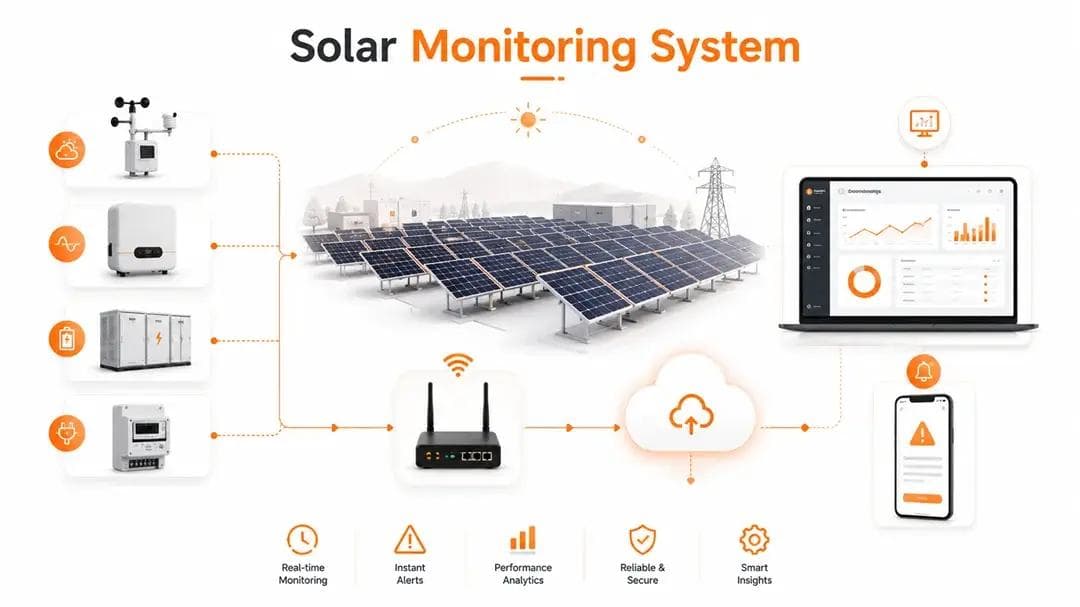
A solar monitoring system tracks how a solar plant is performing every minute, every day, in real time.
Here is the simple version.
A solar panel does its job quietly. It generates electricity and keeps going. But it does not tell you when something is wrong. It does not alert anyone if a row of panels suddenly drops in output. Without monitoring, you find out about problems only when you check the data yourself, and by then, days or weeks have already passed.
A solar monitoring system fixes that.
It collects data from across the entire plant. Inverters, panels, weather sensors, batteries, and grid meters. It processes that data nonstop. Then it turns it into clear, useful information for the people running the site.
It works in three steps.
Step 1 - Collect the data
Sensors pull live readings from every part of the plant. That data gets sent to a central platform, usually in the cloud.
Step 2 - Analyze the data
The platform compares what is happening against what should happen. If a row of panels is producing less than expected, the system flags it. If an inverter starts behaving strangely, an alert goes out.
Step 3 - Deliver the right information to the right person
Field teams get fault alerts. Plant owners get performance reports. Investors get energy yield summaries automatically, without anyone building them manually.
Without these three steps working together, a solar plant operates blindly.
The hardware is there. The signals are not getting through.
How Solar Power Monitoring Systems Work
Most people think monitoring is just a dashboard showing how much energy is coming in.
That is only the surface. A lot more is happening underneath.
Here is how a solar power monitoring system actually works, from start to finish.
Hardware sends data
Every piece of equipment in a solar plant constantly produces data. Voltage. Current. Temperature. Output levels. Fault codes.
This data is sent using communication protocols, the common languages that allow different devices to talk to each other.
The two most common solar ones are Modbus and SunSpec. Modbus is a standard used across industrial equipment. SunSpec is an open protocol built specifically for solar use. Plants in remote areas with no mobile signal often use LoRaWAN, a wireless technology designed for sensors over long distances with no internet connection.
Data reaches the platform
All that data travels to a central platform. This is either cloud-based or running on a local SCADA system on site.
Cloud platforms are now the standard for most new solar plants. You can access them from anywhere. No on-site servers are needed.
The platform checks performance
Raw data alone tells you nothing useful.
The platform compares it against expected benchmarks. If a string is producing 15% less than it should, given the current weather conditions, that gets flagged immediately. If an inverter's behaviour matches a known fault pattern, an early warning goes out before the inverter fully breaks down.
Alerts and reports go to the right people
An O&M manager gets a fault alert with the exact location and likely cause.
A plant owner gets a weekly performance summary.
An investor gets a quarterly report benchmarked against agreed forecasts without anyone preparing it manually.
One thing worth knowing: real-time systems update every few seconds. Interval systems log data every 5 or 15 minutes. In a large solar plant, significant revenue can disappear in 15 minutes of undetected downtime. Faster systems mean faster responses and less money loss.
Types of Solar Panel Monitoring Systems
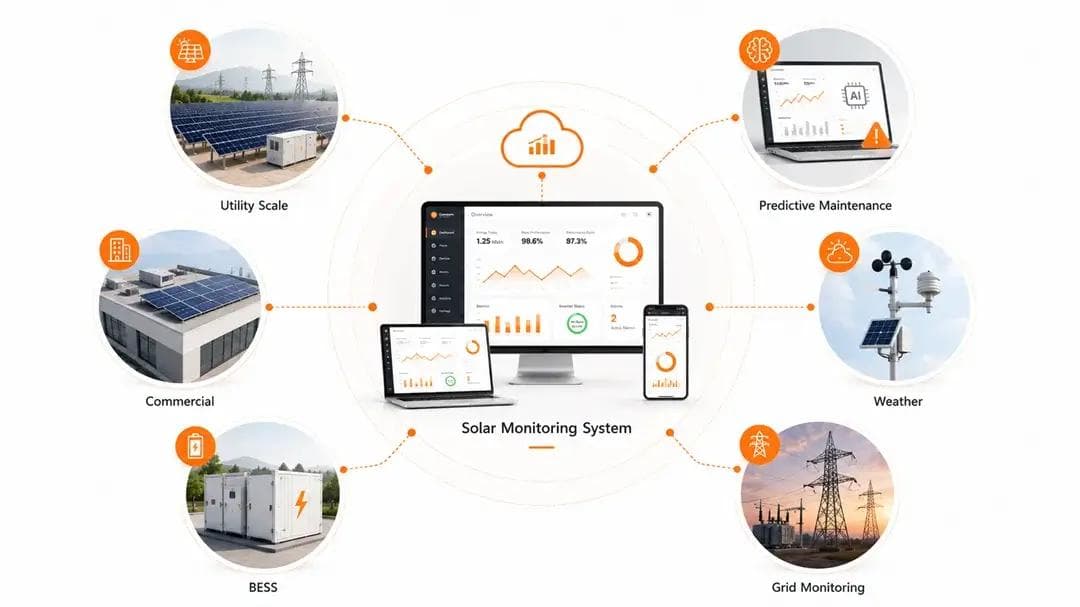
Not every solar plant needs the same monitoring setup.
The right system depends on the size of the plant, who owns it, and what needs to be tracked. Here are the main types.
Utility-Scale Solar Monitoring
These are large solar farms, sometimes hundreds of megawatts in size. They run day and night with nobody physically on site.
Operators need to know immediately when something stops working. Which inverter tripped. Which string is underperforming. What is it costing in lost generation every hour.
At this scale, monitoring is not optional. It is a basic operational requirement.
Rooftop and Commercial Solar Monitoring
Factories, warehouses, and office buildings install solar power to cut electricity bills.
These systems are often spread across many locations and managed by small teams. The biggest challenge is proving the system is saving money. A solar panel monitoring system here gives operators one view across all sites and produces automated savings reports for building owners, with no manual work required.
Battery Storage (BESS) Monitoring
Many solar plants now include a large battery system. It stores energy when the sun is strong and releases it during peak demand or at night.
If the battery degrades quietly, the plant loses its storage advantage without anyone knowing. Monitoring connects battery data and solar data into one view, so operators can see generation, storage, and export all in one place.
Predictive Maintenance and Fault Detection
Waiting for something to break before fixing it is expensive.
Predictive monitoring catches early warning signs of unusual inverter behavior, string output drops, and temperature spikes before a full breakdown happens. This is where monitoring delivers the most direct financial value.
Environmental and Weather Monitoring
Solar output changes with the weather. Clouds, dust in the air, temperature, all of it affects how much energy a plant produces.
Without accurate weather data, an operator cannot tell if a drop in output is a weather issue or a hardware fault. Environmental monitoring connects weather sensor data to plant performance, so operators can separate the two instantly and avoid sending field teams out unnecessarily.
Grid Integration Monitoring
Solar plants must export electricity within strict limits set by the grid operator. Go outside those limits, and you face fines or forced shutdowns.
Monitoring the grid connection in real time protects revenue and keeps the plant compliant.
Asset Performance Management (APM)
Investors need to know their solar portfolio is performing as promised across 25 years.
APM monitoring tracks energy yield against forecasts, monitors how panels degrade over time, and generates investor-ready reports automatically. No manual work from the operations team.
Custom IoT Platform for Solar Monitoring
Every solar plant is different. Different hardware brands, different site conditions, and different data needs.
Off-the-shelf monitoring tools work for standard setups. But OEM manufacturers and operators with complex or mixed hardware environments often need something built around their specific requirements.
A custom IoT platform connects your existing devices, sensors, and inverters into one intelligent system built around how your operation works, not how a generic product assumes it does.
This means custom dashboards, custom alert logic, custom reporting workflows, and integrations with the specific hardware and third-party tools already running on your sites.
For manufacturers, it means your monitoring device ships with a platform layer that is entirely yours, your data structure, and your customer experience.
That is the difference between a device your customer installs and forgets, and a platform they rely on every single day.
The 5 Biggest Problems Solar Energy Monitoring Solves
These are real problems. They happen every day at solar plants around the world. And every single one costs real money.
Problem 1: Inverter failures go unnoticed until it is too late
When an inverter breaks down at 2 am, most plant owners find out the next morning. Sometimes not until the monthly review is complete.
By then, the days of generation are gone. That revenue cannot be recovered.
The hardware recorded the failure. But nothing was acted on when it mattered.
Solar energy monitoring sends an immediate alert the moment a fault is detected. The response starts in minutes, not days.
Problem 2: String-level losses stay hidden
A solar plant can look perfectly fine on a standard dashboard while rows of panels quietly underperform for weeks.
Dust on the panels. A cracked cell. Loose wiring. Partial shading. None of these triggers a standard alert. The loss only surfaces when someone manually digs through the data long after the revenue has gone.
String-level monitoring finds this early. It flags the exact location so the team can fix it before the loss gets worse.
Problem 3: Multi-site operators are stuck in spreadsheets
Teams managing 20 or 30 solar plants across different countries often work out of a different portal for each site. Every week, they manually export data and build performance reports in Excel.
No unified alarm system. No single portfolio view. No quick way to see which sites need attention most.
A centralized solar monitoring system replaces all of that. One screen. One alert system. Automated comparison across every site.
Problem 4: Investors cannot get the reports they need
Banks and investors who finance solar plants expect structured performance reports every quarter. These need to be benchmarked against P50 and P90 energy yield forecasts agreed at the time of investment.
Most platforms produce raw data exports. So, the operations team spends days every quarter manually building those reports. Slow. Error-prone. Completely avoidable.
The right solar monitoring system generates these reports automatically on schedule, without any manual effort.
Problem 5: Remote sites lose data without anyone knowing
Large solar farms in deserts and rural areas often have no reliable mobile signal.
When a monitoring device loses connectivity, data gaps appear in the performance record. No alert is sent. No one knows. By the time the connection comes back, weeks of generated data may be missing.
This makes it impossible to diagnose faults, calculate performance ratios, or prove compliance to the grid operator.
It is a growing challenge across emerging markets in Southeast Asia, Africa, and Latin America, where solar is expanding fast, but network infrastructure has not always kept pace.
Key Energy Monitoring KPIs Every Solar Plant Operator Should Track
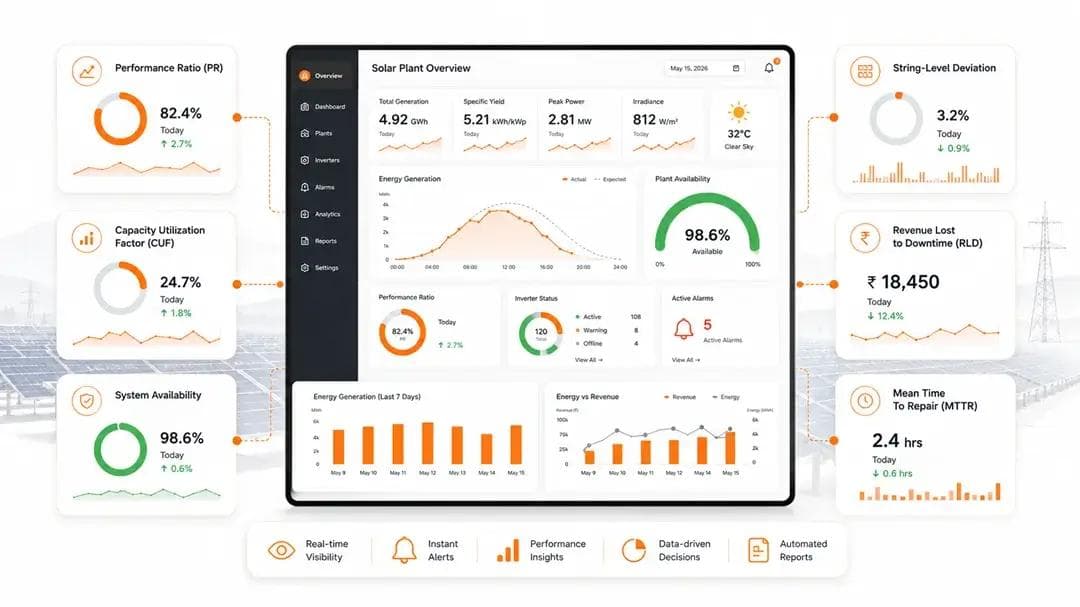
These are the energy monitoring numbers that matter, the ones that show whether a solar plant is healthy and generating as expected.
Performance Ratio (PR): Actual output as a percentage of what the plant would produce under perfect conditions. A healthy plant usually sits between 75% and 85%. Drop that range below consistently, and something needs attention.
Capacity Utilization Factor (CUF): What percentage of maximum rated capacity the plant produced over a full year. Low CUF means the plant is falling short of its financial targets.
System Availability: The percentage of time the plant is fully operational. Every hour of unplanned downtime is revenue that cannot come back.
String-Level Deviation: How much did a single string output drift from what it should produce. Catches panel faults, soiling, shading, and wiring problems that inverter-level data misses completely.
Revenue Lost to Downtime (RLD): Total revenue lost because equipment was offline. This turns a technical problem into a financial number that the language plan owners and investors respond to most directly.
Mean Time to Repair (MTTR): How quickly the team diagnoses and fixes a fault after detection. Good monitoring reduces MTTR by delivering precise fault information immediately instead of requiring manual investigation on-site.
PR vs Guarantee Threshold: Whether the plant's actual performance ratio meets the contractual guarantee in the O&M or EPC contract. Falling below this has really legal and financial consequences.
Tracking these consistently separates reactive teams fixing problems after the damage is done from proactive teams that stop losses before they happen.
Who Uses Solar Monitoring and What They Need
Solar monitoring is not just for engineers.
Many different roles interact with a monitoring platform. Each one needs something different. The best platforms serve all of them without requiring anyone to become a data expert.
Plant Owner / Asset Owner: Invested capital in the plant. Needs clear proof that the plant is generating expected energy, revenue is protected, and the asset is not degrading faster than the financial model assumed.
O&M Manager: Runs daily operations across one or multiple sites. Needs instant fault alerts, clear diagnostic data, and a prioritized work queue, so the team knows exactly where to go and what to fix without having to interpret raw numbers themselves.
Field Technician: Works physically on the ground. Needs a simple mobile interface showing exactly which inverter, string, or panel needs attention and what the likely fault is. Complexity here slows repairs and increases revenue lost per incident.
Financial Analyst / CFO: Tracks revenue and return on investment across the portfolio. Needs automated reports comparing energy yield against P50 and P90 forecasts, ready without the operations team building them manually each quarter.
EPC Contractor: Built the plant and often carries contractual performance guarantees. Needs documented evidence that the plant is meeting the PR thresholds agreed at handover.
Grid Operator / Utility: Buys power from the plant under a long-term contract. Needs accurate, consistent generation data for billing, grid scheduling, and curtailment decisions.
ESG / Sustainability Officer: Manages corporate green certifications and emissions reporting. Needs automated reports showing renewable energy generated, carbon offset, and renewable energy certificates issued and formatted for regulatory submission without manual preparation.
Solar Monitoring Devices: What OEM Manufacturers Need to Know
If you manufacture solar hardware inverters, data loggers, sensors, or monitoring devices, this part matters for your business.
Here is a problem most hardware manufacturers face but rarely talk about.
A customer buys your device. They installed it. Contact ends.
The hardware works. The warranty is honored. But you have no ongoing relationship with the operator. No visibility into how your product performs in the real world. No way to show the value it keeps delivering after installation day.
The device disappears into a plant. You hear nothing until a warranty claim arrives.
Solar monitoring devices are only as valuable as the platform intelligence behind them.
A data logger sending readings into a generic dashboard gives operators raw numbers. The same device connected to an intelligent monitoring platform gives operators answers, fault alerts, performance comparisons, predictive warnings, and automated reports.
Same hardware. Completely different experiences for the customer.
This is why more OEM manufacturers are looking for a neutral platform partner rather than building a proprietary monitoring to stack themselves.
Here is what to look for.
Hardware agnostic
Works with your devices and every other brand the operator uses alongside them. No lock-in. No friction at the point of sale.
Real-time fault intelligence
Alerts go out the moment something goes wrong, not hours later after the damage is already done.
Multi-site capability
Operators managing multiple plants need one unified view. A platform that only works per-site recreates the exact problem the operator was trying to solve.
Automated reporting
Investor reports, compliance summaries, and performance benchmarks are generated automatically without the O&M team preparing them manually.
Scalable architecture
Works for a single commercial rooftop and a 500MW utility-scale solar farm without needing to be rebuilt as the operator grows.
The manufacturers winning in this market are not just selling a device.
They are selling a device plus ongoing operational intelligence that keeps delivering value every day after installation.
The monitoring platform is what makes that possible.
Conclusion
Solar panels are getting cheaper. Installation is faster. Capacity is growing every year.
But the plants that deliver on their financial promises over 25 years are not always the ones with the most advanced hardware.
They are the ones that know what is happening inside the plant at every moment and act on it quickly.
That is what solar plant monitoring does. It connects hardware to decisions. It turns data into action. It gives every person involved, technician, operator, and investor, exactly what they need when they need it.
And a custom IoT platform is what makes all of it possible at scale across any hardware brand, any site type, or any market.
The global solar market has crossed $250 billion and keeps growing. As renewable energy becomes the standard, the platforms behind these assets will matter just as much as the assets themselves.
Upcoming posts go deeper into each area's sub-domains, platform evaluation, KPI benchmarking, and real-world use cases.
If you manufacture solar hardware or operate solar plants, you are in the right place.
The Fault Already Happened. Did Your Platform Catch It?
If the answer is not immediately yes, it is worth a conversation with our team.