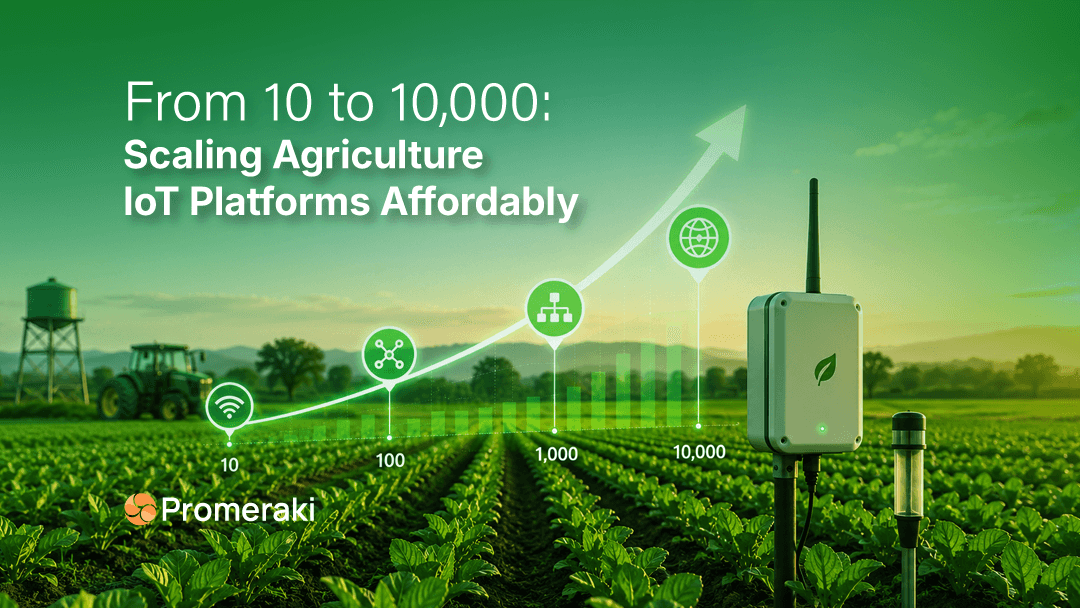
Your pilot worked. Fifty devices in the field, clean data flowing to the dashboard, a demo that made everyone in the room nod. Then the big order lands, ten thousand units, and the real project begins.
This is one of the best moments an agriculture hardware company can reach. It is also the moment that shapes your future. Handle the jump well, and your product becomes the trusted choice in its category. The good news is simple. Scaling an IoT platform affordably is a design choice you make early. When the system is built for growth from the start, moving from ten devices to ten thousand feels smooth, stable, and profitable.
This guide walks you through what changes at scale, the building blocks of a platform that grows with you, and how to keep costs low the whole way up.
Why scaling is the real milestone
A pilot proves your idea works. A full rollout proves your business works. These are two different tests, and the second one is where lasting value is built.
Research from McKinsey found that around 30% of IoT pilots scale across the whole organization, and the ones that do share a common trait: they were designed for production from day one. In most cases, the technology itself performs well, so the real advantage comes from the system underneath it. A platform built to carry thousands of devices from the start grows cleanly as demand rises.
The lesson here is encouraging, because it puts you in control. When you design for the rollout from day one, the same foundation carries you all the way up, and growth stays smooth. Scaling becomes a clear, repeatable process.
What changes from 10 to 10,000 devices
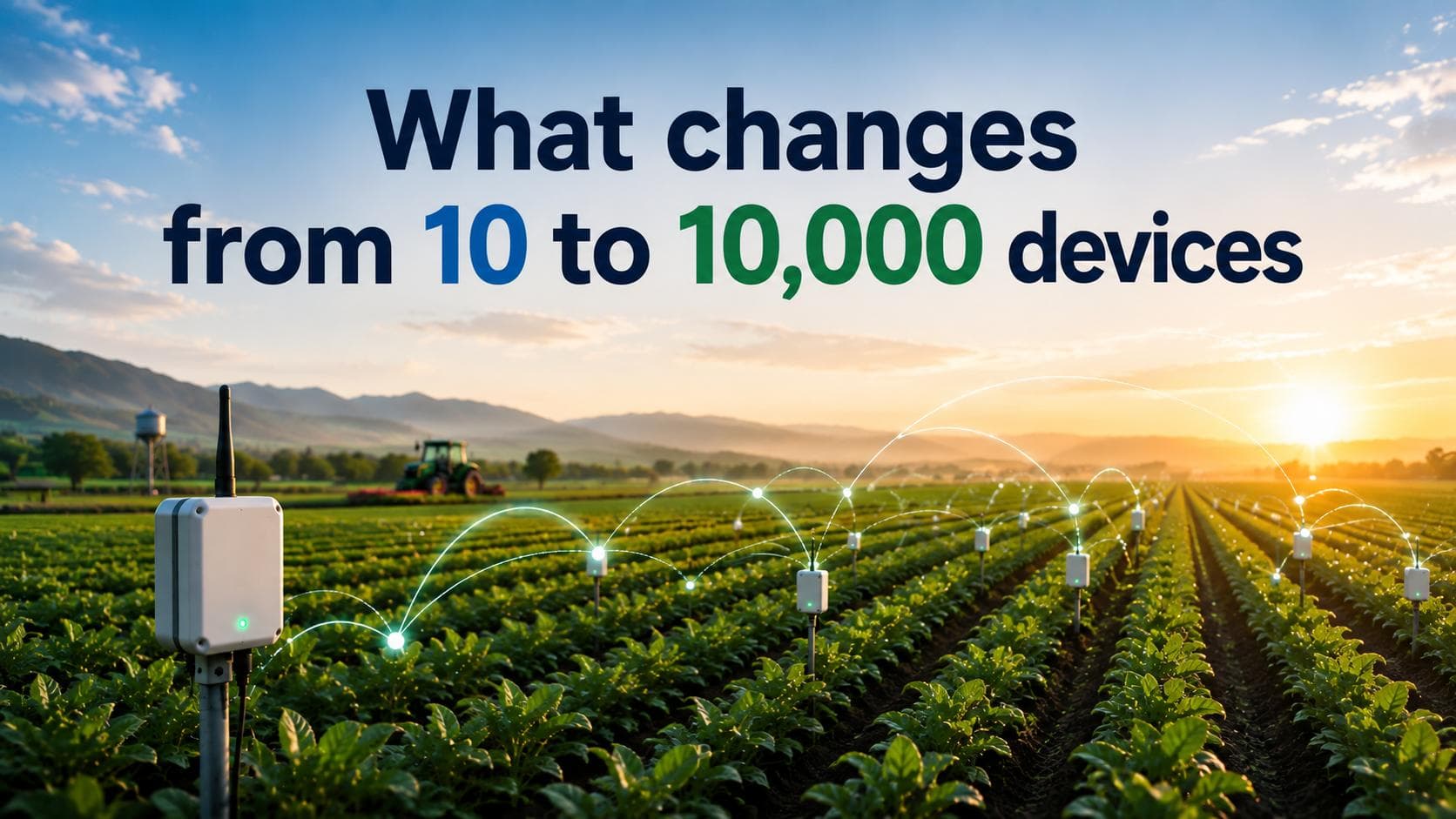
Growth brings a few changes worth planning for. A few parts of the system behave differently once device counts climb, and seeing them early makes planning easy.
| Area | At 10 devices | At 10,000 devices |
|---|---|---|
| Data volume | Easy to store and read | Smart filtering and tiered storage |
| Connectivity | One network works fine | A mix of networks across regions and fields |
| Updates | Update one at a time | Sent to every device at once |
| Support | You know every unit | Alerts do the watching for you |
| Security | Set up per device | Automated, fleet-wide protection |
| Cost | Small and flat | Grows in smooth, planned steps |
Once the right-hand column guides your design, every later stage of growth becomes simpler and cheaper to reach.
The building blocks of a scalable, affordable platform
A platform that scales well rests on five clear layers. Each one keeps the system stable as it grows and helps hold running costs down.
A connectivity layer that fits the field
Farms cover wide, open ground, and signal strength changes from one corner to the next. A scalable setup matches the network to the location. LoRaWAN gives long range and low power on open land, NB-IoT and cellular work well where coverage is strong, and satellite reaches the most remote sites. Choosing the right mix keeps both hardware and data costs low while giving every device a reliable link. It also depends on your device firmware and cloud working as one system, which is the heart of solid firmware and cloud integration.
Edge that keeps working offline
Devices in the field should keep doing their job even when connectivity is briefly limited. Edge logic lets each unit make simple decisions on its own, such as starting a pump, holding a valve, or logging a reading, then sync with the cloud once the link returns. This keeps operations dependable in real conditions and sends far less data upstream, which directly lowers your cloud bill as the fleet grows.
A cloud that grows in steps
Your cloud layer should add capacity as device counts rise, so expansion stays smooth and affordable. A multi-tenant design lets you serve many customers from a single platform while keeping each customer's data cleanly separated and secure. You add resources in small, planned steps and pay for what you actually use. That is the heart of affordable scaling: growth that follows demand.
The payoff is real when this is done right. One manufacturer, Promeraki, worked ith grew from 200 devices in a pilot to 15,000 in production on the same architecture because the platform was built for scale from day one. This is exactly what strong IoT platform engineering is designed to deliver.
Updates you can send to the whole fleet
At ten thousand units, over-the-air (OTA) updates keep your whole fleet current in a single step. They let you send new features, improvements, and security patches to every device at once. The safest way to do this is with managed OTA pipelines that use staged rollouts, rollback support, and version tracking, so every update reaches the fleet smoothly. Your products keep getting better after the sale, your team saves hundreds of hours, and customers stay loyal to a product that quietly improves on its own.
A data pipeline that filters noise
More devices produce more data, and the real value comes from turning that data into clear signals. A strong pipeline cleans, filters, and stores only what matters, then presents it in a way anyone can act on. This keeps storage costs low and dashboards fast even at full scale.
How to keep scaling costs low
The word affordable carries a lot of weight in this topic, and it comes down to a handful of practical habits. Each one keeps spending in line with growth.
- Use a pay-as-you-grow cloud service so costs rise gently and predictably with usage.
- Push work to the edge to reduce how much data you move and store every day.
- Set tiered data retention by keeping recent readings ready to use and archiving older data cheaply.
- Right-size your storage by keeping the insights you need.
- Own your platform so you keep full control of your costs and your product roadmap. A custom platform gives you full ownership and no vendor lock-in.
Done well, this is where the biggest savings show up. A cost-optimized architecture with right-sized resources and efficient data pipelines helps manufacturers cut infrastructure costs by an average of 45%.
A simple path from pilot to production
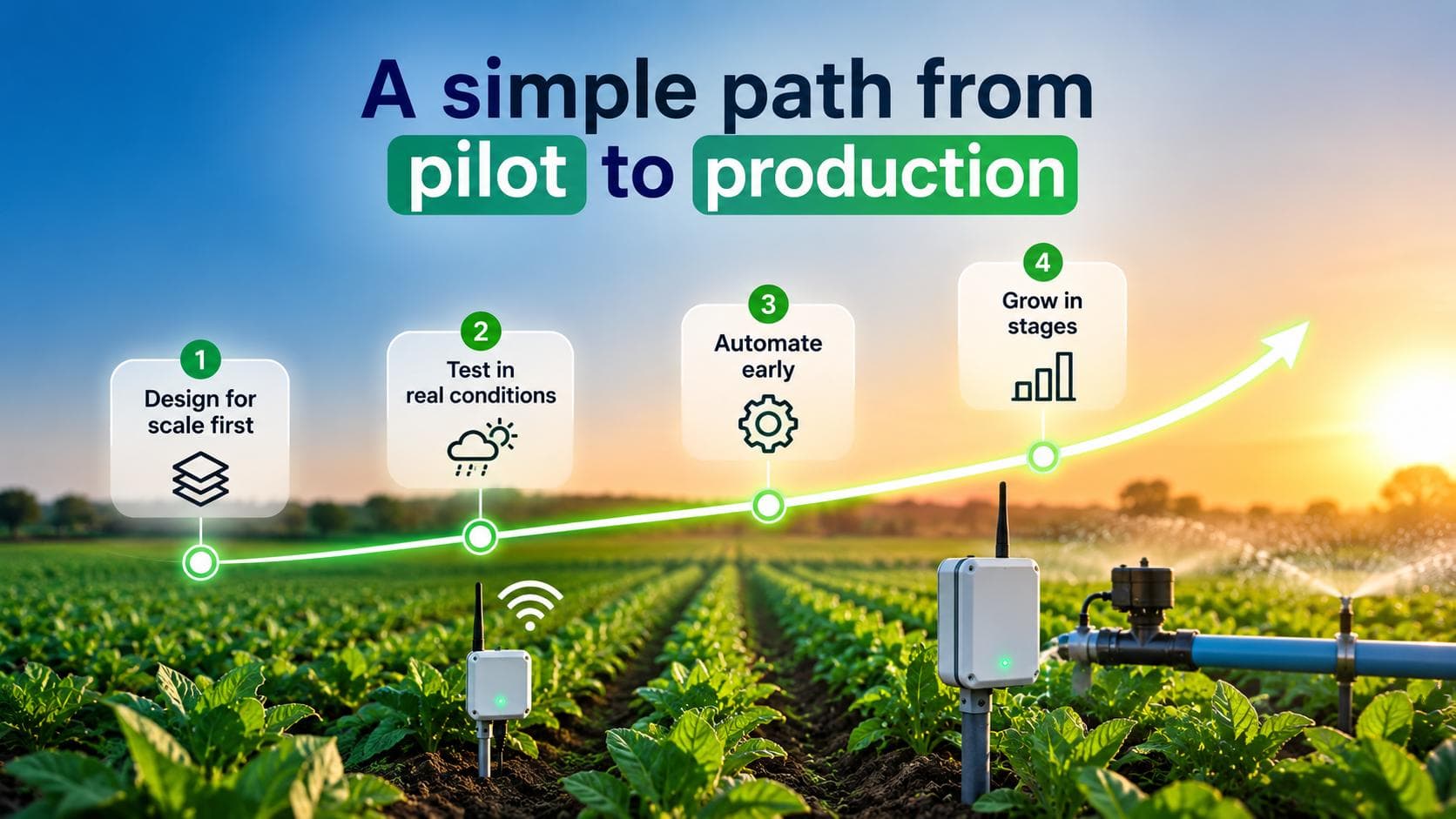
A clear, staged plan turns a promising pilot into a dependable product line. Four steps keep the path smooth.
Design for scale first
Choose your connectivity, edge, and cloud model before the pilot begins, so the same foundation carries you all the way up.
Test in real conditions
Run the pilot across different sites, networks, and weather so it reflects real conditions. This variety makes the full rollout smooth later.
Automate early
Add fleet-wide updates and alert-based support while numbers are still small, so the system is ready before the fleet grows.
Grow in stages
Move from tens to hundreds to thousands in planned steps, checking cost and stability at each one. Confidence builds with every stage.
This staged approach is exactly how leading manufacturers move past the pilot and into steady, profitable rollouts.
Signs your platform is ready to scale
Before a big rollout, it helps to know the platform is truly ready. A few positive signals show you are on solid ground:
- Devices keep working and recover cleanly when connectivity returns.
- Adding new units takes just minutes.
- Updates reach the whole fleet from one place.
- Costs rise smoothly in line with device count.
- Dashboards stay fast as data grows.
When these are in place, scaling becomes a straightforward, confident next step.
Build to scale from day one
The best time to plan for ten thousand devices is while you are still building for ten. A platform designed to grow protects your margins, strengthens your reputation, and turns a strong pilot into a strong, lasting business. Every good decision you make early pays you back at every stage that follows.
Promeraki builds production-ready IoT platforms for OEMs and agri-tech companies, from secure connectivity and edge intelligence to automation, real-time monitoring, and managed OTA updates.
With more than 50,000 devices connected, platforms ready in weeks, and infrastructure costs cut by an average of 45%, you get a system built to scale affordably from your first unit to your ten-thousandth, with full ownership and no vendor lock-in.