Introduction
Farming has always been demanding work. But today, farmers face a combination of pressures that previous generations never had to manage together unpredictable rainfall, rising fertilizer costs, labor shortages, and the constant pressure to produce more from the same land.
IoT in agriculture is changing how farmers respond to these pressures. Connected sensors, smart devices, and real-time data platforms are giving farms a level of visibility and control that simply did not exist a decade ago. Instead of relying on experience and observation alone, farmers now have continuous data from across their entire operation of soil, crops, livestock, equipment, and weather all feed into a single system that helps them make faster, more accurate decisions.
This guide covers what agricultural IoT means in practice, six use cases where it delivers measurable results, the real challenges of implementation, and where smart farming is heading in 2026.
What Is IoT in Agriculture?
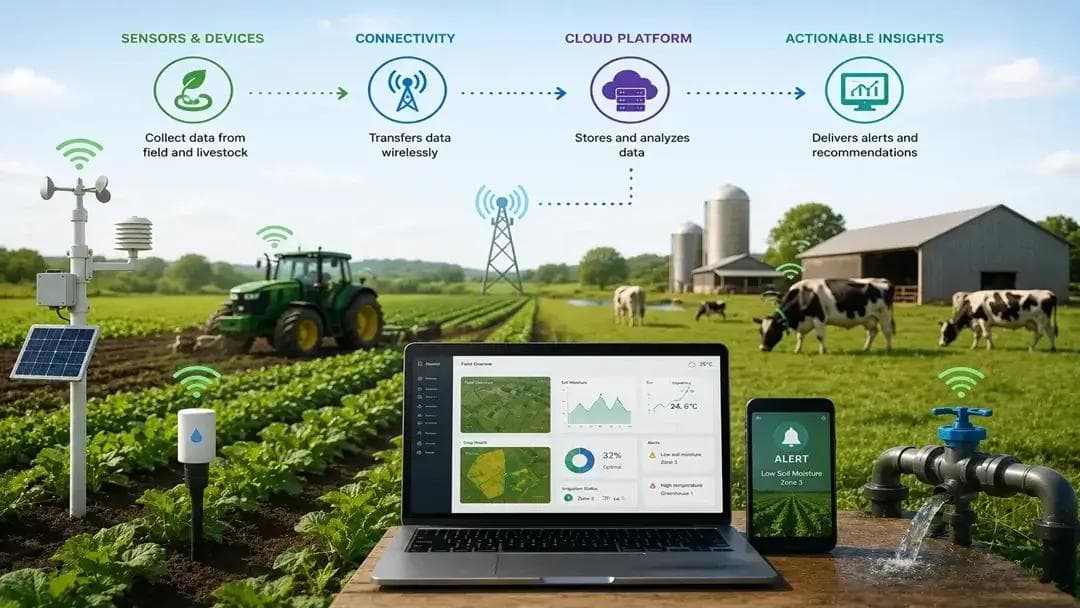
IoT in agriculture means connecting physical devices to sensors, cameras, trackers, and equipment to the internet so they can collect and share data automatically, without requiring someone to manually check and record readings throughout the day.
A working agricultural IoT system runs across four layers:
- Sensors and devices sit in the field, barn, or greenhouse. They measure soil moisture, air temperature, crop health, animal movement, equipment location, and dozens of other variables depending on the application.
- Connectivity carries that data from the field to a central platform. The right protocol depends on farm size and location of LoRaWAN for large rural properties with no cellular coverage, 4G/5G where signal is available, or satellite for the most remote operations.
- A cloud platform receives, stores, and processes the incoming data. It runs analytics, identifies patterns, and generates alerts or recommendations based on rules the farmer sets.
- Action is the result of an irrigation valve opening automatically, a farmer getting a phone alert about a sick animal, or a dashboard flagging a crop stress zone that needs attention.
The core value is simple: IoT replaces guesswork with data. Farmers move from reacting to problems after they occur to catching and preventing them before they grow. That shift drives both cost savings and yield improvements.
The agricultural IoT market reflects growing adoption; it is projected to reach $25 billion by 2027, driven by the need to produce more food with fewer inputs in a changing climate.
Why It Matters
- IoT in agriculture gives farmers continuous operational visibility, helping them move from reactive decision-making to smarter, data-driven control across the entire farm.
Smart Farming Use Cases for IoT Devices
1. Smart Irrigation and Water Management
Traditional irrigation runs on fixed timers and general estimates. It does not account for what is happening in the soil leading to overwatering, underwatering, and wasted resources.
How it works:
- Soil moisture sensors placed at multiple depths send continuous readings to a central platform
- When moisture drops below the crop's threshold, the irrigation system activates automatically
- When a connected weather station detects rainfall, the system pauses the cycle
- Variable rate irrigation adjusts water delivery zone by zone; sandier sections get more, clay-heavy sections get less
Result: According to the Food and Agriculture Organization, precision irrigation reduces water consumption by 30 to 50 percent compared to conventional flood irrigation while maintaining or improving yield.
2. Soil Monitoring and Nutrient Management
A field that looks uniform on the surface can have very different soil conditions just a few meters apart. Applying fertilizer uniformly across that variability means some zones get too much, and others get too little.
What IoT soil sensors measure:
- Soil moisture and temperature
- pH levels
- Electrical conductivity
- Nutrient concentration
How farmers use this data:
- Apply fertilizers only where deficiency exists not uniformly across the whole field
- Determine optimal planting timing based on actual soil temperature, not calendar dates
- Prevent over-fertilization that damages soil biology and causes nutrient runoff
Result: Variable rate fertilizer application guided by soil sensor data can reduce nitrogen use by up to 15 percent while maintaining equivalent yields.
3. Crop Health Monitoring with Sensors and Drones
By the time a field scout identifies a crop disease or pest problem, it has often already spread. IoT sensors and agricultural drones catch issues before they become visible to the human eye.
The two-layer monitoring approach:
| Layer | Tool | What It Does |
|---|---|---|
| Aerial | Multispectral drone | Scans full field and detects stress in near-infrared spectrum |
| Ground | Fixed in-field sensors | Monitors temperature, humidity, leaf wetness continuously |
How it works:
- A single drone flight covers a 200-acre field in under two hours
- Sensors detect plant stress before any visible symptoms appear
- Combined data generates a prescription map showing exactly where treatment is needed and at what intensity
- Treatment goes only to affected zones, not the entire field
Result: Targeted treatment reduces pesticide and fungicide use, lowers input costs, and reduces chemical load on the environment.
4. Livestock Monitoring and Health Tracking
An animal showing early signs of illness may not display visible symptoms for days. By then the condition had worsened and potentially spread through the herd.
What IoT devices track per animal:
- GPS location
- Movement patterns
- Body temperature
- Heart rate
- Feeding behavior
How alerts work:
- The platform establishes a normal baseline for each individual animal
- Any deviation reduced movement, elevated temperature, irregular feeding triggers an alert
- Farmers isolate and treat the animal before symptoms become visible
Additional operational benefits:
- Grazing pattern analysis helps optimize pasture rotation
- Calving alerts notify farmers when a cow shows labor patterns, reducing losses from unattended births
Result: Individual health monitoring at this scale is only possible with connected IoT technology.
5. Greenhouse Climate Control and Automation
Maintaining a stable greenhouse environment manually requires constant attention and still produces inconsistent results. IoT automates the entire process.
What sensors monitor inside the greenhouse:
- Temperature and humidity
- CO₂ concentration
- Light intensity
- Soil or substrate moisture
Automated responses when conditions drift:
| Condition | Automated Action |
|---|---|
| Temperature too high | Ventilation opens |
| Humidity too low | Humidifiers activate |
| Low light (cloud cover) | Grow lights adjust |
| Moisture below threshold | Irrigation triggers |
Additional benefit: Operators monitor and control all conditions remotely from a single dashboard; one manager can oversee multiple greenhouse units simultaneously.
Result: Consistent growing conditions produce uniform crop quality and predictable yield cycles critical for growers supplying buyers under fixed-quality contracts.
6. Pest and Disease Detection
Pest infestations and crop diseases develop under specific, measurable conditions of temperature, humidity, leaf wetness, and seasonal patterns. IoT systems track these conditions in real time and predict outbreak risk before it materializes.
Two detection layers:
Layer 1: Environmental monitoring
- Sensor networks track leaf wetness, temperature, and humidity
- Data feeds into predictive models trained on historical outbreak patterns
- When conditions match a known risk profile, the system sends an early warning
- Farmers apply preventive treatment at the optimal window before infection occurs
Layer 2: Automated insect traps
- Built-in cameras identify and count insect species automatically
- Population trends are tracked continuously
- Alerts trigger when counts cross the action threshold for a specific pest
Why timing matters:
Fungicides applied before infection are substantially more effective than those applied after symptoms appear. IoT makes that timing precise.
Result: Predictive pest management reduces total pesticide use across the growing season. For organic producers with limited chemical options, early detection is especially critical.
Challenges of IoT in Agriculture (And How to Solve Them)
Connectivity in Rural Areas
Most agricultural land sits outside reliable cellular coverage. This is one of the most common practical barriers to IoT adoption, and the reason for choosing the right connectivity protocol matters as much as choosing the right sensors.
LoRaWAN is the most widely used protocol for large outdoor farm deployments. It transmits data over distances of 10 to 15 kilometers on a single charge, consumes minimal power, and requires only a single gateway device to cover a large area. For operations in areas with no cellular infrastructure, LoRaWAN is typically the first choice. Satellite connectivity is now more affordable through providers like Starlink, covering locations where even LoRaWAN infrastructure is not practical to deploy.
Upfront Hardware and Platform Cost
IoT systems require investment in hardware, installation, and ongoing platform subscriptions. For smaller operations, the total cost can be a genuine barrier. The practical approach is to start with a single high-impact use case, smart irrigation or soil monitoring where the ROI case is clearest and measurable within one growing season.
Most IoT platforms are designed to scale incrementally, so the initial deployment does not need to cover the entire farm to deliver value. Starting small, proving the return, and expanding from there reduces financial risk significantly.
Turning Data into Decisions
Raw sensor data has no value if farmers cannot interpret and act on it. A platform that outputs CSV files of moisture readings does not help a farmer who needs to know whether to irrigate today.
The platforms that deliver real value translate data into clear, plain-language alerts and simple visual dashboards telling farmers what is happening and what to do about it, not just what the numbers say. When evaluating any IoT provider, the quality of the interface and the clarity of its outputs matter as much as the sensor hardware.
The Future of Smart Farming: Key Trends for 2026
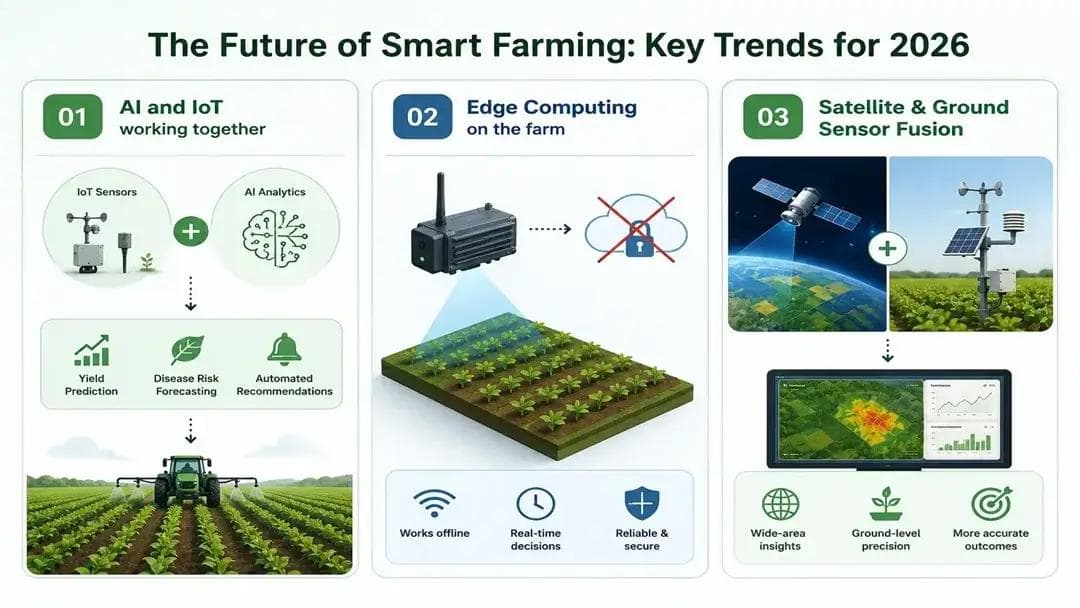
AI and IoT working together
Sensor data tells you what is happening right now. AI models built on continuous data tell you what is likely to happen next, enabling yield prediction, disease risk forecasting, and automated intervention recommendations. McKinsey estimates AI-driven precision farming could add $500 billion in value to global agriculture by 2030.
Edge computing on the farm
Processing data directly on the device rather than routing it through the cloud keeps critical systems running even when connectivity drops. As edge AI chips become more affordable and power-efficient, on-device intelligence is becoming practical at field scale.
Satellite and ground sensor fusion
Satellite imagery delivers wide-area crop monitoring. In-field sensors deliver ground-level precision. Platforms combining both produce more accurate insights than either source alone, or the European Space Agency's Copernicus program makes satellite imagery freely available for agricultural use, reducing the cost barrier significantly.
Conclusion
IoT in agriculture is delivering real, measurable results on farms today not as a future possibility but as a working reality. Farmers using connected sensors and smart platforms are using less water, catching disease earlier, improving livestock welfare, and making every input go further.
The technology scales to any operation size. Starting with one high-impact use case, proving the return, and expanding from there is a practical path for farms at any stage of digital adoption. The data infrastructure built today becomes the foundation for AI-driven decisions tomorrow.
Promeraki builds the IoT platform infrastructure that makes connected agriculture possible from device integration and connectivity to cloud analytics and real-time dashboards.
Ready to Connect Your Farm?
Promeraki designs and builds IoT platforms for precision agriculture from device integration to real-time analytics dashboards.