A soil probe sits in the middle of a field. A water tank stands behind a hill. A herd drifts across open land all day. None of them are near a PowerPoint or a Wi-Fi router, and that's the whole challenge with farm data.
LoRaWAN was made for exactly this. It carries small bits of data across long distances on a battery that lasts years, reaching the remote corners where power lines and cell towers simply don't go. That's why LoRaWAN in agriculture has become one of the technology's biggest success stories.
This is a builder's guide, not a brochure. If you make sensors, trackers, or gateways, here's where LoRaWAN earns its place on a farm, how far it reaches, how many devices it can carry, and what to get right when you build.
What Is LoRaWAN? A Quick Overview
LoRaWAN means Long Range Wide Area Network. In plain terms, it moves small amounts of data a long way, using almost no power.
It rides on free radio bands, so there's no SIM and no monthly bill per device. It's built for a sensor that wakes up, sends 20 bytes, and goes back to sleep. That focus is its strength; it does one job extremely well.
The setup is four simple parts:
- A sensor reads soil, water, or weather.
- A gateway catches the signal and sends it online.
- A network server manages the devices and security.
- An app or platform turns raw numbers into something a farmer can act on.
One gateway can feed thousands of sensors. That single fact is what makes covering a whole farm affordable.
Why LoRaWAN Works Well on Remote Farms
Most farmland is exactly where other networks give up. No mains power. Patchy or no mobile signal. Kilometers between the field and the farmhouse. LoRaWAN turns that hard environment into an easy one.
It works so well here for four clear reasons:
- It reaches far. One gateway on a rooftop or pole can cover fields that stretch for kilometers.
- It needs no power lines. You can't run a cable through a paddy or a pasture. LoRaWAN sensors run on batteries alone.
- It skips the cell network. No SIM, no tower dependence, no monthly data fees for every device.
- It grows with you. Ten sensors today, thousands next season, all on the same network.
Common Uses of LoRaWAN in Agriculture
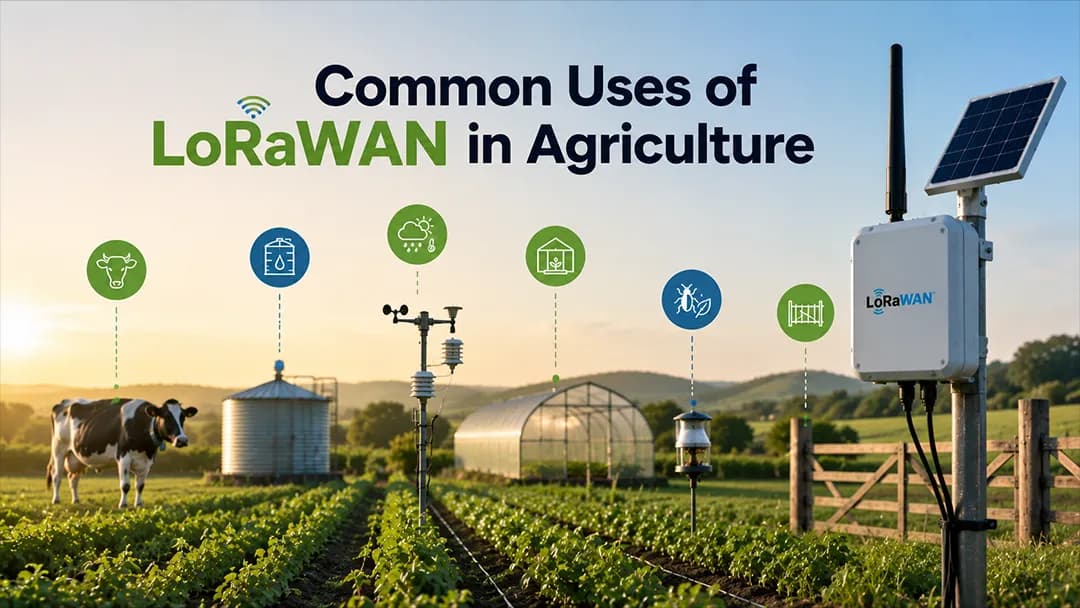
The pattern is always the same: small data, sent often, from far away. These are the tasks where it performs best.
1. Soil moisture and irrigation. A probe sends moisture and temperature every 15 to 30 minutes, so water flows only when the crop needs it. That's precision agriculture at its simplest less water, lower pump bills, and no walking the field.
2. Livestock tracking. Collars report where animals are and how much they move. A sick or missing animal shows up in hours, not days.
3. Water and tank levels. Ultrasonic sensors watch tanks, troughs, and silos, so no one drives out just to check a level by eye.
4. Weather and microclimate. Rain, humidity, and frost readings taken field by field. One farm can hold several microclimates that a single weather station would miss.
5. Greenhouse climate. Low-power nodes let you place sensors densely and catch a cold or damp corner before it spreads.
6. Pest and disease alerts. Smart traps and leaf-wetness sensors flag the exact conditions pests and fungus love, so spraying follows the risk, not the calendar.
7. Gate and equipment status. Open or closed, on or off, from the far edge of the property, simple signals that save a lot of driving.
Range and Battery Life: The Two Numbers That Matter
For a builder, two specs matter most: how far the signal travels and how long the battery lasts. Both look great on a datasheet and behave differently outdoors, so design for the real-world number.
Range: Crops, tree lines, and hills soften the signal, so height beats power every time. A gateway on a pole or roof reaches far more than a stronger radio at fence height. Semtech lists up to 15 km in open land; a planted field usually gives you a few kilometers. Test in mid-season, when crops are tallest, and you'll size it right.
Battery: This is a setting, not a fixed number. Send every 5 minutes, and a cell lasts months; send every 30 minutes, and it lasts years. The LoRa Alliance points to around five years as a fair target for crop monitoring. Your biggest lever is send frequency, so pick the slowest one the job allows.
How Many Devices Can One LoRaWAN Network Carry?
This is where LoRaWAN really pays off on a farm. Unlike Wi-Fi, a gateway isn't capped at a fixed number of connections. Sensors only wake up to send a few bytes, so a single gateway can quietly carry thousands of devices, even tens of thousands, when they report just a few times a day.
That's how an entire farm runs on one or two gateways. Start with a dozen sensors in a pilot and grow to thousands on the same backbone, with no rewiring. Mature platforms already manage tens of thousands of connected devices this way, and the cost per sensor keeps falling as the fleet grows.
LoRaWAN vs NB-IoT for Farming
Most device makers weigh these two. Both are low-power and long-range. The real difference is who owns the network.
| Factor | LoRaWAN | NB-IoT |
|---|---|---|
| Who runs it | You (your gateway) | A mobile carrier |
| Ongoing fee | None | Per device |
| Rural coverage | You control it | Only where towers reach |
| Best when | You own the land | Assets are scattered |
Battery usually favors LoRaWAN. In one controlled test on the same 3000 mAh cell, a LoRaWAN node lasted about 33 months against roughly 20 for NB-IoT.
Quick call: own the land and want zero data fees, go LoRaWAN. Scattered assets with good cell signal, NB-IoT can be simpler. If you're weighing both, firmware and cloud integration that supports either protocol keeps your options open before you lock the design.
Gateway Placement: The Key to Good Coverage
Get the gateway right, and the rest of the network just works. The radio is only as good as its line of sight, so a little planning here saves a lot later.
Four rules that hold up outdoors:
- Go high. Three to five extra meters can add kilometers of reach. A pole, a barn roof, or a water tower beats a fence post.
- Keep it in sight. Hills, tree lines, and metal sheds soften signals. Put the gateway where it can see the sensors.
- Test at full crop height. That's when the signal works hardest, so plan for it.
- Add a gateway, not more power. If a field sits out of reach, a second gateway is the clean fix.
One tip for builders: when coverage is off, the sensor often gets blamed, not the placement. Ship clear mounting notes, or build a quick signal-check mode into the device so installers get instant feedback in the field.
Conclusion
LoRaWAN is the right tool for one clear job: small data, long range, and tiny power. On a farm, that job is everywhere soil, water, weather, and livestock, all the way out to the fields nothing else can reach. It connects thousands of sensors across remote land on batteries that last years, with no cabling and no monthly fee for every device.
For device makers, the approach is simple: design for the real field, not the datasheet, and pair the radio with a solid platform that turns readings into decisions. Get range, battery, scale, and the cloud layer right, and you'll ship a product that runs for years where connectivity was once impossible.
Turning a connected device into a full farm platform? Talk to an IoT expert about the cloud, automation, and fleet control behind it.