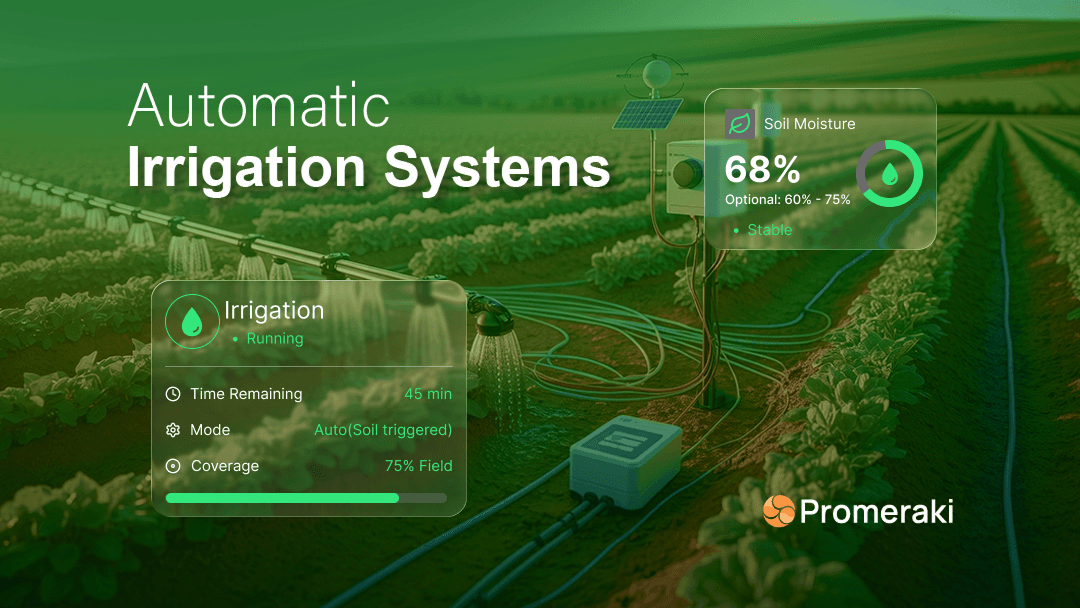
Water management is a key challenge in farming and landscaping. Manual watering often wastes water and creates uneven coverage. It also takes up daily effort. Some plants get too much water. Others do not get enough.
Automatic irrigation systems solve this by watering based on plant needs. They reduce guesswork and improve consistency.
Modern IoT platforms for smart agriculture help these systems monitor soil conditions, control watering schedules, and stay reliable over time.
In this blog, you will learn how automatic irrigation works, what parts it uses, why adoption is rising, and how software improves results for farms and homes.
What are Automatic Irrigation Systems?
Automatic irrigation systems water plants without manual control. They use sensors and controllers to decide when to water. They also decide how much water to deliver.
These systems are used in farms, greenhouses, gardens, lawns, nurseries, and indoor plant setups. They support drip irrigation, sprinkler systems, and zone-based layouts.
Instead of following a fixed schedule, the system reacts to real conditions. This improves water use and supports healthier plant growth.
How do Automatic Irrigation Systems Work?
Automatic irrigation follows a simple flow.
Sensors measure soil moisture and basic weather signals such as rainfall. Some systems also measure temperature and humidity.
The controller checks this data against preset limits. If the moisture drops below the target, irrigation starts.
Valves open and pumps turn on. Water moves through drip lines or sprinklers.
When the soil reaches the target moisture level, irrigation stops. The system saves the data and sends alerts if something is wrong.
This same process works for large farms and small home systems.
What Components Make Up an Automatic Irrigation System?
An automatic irrigation system includes a few core parts that work together.
Sensors collect real-time data from soil and air. Common sensors measure moisture, temperature, humidity, and rain.
The controller or smart hub uses this data to control irrigation. In smart systems, the controller connects to the cloud for remote access.
Valves control water flow across zones. Pumps provide pressure, so water reaches every line and sprinkler.
A communication network, such as Wi Fi, GSM, 4G, or LoRaWAN, helps devices exchange data.
A dashboard or mobile app shows moisture levels, schedules, and alerts. Weather inputs help the system avoid watering during rain or high humidity.
Together, these parts create a system that runs with low manual effort.
In short:
- Five core parts power every smart irrigation system: sensors, controller, valves/pumps, connectivity network, and a dashboard app. Each layer talks to the next.
Why are Automatic Irrigation Systems Becoming More Important?
Automatic irrigation is growing because water scarcity is increasing worldwide.
Farmers also face tighter margins and more unpredictable weather. That makes water waste more expensive.
Automatic irrigation helps by watering only when needed. It also reduces waste caused by poor timing.
This is why many teams invest in smart irrigation system development services to modernize water operations.
What Types of Automatic Irrigation Systems are Available?
Different environments need different watering methods.
Drip irrigation systems deliver water near the roots. This reduces evaporation and water loss. It works well for farms, orchards, and greenhouses.
Sprinkler systems spread water over a wider area. They are common in lawns, sports fields, and some crop fields.
Garden watering systems suit home landscapes. Many combines drip and sprinklers across zones.
Potted plant systems support nurseries and balconies. They keep moisture stable with less daily attention.
Indoor watering systems use small pumps and moisture sensors. They work well for houseplants.
Self-watering plant systems often rely on gravity or simple triggers. They require minimal setup.
What Benefits do Automatic Irrigation Systems Provide?
- Automatic irrigation improves water efficiency and reduces manual work.
- Labour needs to drop because watering becomes automatic.
- Plants receive steadier moisture. That supports more uniform growth.
- Pumps run only when required, so energy use drops.
- Controlled watering also reduces standing moisture near roots. This can lower disease risks.
- Remote access lets you monitor and control water from anywhere.
These benefits apply to farms and home gardens.
What Problems Does Automatic Irrigation Solve?
Manual irrigation often leads to uneven water. Some areas get excess water. Others stay dry.
Watering schedules also get missed during busy days. Labour needs to stay high. Water waste rises due to poor timing and uncontrolled flow.
Automatic irrigation reduces these problems. It uses scheduling, zone control, and sensor data. It also sends alerts for leaks, low pressure, or sensor faults. Over time, saved data helps improve future decisions.
What is the Cost and Return on Investment?
System cost depends on land size, zone count, sensor types, and connectivity.
Small home setups cost less. Large farm installations cost more due to equipment and layout complexity.
Returns often come faster than expected.
Drip and micro-irrigation systems can cut water use by up to about 30–50 percent and improve crop yields compared with traditional methods, making irrigation more efficient and sustainable.
Many farms recover costs within one or two seasons through water savings, lower labour effort, and stronger output.
Why is Automatic Irrigation Adoption Accelerating Worldwide?
Smart irrigation is becoming a standard part of modern agriculture.
The smart irrigation market is expected to grow sharply over the next decade, with global value projected to reach roughly USD 6.9 billion by 2033 as farms and landscapes adopt more efficient irrigation tech.
Smart farming is also expanding.
Industry research estimates the global smart agriculture market could approach around USD 36 billion by 2030 as farms increasingly use sensors, automation, and data-driven tools.
As adoption grows, more teams invest in IoT solutions for agriculture and irrigation to manage systems at scale.
How does Software Improve Automatic Irrigation Systems?
Hardware sets the base. Software drives performance.
Software platforms collect sensor data and apply automation rules. They store history and generate reports. They also send alerts and support remote controls.
This is why many teams treat custom IoT software solutions as core infrastructure for irrigation projects.
Advanced platforms also spot early warning signals. They detect leaks, pump stress, or abnormal moisture patterns. This helps teams fix issues before they spread.
Ready to Modernize Your Irrigation Operations?
Water shortage is rising. Manual systems are falling behind. See how a smart irrigation platform built for your environment can change the way you manage water.
How Promeraki Builds Smart Automatic Irrigation Systems?
Promeraki builds smart irrigation using a Connect, Monitor, and Automate approach.
- Sensors, pumps, valves, and weather inputs connect to one platform.
- Operators get real-time visibility into soil conditions and water usage.
- Automation rules start watering only when moisture drops below the set level.
- Predictive alerts highlight leaks, pump faults, and unusual patterns early.
The platform also supports large-scale device management across farms and irrigation networks. This reduces manual work and improves reliability.
Strong Platforms Matter for Long-Term Success
As irrigation systems expand, complexity rises. More sensors, zones, and users increase coordination effort.
Platforms that support connected irrigation device management help teams scale without expanding operations teams at the same pace. Strong platforms support stable performance, accurate data, automation, secure access, and easier scaling.
Final Thoughts
Automatic irrigation brings accuracy and reliability to water management. It helps farms and homes reduce water waste. It also improves plant health through consistent moisture.
Water scarcity and climate pressure make this shift more urgent. Smart irrigation saves water, lowers costs, and reduces daily effort.
When paired with strong software platforms and smart irrigation system development services, these systems become long-term operational tools, not only watering tools.
Well-designed irrigation systems support sustainable growth for farms, businesses, and ecosystems.