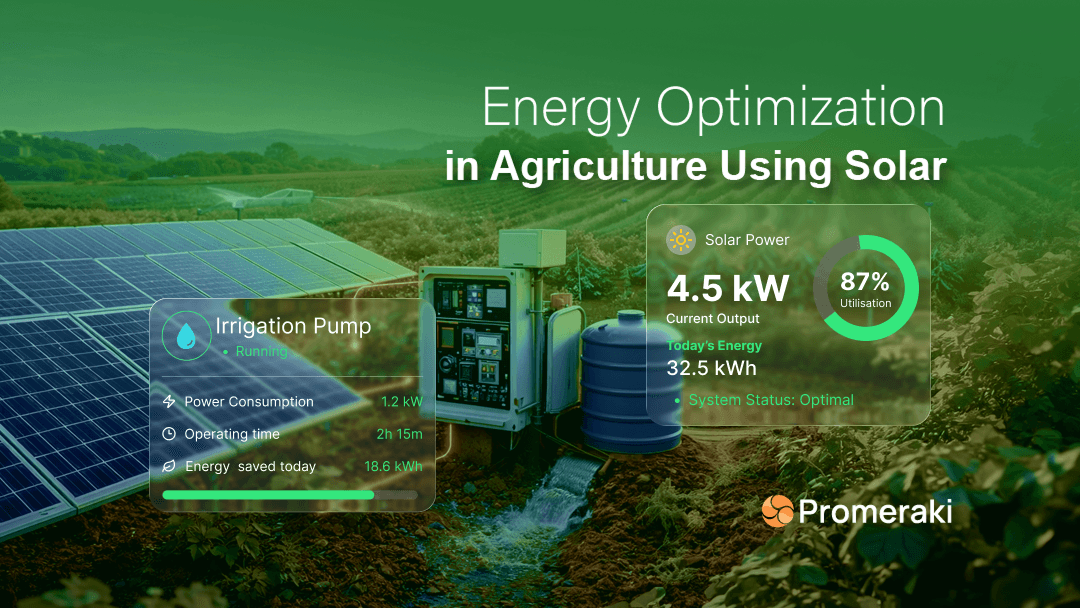
Energy has become a noticeable cost on many farms today. Irrigation pumps, motors, and cooling systems often run for long hours, especially during dry seasons. When electricity prices increase, farmers feel the impact quickly because these systems are essential to daily operations.
For that reason, many farms are starting to rethink how energy is used across the field. Solar-powered pumps, automated controls, and sensor monitoring are helping reduce unnecessary power consumption while keeping equipment running when needed. IoT platforms for smart agriculture help connect these systems, monitor performance, and keep operations stable over time. This approach is becoming central to energy optimization in agriculture.
This article explains how solar energy and automation reduce farm energy use, how these systems work in real agricultural environments, and why this shift is creating a strong opportunity for agricultural equipment manufacturers.
What energy optimization means for agricultural manufacturers
Energy optimization is not only about lowering electricity usage. For manufacturers, it changes how products compete in the market.
An energy-optimized product helps farmers:
- Spend less on monthly electricity
- Reduce pump failures and motor damage.
- Improve irrigation accuracy
- Lower labor effort
- Operate reliably during power shortages.
For manufacturers, this leads to:
- Higher product demand
- Better customer satisfaction
- Fewer service complaints
- Stronger dealer confidence
- Access to government subsidy programs
- Improved brand trust
Farmers no longer buy equipment based only on horsepower or flow rate, but by total operating cost. Energy-saving features make products easier to sell.
That is why many companies are investing in smart irrigation system development services to upgrade traditional products with energy-saving features.`
Product Strategy:
- Energy optimization isn't just about saving electricity: it's a product strategy. Farmers now buy on total operating cost, not horsepower. Energy-saving features make your equipment easier to sell.
Why are electricity costs high on farms?
Understanding energy waste helps manufacturers design better systems.
Most farms lose power efficiency because of:
- Pumps running longer than required
- Manual switching delays
- Irrigation at peak electricity hours
- Water leakage in pipelines
- Low-efficiency motors
- Dry-run conditions
- Poor scheduling
In rural areas, farmers often leave pumps running unattended because fields are far from home. This wastes electricity and shortens pump life.
When manufacturers solve these problems using automation and monitoring, the product value increases immediately.
How solar power reduces farm energy costs
Solar energy is one of the most effective ways to cut electricity bills in agriculture.
Modern farms use solar for:
- Irrigation pumps
- Automation panels
- Controllers
- Storage systems
- Hybrid solar-grid setups
Solar irrigation allows farms to operate without depending fully on the power grid or diesel generators. This is critical in remote areas with unstable electricity supply.
Benefits of solar integration for manufacturers
Solar-ready equipment allows manufacturers to:
- Enter new rural markets
- Offer premium product variants
- Participate in government subsidy programs
- Reduce dependency on grid pricing
- Improve export potential
Solar energy is becoming more common on farms because it cuts ongoing electricity costs and lowers dependency on the power grid. According to the International Energy Agency, renewable energy adoption in agriculture is rising quickly as the cost of solar power falls and fuel prices grow, making solar a key tool for reducing farm energy expenses.
Solar integration is no longer optional. It is becoming a standard feature in new agricultural equipment.
How automation cuts electricity usage
Automation ensures that machines run only when needed.
Instead of manual operation, automated systems:
- Start pumps automatically
- Stop irrigation once soil moisture is sufficient
- Adjust schedules based on the weather
- Prevent dry-run damage
- Balance load during off-peak hours
Manufacturers can include:
- Automatic pump start/stop
- Time-based irrigation schedules
- Pressure-based shutdown
- Flow-based detection
- Weather-controlled irrigation
- Remote on/off access
Example:
If soil moisture reaches the target level, the system stops the pump automatically. This prevents water waste and avoids unnecessary electricity usage.
Automation also reduces labor and service costs.
Why sensors are critical for energy optimization
Sensors convert irrigation into a data-driven system.
Common sensor types include:
- Soil moisture sensors
- Flow sensors
- Pressure sensors
- Tank level sensors
- Temperature sensors
These sensors tell the system:
- When to water
- When to stop
- If water is leaking
- If pressure is abnormal
- If the pump is overloaded
With real-time feedback, irrigation becomes accurate instead of reactive.
This improves energy efficiency and protects hardware.
Market demand for energy-optimized farm equipment
Smart agriculture is growing quickly.
The global precision agriculture market, which includes automation and sensor-based irrigation systems, is expected to reach nearly USD 12 billion by 2030 as farms adopt technology that improves efficiency and reduces operating costs.
This shows strong farmer interest in technology that lowers costs and improves productivity.
At the same time, smart irrigation adoption is increasing.
Grand View Research projects that the global smart irrigation market will exceed USD 4.5 billion by 2030, driven by water conservation policies, precision farming adoption, and rising demand for efficient irrigation technologies.
This growth creates a steady demand for IoT solutions for agriculture and irrigation.
Energy optimization as a business advantage
Energy-efficient equipment changes how manufacturers compete.
Instead of selling only on power ratings, companies sell on:
- Monthly electricity savings
- Lower maintenance cost
- Longer pump life
- Reduced breakdown risk
This creates:
- Faster sales cycles
- Higher margins
- Strong dealer loyalty
- Repeat customers
Dealers prefer products that reduce customer complaints and service calls.
Energy optimization shifts competition from hardware to performance and efficiency.
How Promeraki Supports Manufacturers?
Many manufacturers want to build smart energy-optimized systems but face
- Software complexity
- Long development cycles
- High R&D costs
- Mobile app challenges
- Cloud platform design issues
Promeraki offers ready-to-integrate solutions:
- Smart controllers
- Solar pump integration
- Sensor connectivity
- Automation workflows
- White-label mobile apps
- Cloud dashboards
- API integration for OEM platforms
This allows manufacturers to launch advanced products without building everything from scratch.
Your hardware is ready. Is your platform?
Promeraki enables your hardware to do more: solar controls, smart monitoring, white-label apps, all included.
Benefits for manufacturers using Promeraki
Manufacturers gain:
- Faster product launches
- Higher equipment value
- New subscription revenue models
- Improved dealer adoption
- Better customer retention
Promeraki also supports product training and dealer onboarding, which simplifies market adoption.
Why platforms matter in large deployments
As farms grow, complexity increases.
Large irrigation networks require:
- Device tracking
- Data storage
- Automation logic
- Secure access
- Performance monitoring
Platforms that support connected irrigation device management make scaling practical.
Strong platforms reduce human error and improve long-term reliability.
The long-term impact of energy optimization
Energy-optimized systems deliver:
- Lower operating costs
- Stable irrigation performance
- Reduced environmental impact
- Longer equipment lifespan
- Higher farmer income
This makes energy optimization a core requirement for sustainable agriculture. By combining solar hardware with a scalable smart farming platform, manufacturers deliver lasting cost savings for farmers and create stronger, more stable product ecosystems.
Conclusion
Energy optimization is changing how agriculture operates.
Solar power lowers dependency on the grid. Automation removes unnecessary power use. Sensors improve accuracy.
For farmers, this means lower bills and reliable irrigation.
For manufacturers, it means:
- Higher product value
- Market differentiation
- Recurring revenue
- Stronger brand trust
With platforms like Promeraki, OEMs can build smart, energy-efficient products faster and with lower risk.
Energy optimization does more than save electricity.
It transforms agricultural equipment into intelligent systems built for the future.