Businesses today are not asking whether to adopt IoT. They are asking where to start and how to make it work on a scale.
IoT applications for businesses have moved well past the pilot stage. In 2026, connected devices are embedded into supply chains, factory floors, farms, hospitals, and commercial buildings, generating real-time data that drives faster decisions and measurable cost savings.
What has changed this year is not the concept. It is the infrastructure behind it:
- Edge computing IoT now processes data directly on devices without routing everything through the cloud
- Smart sensors for business have dropped significantly in cost, lowering the entry point for smaller operations
- Regulatory pressure around energy, emissions, and compliance is pushing IoT implementation faster than most businesses planned
This article covers six IoT business use cases delivering clear value right now, what problem each one solves, how it works, and why 2026 is the right time to act.
Quick Take
- IoT is no longer experimental. Businesses using connected devices in 2026 are cutting costs, meeting compliance, and outperforming competitors.
Top IoT Applications Transforming Businesses in 2026
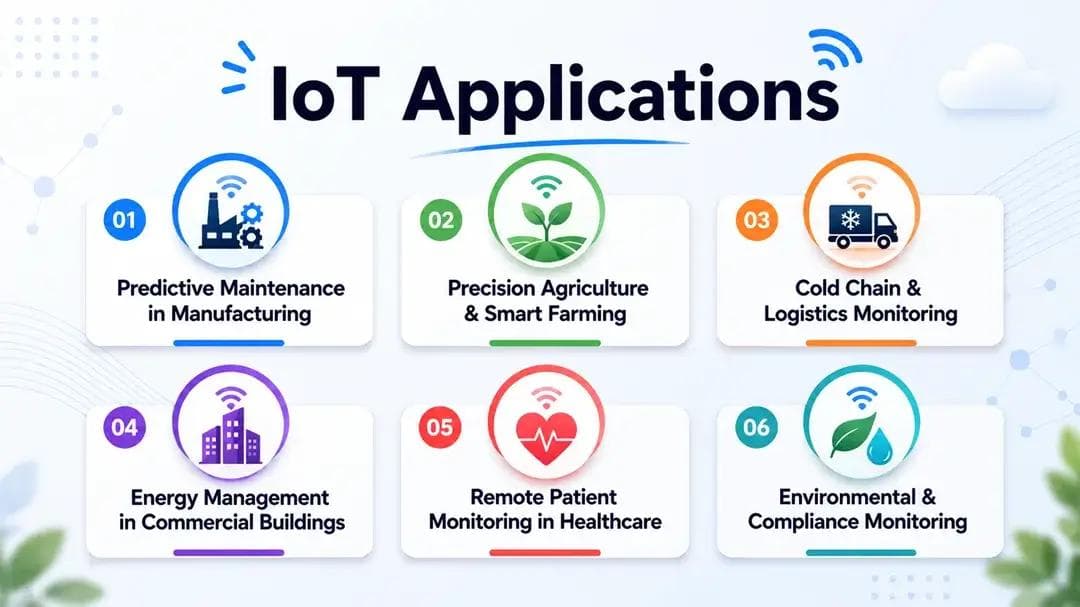
Predictive Maintenance in Manufacturing
Equipment failure does not announce itself. A machine runs normally, then stops production with it.
Unplanned downtime in manufacturing can cost anywhere from thousands to hundreds of thousands of dollars per hour. Most of that loss is preventable with the right condition monitoring IoT infrastructure.
How predictive maintenance IoT sensors work:
| Sensor Type | What It Detects | When It Alerts |
|---|---|---|
| Vibration sensors | Mechanical imbalance, bearing wear | Before failure develops |
| Thermal cameras | Overheating motors, electrical faults | Early heat spike detection |
| Acoustic monitors | Unusual friction or pressure sounds | Pattern deviation from baseline |
These wireless sensor networks feed IoT data analytics models that flag abnormal patterns before breakdown occurs. Maintenance teams schedule repairs during planned downtime.
Business outcome:
- Fewer unplanned production stops
- Extended equipment lifespan
- Lower per-unit maintenance cost
The 2026 shift is worth noting: edge computing IoT. Devices now process sensor data locally on the factory floor for real-time alerts, no cloud latency, and no connectivity dependency. For high-throughput manufacturing IoT solutions, this is a significant reliability upgrade that directly improves IoT ROI for businesses.
Precision Agriculture and Smart Farming
Agriculture has always dealt with variables outside human control of soil variation, water availability, and unpredictable weather. What IoT in agriculture changes is visibility. Operators now see those variables in real time and make decisions based on actual field conditions, not estimates.
Core smart farming IoT applications:
- Soil moisture sensors - measure hydration at different depths across the field
- On-site weather stations – track temperature, humidity, and rainfall at farm level, not regional averages
- Automated irrigation systems - release water only where and when sensors show it is needed
- Crop monitoring cameras - detect early signs of disease, pest pressure, or stress
Farms using precision agriculture IoT consistently reports 20-40% water savings compared to schedule-based systems. Yield consistency improves because crops receive precisely what they need.
For specialty crops, vineyards, orchards, and high-value produce, the precision matters even more. Microclimate variation across a single field affects quality in measurable ways. Agriculture IoT technology maps those differences and lets growers manage each zone independently.
2026 entry point: Low-power field hardware, LPWAN connectivity, and machine learning IoT crop models now run directly on field devices, making smart farming IoT applications accessible to operations that could not justify the cost two years ago.
Cold Chain and Logistics Monitoring
Every product moving through a temperature-controlled supply chain carries spoilage and compliance risk at every handoff. The problem is that temperature excursions happen. It is that they go undetected until the product reaches its destination.
Where IoT logistics tracking fits across the cold chain:
| Location | Sensor Placement | Data Captured |
|---|---|---|
| Storage units | Inside refrigeration chambers | Temperature, humidity, door open events |
| In-transit shipments | Inside packaging or containers | Continuous readings with GPS asset tracking |
| Loading docks | Entry/exit checkpoints | Condition recorded at each handoff |
Supply chain IoT applications give operations teams immediate alerts when readings go outside acceptable ranges, allowing intervention before product is lost. Beyond loss prevention, every reading becomes part of an auditable temperature monitoring IoT record that is structured, timestamped, and ready for regulatory review.
Supply chain visibility IoT outcomes:
- Measurable reduction in spoilage losses
- Faster compliance audits with auto-generated records
- Full traceability across every transit point
Why 2026 matter here: Food safety and pharmaceutical regulators across multiple markets are tightening temperature documentation requirements. Cold chain monitoring IoT is moving from best practice to obligation for businesses operating at scale or across borders.
Energy Management in Commercial Buildings
Energy is one of the largest operating costs for commercial facilities. Without granular data on where energy is going and when, reduction efforts rely on blanket measures that rarely deliver real results.
Smart building IoT applications make the waste visible:
- Occupancy sensors detect which areas are actively in use
- Building automation IoT adjusts HVAC based on real occupancy, not fixed schedules
- Submeters on individual systems (lighting, HVAC, equipment) show real-time IoT monitoring of consumption
- Dashboards surface exactly where and when energy is being wasted
Buildings using IoT energy management systems consistently achieve 20-30% reductions in energy consumption. Payback period on the infrastructure investment is typically under two years for medium to large facilities.
The 2026 business case is twofold:
- Rising energy costs make reduction a direct financial priority
- ESG disclosure requirements now demand auditable energy data, not manually compiled estimates
Smart building technology generates that data automatically. The same commercial IoT applications infrastructure that cuts your energy bill also produces the sustainability reports your investors and regulators are asking for.
Remote Patient Monitoring in Healthcare
The gap between hospital discharge and the next appointment is where most complications develop undetected. Patients leave with instructions but without continuous clinical oversight and early warning signs go unreported until they become serious.
How healthcare IoT systems work in remote monitoring:
| Device | Vital Tracked | Clinical Use |
|---|---|---|
| Wearable monitors | Heart rate, SpO2 | Cardiac and respiratory monitoring |
| Blood pressure cuffs | Systolic/diastolic pressure | Hypertension management |
| Glucose monitors | Blood sugar levels | Diabetes management |
| Patch sensors | Temperature, activity | Post-surgical recovery |
Telemedicine IoT devices transmit readings continuously to care for teams through a cloud-based IoT platform. Clinicians monitor multiple patients simultaneously and receive alerts when readings move outside safe parameters, enabling early intervention before a condition escalates.
Measured outcomes:
- Reduction in hospital readmission rates
- Improved chronic disease management results
- Higher patient satisfaction between appointments
2026 context: Reimbursement frameworks in several major markets now support IoT remote patient monitoring at scale. The commercial model has become viable for a wider range of healthcare organizations. For medical device manufacturers, healthcare IoT applications represent a significant and growing IoT platform opportunity.
Environmental and Compliance Monitoring
Regulatory requirements around air quality, water discharge, and emissions are tightening across industries and geographies. Historically, compliance meant periodic manual inspections and paperwork, slow, resource-heavy, and full of gaps between measurement points.
Real-time IoT monitoring replaces that model with continuous, automated measurements.
What environmental monitoring IoT covers:
- Air quality sensors - measure particulate matter, VOCs, CO2 in real time
- Water quality meters - track pH, turbidity, chemical levels at discharge points
- Noise monitors - flag exceedances in industrial or construction zones
- Emissions detectors - track Scope 1 outputs continuously against regulatory thresholds
All readings from these IoT sensor applications feed into a centralized IoT compliance monitoring dashboard. If any parameter exceeds a threshold, the system flags it immediately, giving operations teams time to respond before a violation becomes a formal incident.
Operational benefits:
- Lower labor cost of compliance programs
- No gaps in measurement coverage
- Audit-ready records generated automatically
Why this matters in 2026: ESG disclosure requirements, particularly around Scope 1 and Scope 2 emissions, are now legally significant in regulated markets. IoT data analytics is what regulators and investors increasingly expect to see. Companies deploying enterprise IoT applications for environmental monitoring now are building the data foundation that compliance will require at scale.
Bottom Line
- Match IoT to one specific problem, measure the outcome, and scale from there. These six use cases are the best starting points.
Conclusion
IoT solutions for businesses deliver the most value when matched to a specific operational problem.
The right starting point is not the most ambitious application. It is the one where:
- The cost of the current problem is visible and measurable
- The data requirements are straightforward
- The path from IoT sensors to decision is direct
The six industrial IoT applications covered here share a common thread established business case, mature IoT platform applications, and 2026 conditions that make deployment more practical than ever before.
Promeraki builds connected device platforms that help businesses move from IoT implementation strategy to working infrastructure. If you are evaluating where business IoT applications fit in your operation, our team can help you define the right scope and build the right system.