There's a counterintuitive truth in modern viticulture: the vineyards producing the world's most concentrated wines aren't giving their vines all the water they want. They're giving them just enough and sometimes, deliberately less. That's deficit irrigation in vineyards, and it's one of the most effective vineyard irrigation strategies that saves water and improves quality at the same time.
As climate change reshapes growing regions and water scarcity intensifies, deficit irrigation has moved from niche technique to foundational practice. If you grow wine grapes, this is the approach worth understanding.
What Is Deficit Irrigation in Viticulture?
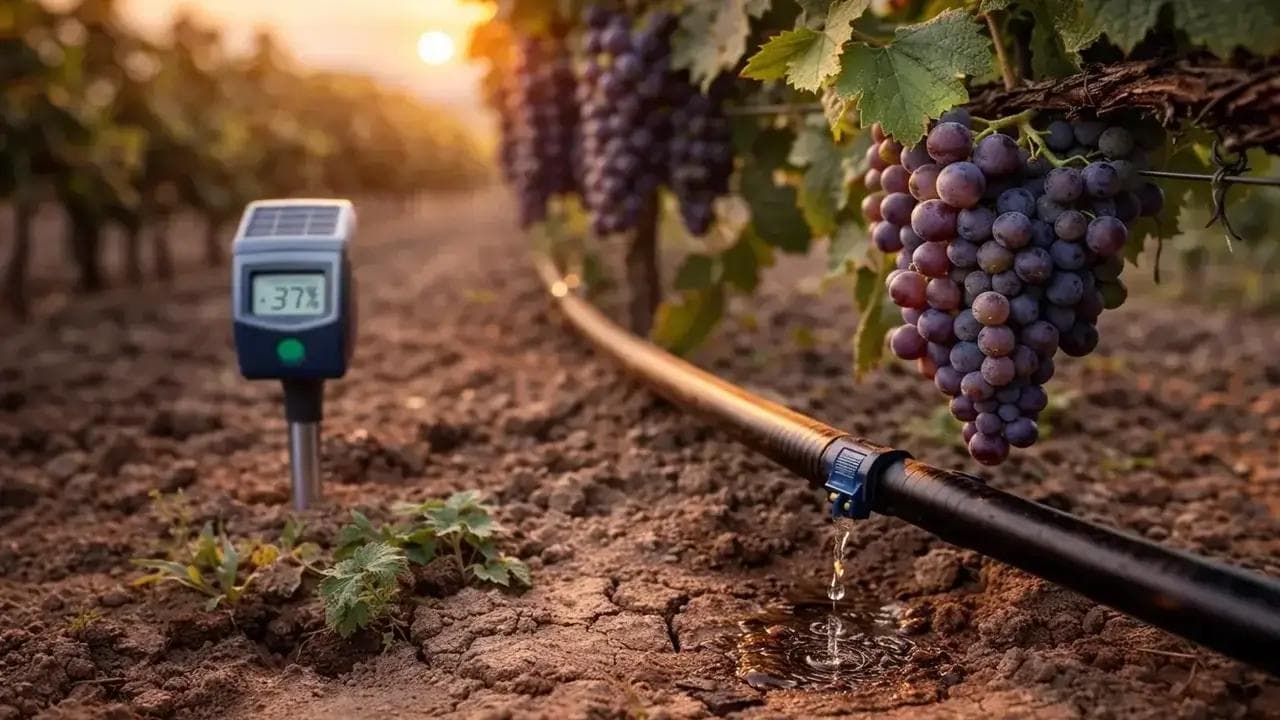
Deficit irrigation in viticulture is the practice of applying water below full crop evapotranspiration requirements intentionally inducing mild to moderate vine water stress during specific growth stages to improve grape quality, control vine vigor, and reduce water use.
Grapevines are naturally adapted to dry conditions. When subjected to controlled, timed water stress, they respond by concentrating sugars, flavors, and phenolic compounds in the berry outcomes that directly benefit wine quality.
TLD;R
- Less water, on purpose. Timed stress between fruit set and veraison produces concentrated berries, better wine, and 30–50% water savings.
What Is Regulated Deficit Irrigation (RDI)?
Regulated Deficit Irrigation (RDI) is a structured strategy where water supply is reduced to a set percentage of full crop water requirements during defined growth windows typically post-fruit-set through veraison while maintaining adequate irrigation at other sensitive stages.
RDI viticulture is the most widely researched and applied form of deficit irrigation for wine grapes. It gives growers a clear framework: define the stress level, define the timing, and monitor vine water status throughout.
How Does Deficit Irrigation Work in Vineyards?
- Establish a baseline: Calculate full crop water demand using evapotranspiration (ETo) data and vine growth stage coefficients.
- Set a deficit target: RDI programs typically apply 50–70% of full ETo during the stress window.
- Choose your timing: Apply deficit post-fruit-set through veraison for maximum quality benefit.
- Monitor vine water status: Use leaf water potential measurements or soil moisture sensors to stay within target thresholds.
- Rehydrate at key moments: Restore full irrigation at veraison and post-harvest for vine recovery.
- Adjust season to season: Rainfall, temperature, and vine age shift the picture every year.
The Two Core Strategies: RDI vs PRD
Regulated Deficit Irrigation (RDI) in Viticulture
RDI reduces total water volume across the entire root zone. The vine experiences systemic water stress, triggering a hormonal response that closes stomata, slows shoot growth, and redirects energy toward berry development. The result: smaller berries, higher skin-to-pulp ratios, greater phenolic concentration, and natural canopy vigor control all without mechanical intervention.
Partial Rootzone Drying (PRD) Irrigation for Wine Grapes
PRD alternates irrigation between two sides of the root system every 10–14 days. One side dry while the other stays wet. The drying roots send stress signals while the wet roots maintain turgor and nutrient uptake. PRD wine grape programs can achieve similar quality outcomes to RDI, making it a strong option for premium and research-forward vineyard operations.
RDI vs PRD: What Is the Difference?
| Feature | RDI | PRD |
|---|---|---|
| Mechanism | Reduces total water applied | Alternates wet/dry root zones |
| Water saving | 30-50% reduction | 30-40% reduction |
| Infrastructure | Standard drip system | Dual-lateral drip required |
| Operational complexity | Moderate | Higher |
| Best suited for | Most commercial vineyards | Premium, research-forward operations |
Vine Water Stress Management: What's Happening Inside the Vine
When soil moisture drops, roots send chemical signals upward through the vine. Stomata close, shoot growth slows, and the vine naturally prioritizes berry development over vegetative growth. Mild to moderate grapevine water stress at the right growth stage is exactly what growers are aiming for, and the right monitoring tools keep that stress within the intended range.
Measuring Vine Water Status
Leaf water potential is the most precise measurement tool. A pressure chamber instrument applied to a leaf gives a reading of the vine's internal water tension. Target ranges for RDI programs typically sit between -1.0 and -1.4 MPa (midday stem water potential). Readings below -1.6 MPa are a clear signal to irrigate.
Soil moisture monitoring in vineyards completes the picture. Capacitance probes, tensiometers, or EM sensors installed at multiple root depths (30 cm, 60 cm, 90 cm) show how quickly the soil profile is drying and whether water is reaching where the roots are. For a deeper look at how modern sensor technology supports vineyard irrigation decisions, Wine Australia's irrigation management resources are a valuable reference.
Irrigation Scheduling in Viticulture: Timing Is Everything
Fruit Set Through Pre-Veraison
Maintain full or near-full irrigation from budburst through fruit set. Consistent moisture during this window supports healthy shoot development, uniform berry set, and strong bunch formation, the foundation that makes everything downstream possible.
Veraison Irrigation Timing: The Critical Window
The 2-4 weeks before veraison through veraison itself is where deficit irrigation delivers its strongest quality returns. Berry cell division has peaked, sugar accumulation accelerates, and phenolic compounds begin building in the skin. Moderate stress during this window limits water uptake into berries, raises skin-to-pulp ratios, and concentrates flavor and tannin development naturally.
When to Start Deficit Irrigation in Vineyards
Start the deficit window after the fruit set is confirmed, typically 4-6 weeks of post-flowering. Established vines respond well to structured deficit programs; younger vines under three years benefit from consistent moisture to develop strong, deep root systems first.
Deficit Irrigation Effects on Grape Quality

Berry Size and Wine Quality
Smaller berries mean more skin per unit of juice, and skin is where color, tannin, and aromatic precursors live. Deficit irrigation is one of the most reliable tools for naturally producing smaller, more concentrated berries without chemical intervention. According to UC Davis Viticulture & Enology research, controlled water stress consistently reduces berry volume while maintaining or improving overall fruit quality scores.
Tannin Concentration and Deficit Irrigation
RDI consistently produces higher tannin concentrations in red wine grapes both through the physical skin-to-pulp effect and through the vine's natural biochemical response to mild water stress. The practical outcome is wines with better structure, deeper color, and greater aging potential. This is why deficit irrigation is most actively practiced in premium red wine regions like the Barossa Valley, Napa Valley, the Douro, and Rioja, among others.
Red Wine Grapes vs White Grapes
Redvarieties of Cabernet Sauvignon, Shiraz, Malbec, and Tempranillo respond most strongly, with meaningful gains in phenolic concentration, tannin, and color intensity.
White varieties benefit from a lighter touch. Moderate deficit stress enhances aromatic complexity and helps preserve natural acidity in Chardonnay and Sauvignon Blanc. A more conservative deficit target and shorter stress window keep white grape programs in the quality-positive zone.
Deficit Irrigation Benefits for Vineyards
- Higher grape quality smaller berries, greater phenolic concentration, improved tannin and color structure
- 30-50% reduction in seasonal irrigation water use
- Natural canopy vigor control less mechanical shoot management required
- Lower disease pressure from more open, well-ventilated canopies
- Deeper root system development, stronger drought resilience long-term
- Better vineyard water use efficiency more quality output per unit of water applied
How to Implement Deficit Irrigation in a Vineyard
Drip irrigation is the delivery system of choice. Surface or subsurface drip lines allow precise volume control, zone-by-zone scheduling, and minimal evaporative loss. For PRD, a dual-lateral setup with alternating manifold control is required. For a complete breakdown of how smart drip systems support vineyard-scale water management, see our guide on smart irrigation systems for vineyards.
ETo-based scheduling is the foundation. Regional evapotranspiration data combined with vine-stage crop coefficients gives you the full water demand figure. Your deficit target is a defined fraction of that.
Vineyard watering system best practices:
- Audit drip emitters annually; consistent emitter performance is essential for deficit precision
- Monitor soil moisture at two depths minimum per block
- Measure leaf water potential weekly during the stress window
- Keep a season-by-season irrigation diary to refine your program over time
Sustainable Viticulture and Water: The Bigger Picture
Climate change is increasing evaporative demand and making summer rainfall less predictable across most of the world's wine regions. Regulatory pressure on groundwater access is tightening in California, South Australia, and parts of Europe. In this environment, precision irrigation for sustainable viticulture is not a future consideration; it's a present necessity.
Smart water management for wine grape growers increasingly means IoT-connected soil sensors, automated drip scheduling tied to real-time ETo data, and variable-rate irrigation informed by canopy mapping technology. How vineyards use controlled water stress to improve wine quality is increasingly a question answered by data, not instinct alone.
The OIV (International Organisation of Vine and Wine) reports that viticulture accounts for a significant share of agricultural water use in key wine-producing countries, making deficit irrigation one of the most impactful sustainability tools available at the vineyard level.
Deficit irrigation is where that data-driven approach starts. Biology is well established. The tools are accessible. The advantage belongs to growers who treat water management as a precision discipline, not a calendar routine.
Conclusion
Deficit irrigation in vineyards, where less water becomes available, is applied with precision and intention, producing better fruit and better wine. For vineyard owners navigating water constraints and quality targets simultaneously, it's one of the most valuable tools in modern viticulture.
A vineyard irrigation strategy that saves water and improves quality at the same time isn't a compromise. It's smart viticulture, and it starts with understanding exactly how and exactly when to let the vine work for you.
Deficit irrigation is only half the picture.
See how smart irrigation systems handle the other half.