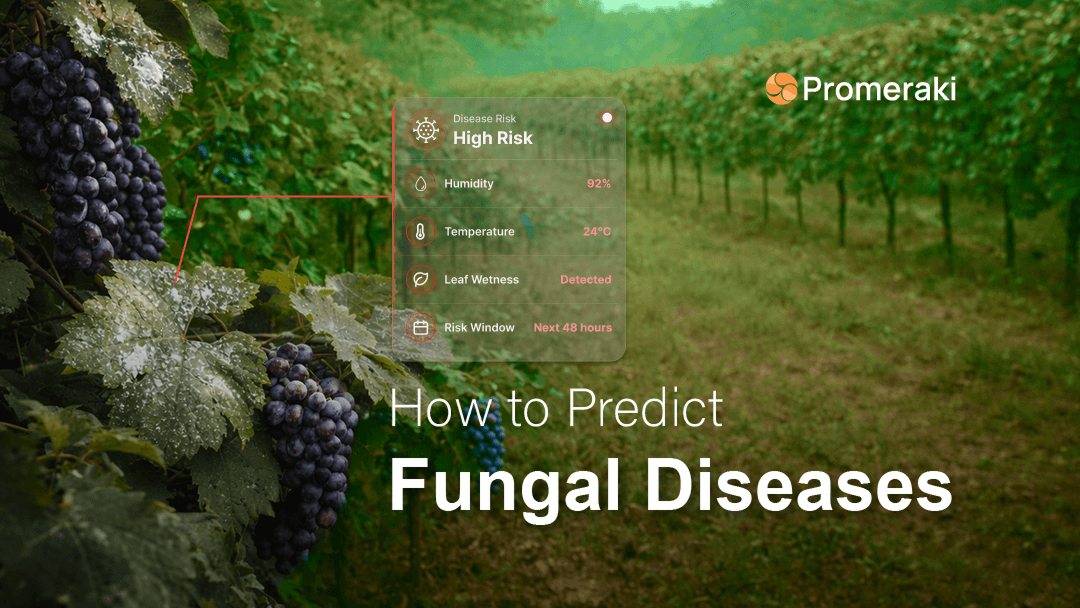
Introduction
Every vineyard manager knows the feeling. You walk the rows on a humid morning, the air sitting heavy and still, and you wonder if something is already spreading through the canopy that you cannot yet, see?
Fungal disease does not announce itself. By the time white powdery patches appear on leaves or grape clusters start to rot, the infection has already been active for days, sometimes weeks. And by then, your options narrow fast: emergency spraying, yield loss, or both.
This is precisely why the most forward-thinking viticulture operations are shifting how they think about disease management. Instead of reacting to outbreaks, they are predicting them using real-time microclimate data, sensor networks, and disease forecasting models to identify risk windows before the first spore takes hold.
The result? Less crop damage, fewer unnecessary fungicide applications, and a vineyard that is managed with precision rather than panic.
This guide walks you through everything you need to know, from understanding vineyard fungal diseases and spotting their earliest signs to the technology that makes predictive disease management possible at any scale.
TL;DR
- Monitor humidity, temperature, and leaf wetness with IoT sensors to predict and prevent vineyard fungal disease before it spreads.
What are Vineyard Fungal Diseases?
Vineyard fungal diseases are infections caused by fungal pathogens that colonize grapevine tissue, leaves, shoots, berries, and wood under specific environmental conditions. Unlike bacterial or viral diseases, fungi are opportunistic. They are always present in the environment, waiting for the right combination of humidity, temperature, and leaf wetness to multiply rapidly.
Fungal pathogens spread through multiple pathways; wind carries spores across rows; rain splash moves them from plant to plant; contaminated soil transfers them through roots; and even vineyard tools can carry infection from one block to another.
The four fungal diseases that cause the greatest economic damage in vineyards globally are:
Powdery Mildew (Erysiphe Necator)
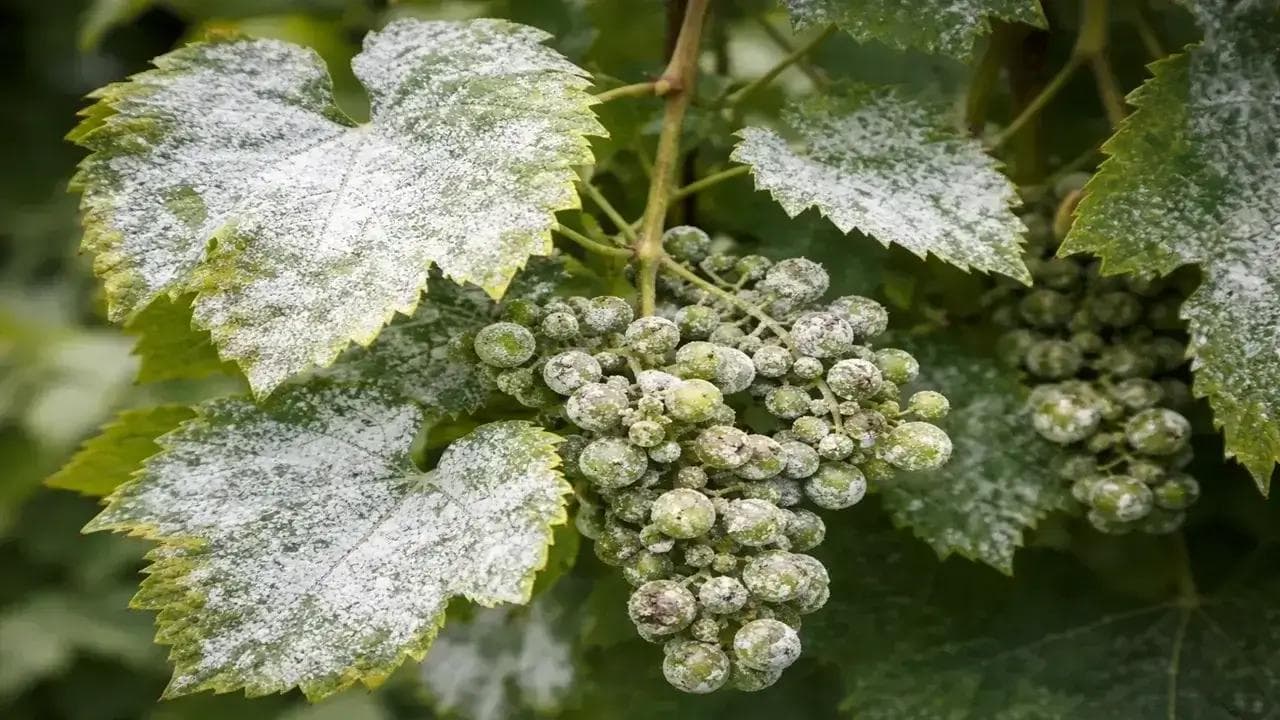
It is one of the most prevalent grapevine diseases globally. It thrives in warm, dry conditions with moderate humidity, making it unpredictable and easy to underestimate. White, powdery growth appears on leaves and young berries, reducing photosynthesis and causing berries to crack or fail to develop properly.
Downy Mildew (Plasmopara Viticola)
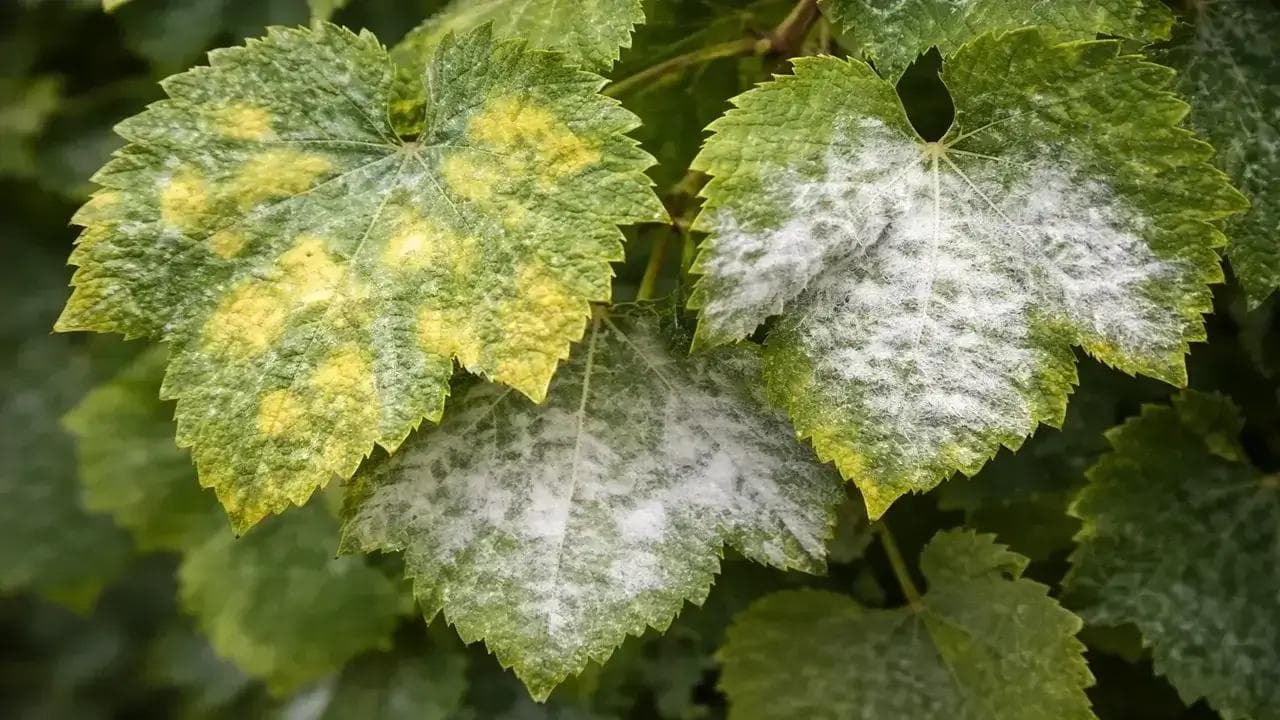
A moisture-loving pathogen that spreads aggressively during wet, cool periods. It appears as yellow oil spots on leaf surfaces with white downy growth on the underside. Left unchecked, it can defoliate an entire vineyard and cause complete crop failure in a single season.
Botrytis Bunch Rot (Botrytis Cinerea)
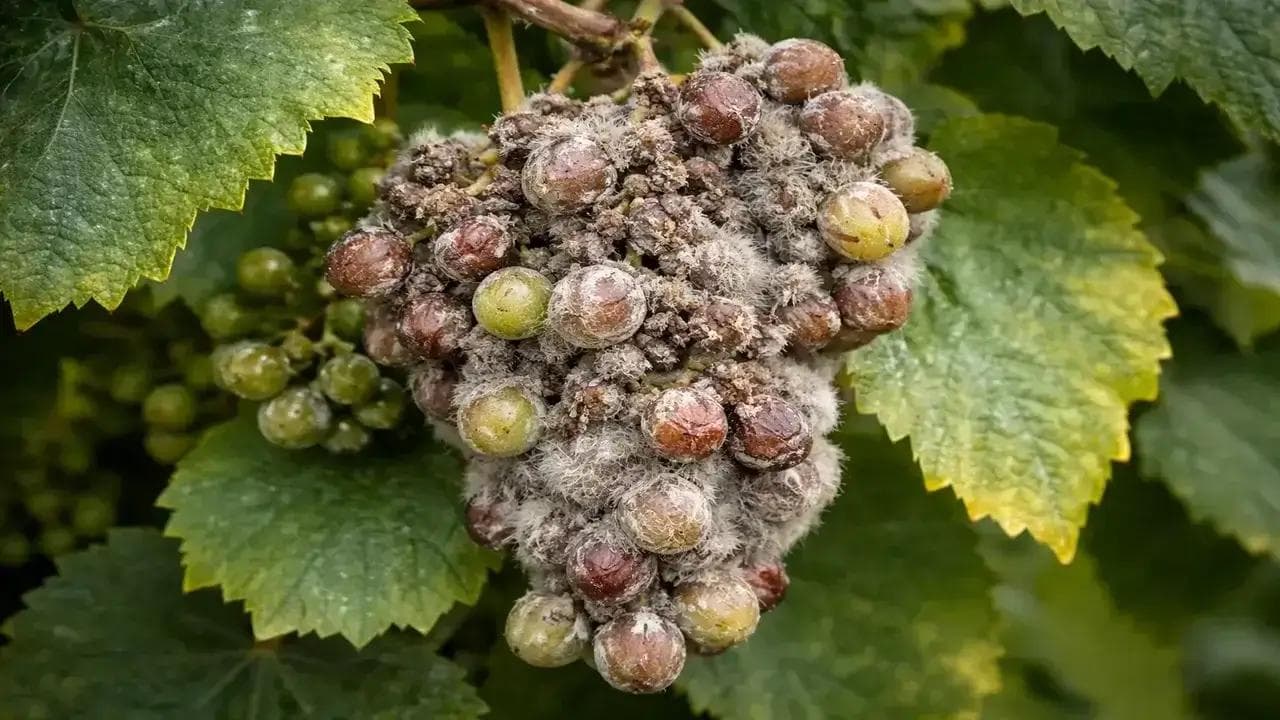
This fungus is probably the most harmful to grapes grown around the world. Research estimates Botrytis causes approximately $2 billion USD in crop losses annually worldwide, with direct losses in some cool-climate regions reaching thousands of dollars per hectare in a single bad season. It attacks grape clusters during high-humidity periods, particularly around flowering and pre-harvest.
Black Rot (Guignardia Bidwellii)
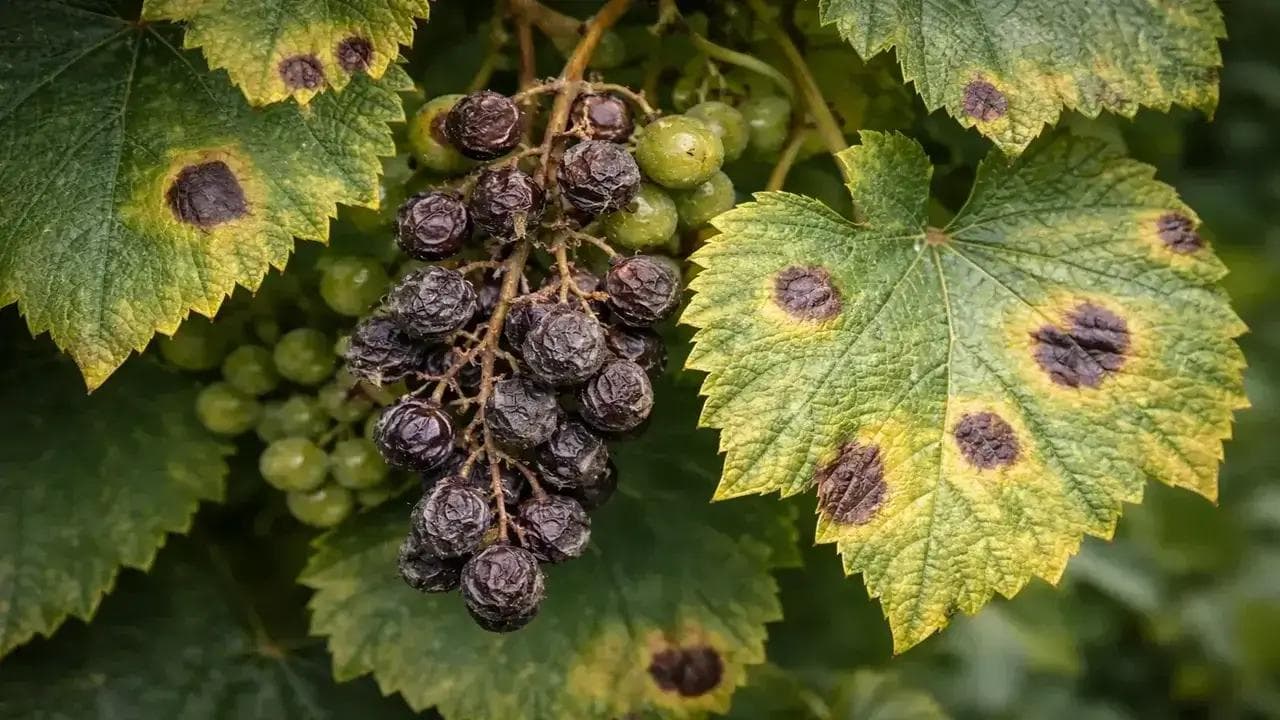
A warm-season pathogen that causes circular lesions on leaves and shriveled, mummified berries. It is most aggressive during periods of rainfall followed by warm temperatures, making it especially relevant in climates with variable spring and summer weather.
What makes all four of these diseases particularly challenging is that their damage is largely irreversible once symptoms appear. Prevention, and specifically, early-stage intervention before visible symptoms, is the only truly effective management strategy.
Early Signs of Fungal Diseases in Grapevines
The earliest signs of grapevine fungal disease are subtle. Knowing what to look for and where to look can make the difference between a contained intervention and a full-scale outbreak.
On leaves:
- Powdery Mildew: A faint dusty or powdery coating on young leaves; curling or distortion of leaf margins in early stages
- Downy Mildew: Pale yellow-green oil spots on the upper leaf surface; a white cotton-like coating on the underside in humid conditions
- Black Rot: Small, circular brown lesions with a darker border; tiny black dots visible in older lesions
On shoots and stems:
- Dark streaking or discolouration on young green shoots
- Poor shoot growth or stunted development compared to healthy sections of the vineyard
- Mildew covering young shoot tissue before it hardens
On berries:
- Powdery Mildew: A white dusty coating; berries that crack or fail to develop properly around fruit set
- Botrytis: Brown, water-soaked spots on individual berries; rapid spread of grey fuzzy mould across the bunch in humid conditions
- Black Rot: Berries that shrivel and turn black-purple; mummified clusters that remain attached to the bunch
Here is the critical point: visible symptoms are a lagging indicator. By the time any of these signs appear in your vineyard, the fungal infection has already been active and spreading often for 7 to 14 days. This is why building an early detection system around only what you can see is never enough on its own.
How Humidity and Temperature Trigger Fungal Outbreaks
Every fungal pathogen has a preferred environmental window in which it thrives. Understanding these conditions is the foundation of predictive disease management.
Humidity is the most critical factor. Most vineyard fungal pathogens require relative humidity above 80–85% to germinate and spread effectively. Botrytis can infect tissue at humidity levels above 90% within just a few hours. Research across global wine-growing regions consistently shows that fungal disease pressure correlates strongly with periods of sustained high humidity, especially when combined with specific temperature ranges.
Temperature determines which pathogen is most active at any given point in the season:
- Downy Mildew is most aggressive between 10°C and 20°C
- Powdery Mildew thrives between 20°C and 27°C
- Botrytis becomes highly infectious between 15°C and 25°C
- Black Rot is most active between 20°C and 30°C, particularly after rainfall events
Leaf wetness duration is the third variable. Many infection models use the number of consecutive hours leaf surfaces remain wet combined with temperature to calculate actual infection risk. Even a brief rain event followed by slow drying conditions inside a dense canopy can create an infection window that growers would never detect by looking at a standard weather forecast.
This is where regional weather data falls short. A weather station located several kilometers away cannot capture what is happening inside your canopy on a humid morning. Studies using vineyard-specific aerobiological monitoring have demonstrated that spore concentrations and infection events vary significantly between adjacent growing zones, making local microclimate data essential for accurate disease management decisions.
The Role of Microclimate Sensors in Early Detection
Microclimate sensors are the eyes and ears of a predictive disease monitoring system. Placed strategically throughout your vineyard, they capture the environmental data that matters most for fungal disease risk at the exact locations where that risk is developing.
A well-designed sensor network typically monitors the following:
- Temperature at canopy height and soil level
- Relative humidity within and above the canopy
- Leaf wetness measuring how long leaf surfaces remain wet after rain or dew events
- Soil moisture an indicator of vine stress and microclimate conditions around the root zone
The key advantage over traditional weather monitoring is spatial resolution. A vineyard is not a uniform environment. Research published in Scientific Reports confirms that microclimate conditions and therefore disease pressure vary considerably between rows, elevations, and canopy zones across the same vineyard block. A single weather station captures none of this variation.
Dense sensor deployment creates a full-picture map of your vineyard's microclimates. Your field management team can see in real time which zones are running high humidity.
Overnight, which canopy sections stay wet longest after rain, and which blocks are consistently sitting within dangerous temperature and humidity thresholds.
Wireless sensor networks deployed in precision viticulture have shown practical effectiveness in supporting disease prevention decisions, irrigation scheduling, and harvest timing, with real-time alerts providing managers actionable information exactly when it matters most.
How Alert Systems Translate Data into Action
Sensor data is only as valuable as the decisions it enables. A well-configured alert system closes the gap between field data and field action automatically and in real time.
Here is how it works in practice. Threshold-based alert rules are configured around the disease risk conditions specific to your vineyard and target pathogens. When sensor data crosses a defined threshold, such as humidity sustained above 85% for more than six consecutive hours at canopy height, for example, the system triggers an alert to the vineyard manager, agronomist, or field team instantly.
This shifts the entire management approach. Instead of spraying on a calendar schedule, conventional vineyards in wet regions can spray up to 20 times per season. Regardless of actual disease pressure, growers can act only when real risk conditions are confirmed. That means fewer applications, lower input costs, and reduced chemical load on the vineyard ecosystem.
Alert systems also support spray timing precision. Fungicide applications are most effective when applied before infection events or in the very early stages of an infection window. Data-backed alerts give vineyard teams the lead time to act at exactly the right moment; not too early, not too late.
Vineyard Disease Forecasting; Predicting Risk Before It Appears
Disease forecasting takes sensor monitoring a step further. Rather than alerting when conditions are currently dangerous, forecasting models use a combination of historical microclimate patterns and live sensor data to predict when disease risk windows are likely to open hours or even days in advance.
Several established forecasting models are used across viticulture worldwide:
Goidanich Model (Downy Mildew):
One of the most widely used models for Plasmopara viticola, it calculates primary infection risk using accumulated rainfall and temperature data during the vine's growing season. Integrated with live sensor data, it can predict the timing of primary infection periods at the vineyard level.
Mills Table (Black Rot):
Developed by plant pathologist W.D. Mills, this model correlates temperature and leaf wetness duration to calculate the probability of Black Rot infection events. It has been validated across multiple grape-growing regions and remains a standard reference for disease management timing.
Botrytis Risk Index:
Various Botrytis risk models use temperature, humidity, and the growth stage of the vines, especially during flowering and just before harvest, to figure out the chances of infection throughout the growing season
Research published in the Precision Agriculture journal shows that plant disease forecasting models using real-time IoT data are dependable tools for predicting disease outbreaks accurately, allowing growers to act before problems arise and manage their resources more effectively.
The practical value for your operation: instead of discovering that a high-risk event has already occurred, your team receives a multi-day forecast of disease risk windows, enabling planned spray scheduling, canopy management decisions, and labour deployment well ahead of time.
Protect Your Vineyard Before It’s Too Late!
Identify disease risk early and reduce crop loss with data-driven monitoring.
Conclusion
Fungal disease does not have to catch your vineyard off guard. The environmental conditions that drive powdery mildew, downy mildew, botrytis, and black rot are measurable, trackable, and, with the right platform predictable.
Vineyards that invest in microclimate monitoring and disease forecasting protect their yield more effectively, reduce their fungicide input costs, and build a management operation that is proactive by design rather than reactive by default. In a sector where a single outbreak of season can erase an entire year's margins, that shift in approach is a genuine competitive advantage.
Knowing the risk is coming is only half the battle. Acting on it at the right time, with the right data, is what protects your crop. Promeraki builds custom IoT platforms purpose-engineered for viticulture operations. From microclimate sensor integration to real-time dashboards, automated disease alerts, and forecasting model integration, everything your vineyard needs to move from reactive spraying to predictive disease control is built into one platform designed around your operation, not the other way around.
Whether you manage 10 hectares or 500, Promeraki's platform scales with you, ready when you are, built around your operation, and designed to protect every harvest that matters.
Ready to take control of fungal disease in your vineyard? Let's talk.