Ask any seasoned grower what drives grape quality, and the conversation usually starts underground rootstock, soil health, and water management. That foundation matters. But the canopy, all the green, leafy growth stretching upward from each vine, shapes harvest outcomes just as much as anything happening below the surface.
Canopy management in vineyards is how growers control that growth. It involves shaping, thinning, and positioning shoots and leaves, so every grape cluster gets the sunlight, airflow, and vine energy it needs to ripen properly. Done well, it can be the difference between an average harvest and a consistently strong one.
This guide walks through what vineyard canopy management involves, the techniques that matter most, and how growers at any scale can start putting these practices to work.
TLD;R
- Canopy management controls grapevine foliage to improve sunlight, airflow, and grape quality while reducing disease pressure across any vineyard size.
What Is Canopy Management in Viticulture?
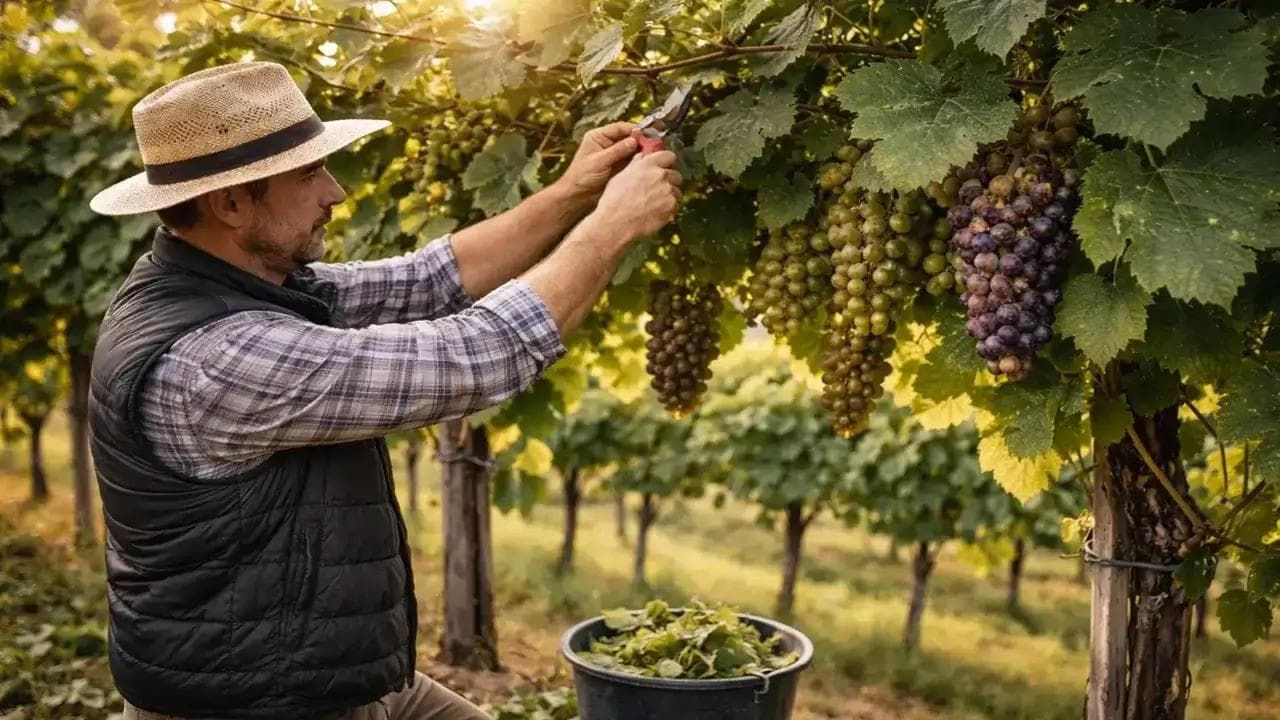
In simple terms, canopy management is everything a grower does to control the size, shape, and density of grapevine foliage during the growing season. That includes removing extra shoots, pulling select leaves, positioning growth along trellis wires, and trimming where needed.
The concept of grapevine canopy management is fundamentally based on the principle of vine balance. That is the relationship between how much leaf and shoot growth a vine produces (vegetative growth) and how many grape clusters it carries (reproductive growth). A vine in balance puts its energy where it counts into ripening grapes rather than pushing out more foliage than it can support.
Every canopy management decision also ties back to the trellis system the vineyard uses. A VSP (Vertical Shoot Positioning) trellis, for example, trains shoot upward into an organized wall of foliage, making it easier to manage density and light exposure throughout the season. The Cornell Viticulture and Enology Program has published detailed research on how different trellis designs influence canopy behavior across climates and varieties. Trellis selection is its own topic, but it helps to understand that the trellis is the scaffolding; canopy management is the ongoing work you do within that structure.
Why Canopy Management Matters
Grape canopy management touches three things that directly shape what ends up in the bin at harvest.
Sunlight Exposure
Grapes rely on consistent, filtered sunlight to develop sugars, build color, and produce the aromatic compounds that define wine character. When the canopy is too dense, grape clusters sit in the shade. Ripening slows down; colors stay muted, and flavor development stalls. Good canopy management opens things up, so sunlight reaches the grape zone without going so far that clusters get sunburned. Research published in the American Journal of Enology and Viticulture has repeatedly linked well-managed light exposure to stronger phenolic development in wine grapes.
Airflow and Disease Pressure
Dense, tangled canopies trap moisture. That humidity sitting on leaves and around grape clusters is precisely what fungal diseases like powdery mildew and botrytis need to take hold. The mechanics behind fungal disease prediction in vineyards show just how quickly these pathogens exploit poor airflow and why canopy management is one of the most effective first lines of defense.
Grape Quality Improvement
When light and air are where they should be, grape quality responds. Berries develop more concentrated flavors, a firmer tannin structure, and even higher sugar levels across the block. That consistency is what makes canopy management one of the most impactful grape quality improvement techniques a grower can invest time in.
Core Canopy Management Techniques
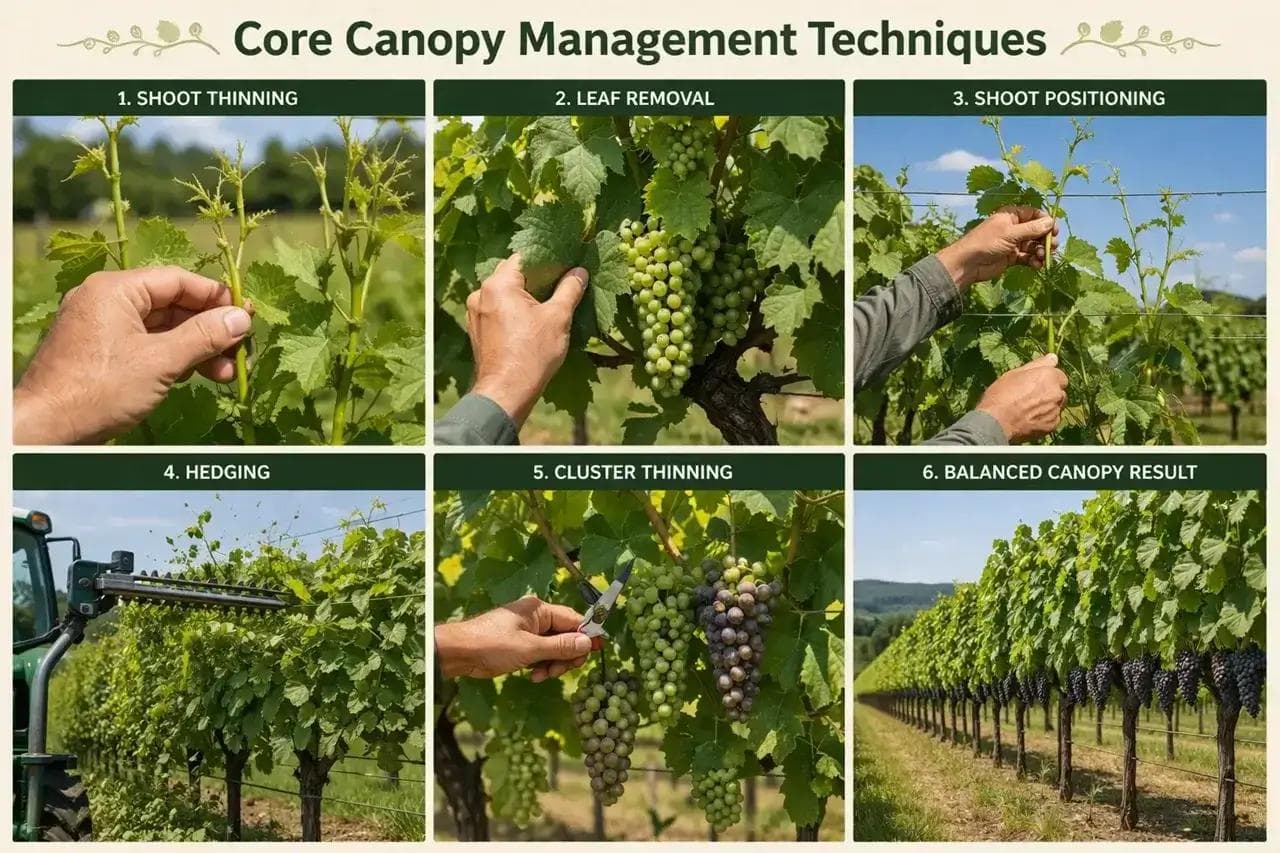
Viticulture canopy management is not one single action; it is a set of practices spread across the growing season. Each addresses something specific, and together, they create the conditions for healthy vines and high-quality grapes.
Shoot Thinning
Shoot thinning means removing excess or poorly placed shoots early in the season, before the canopy fills in. Not every bud that breaks needs to become a full shoot. When too many develop, they crowd each other out, shade the interior of the vine, and compete for nutrients and water.
Growers typically walk the rows and hand-remove weak, doubled, or inward-facing shoots when they are still 15 to 25 centimeters long. At that size, the vine barely notices. Wait too long, and removal becomes more stressful for the plant. Virginia Tech's Viticulture Extension recommends keeping the window tight, ideally before shootings pass 20 centimeters.
So, how does shoot thinning affect wine quality? Fewer, well-spaced shoots let more light into the canopy, produce stronger individual shoots, and lead to more even ripening across grape clusters. For wine grapes, shoot thinning in the vineyard is one of the earliest interventions a grower can make and one of the most cost-effective.
Leaf Removal
Leaf removal in the vineyard, sometimes called leaf pulling, focuses on the leaves directly around grape clusters in the ripening zone. Selectively removing some of these leaves lets more sunlight and air reach the clusters during the critical ripening window.
Timing is important. Most growers handle grape leaf removal somewhere between the berry set and veraison (when the berries start changing color). Pulling leaves too early and young berries risk sunburn. Wait too long and the benefits shrink. In cooler climates, earlier removal tends to promote better grape development. Growers frequently pull from the shaded side of the canopy in warmer climates to maximize airflow without overexposing grapes. The Oregon State University Extension Service has published practical timing guidelines based on Pacific Northwest vineyard trials.
The payoff is straightforward with better light on grape clusters, quicker drying after rain, lower fungal disease risk, and more uniform ripening across the vine.
Shoot Positioning
Shoot positioning on grapevines is the process of training and tucking growing shoots into trellis wires so they grow upward in an orderly fashion rather than flopping sideways or outward. This matters most in VSP-trained vineyards, where the goal is a clean, narrow canopy wall.
During spring and early summer, vineyard crews guide shoot upward between catch wires. It keeps the canopy tidy, prevents one vine's growth from shading its neighbor, and keeps the grape zone open and easy to access.
Beyond the vine-level benefits, good positioning also makes later operations like leaf pulling and mechanical harvesting significantly more efficient.
Hedging
Hedging grapevines means trimming the tops and sometimes the sides of the canopy once the shoots grow past the top trellis wire. Without it, vigorous growth flops over and shades the grape zone or spills into neighboring rows.
Mechanical hedgers cut shoot tips back to a uniform height. The timing and intensity matter; cutting too aggressively too early can trigger a flush of lateral shoots that creates the same density problem all over again. Most growers hedge once or twice per season, aiming to keep things manageable without provoking regrowth.
The purpose is simple: keep the vine's energy pointed at ripening grapes, not fueling unnecessary leaf growth.
Cluster Thinning
Cluster thinning or crop load management is the practice of removing whole grape clusters before harvesting to reduce the vine's total crop load.
A vine carrying more clusters than it can ripen evenly will produce grapes with diluted sugar, pale color, and underdeveloped flavors. By dropping excess clusters, growers concentrate the vine resources into fewer, higher-quality ones. Most growers thin shortly after the berries are set, once they can see how much the vine is carrying relative to its vigor. The International Organisation of Vine and Wine (OIV) references leaf-to-cluster ratio benchmarks that help guide these decisions across major wine-producing regions.
How many clusters to remove depends on the vine, the variety, and the quality targets. The guiding principle is proportionality; the vine should carry only as many grapes as its canopy can fully ripen.
It takes discipline. Dropping clusters that look perfectly healthy goes against instinct. But for premium grape production, the quality difference is measurable and consistent.
How Canopy Management Shapes Grape Quality
All of these techniques share a single purpose, creating conditions where grapes ripen fully, evenly, and with the concentration of flavor and structure that defines quality.
Sugar accumulation runs on photosynthesis, which requires well-lit, healthy leaves. A balanced canopy with the right leaf-to-cluster ratio lets the vine produce enough sugar to ripen its crop properly.
Color development in red varieties depends on anthocyanin production, a process that responds directly to moderate sunlight on grape clusters. Shaded grape zones consistently produce lighter, less expressive berries.
Flavor concentration comes from focus. Focusing the vine energy on fewer shoots and clusters instead of spreading it thin allows the remaining grapes to develop a deeper, more complex character.
In practice, grapevine pruning techniques during the dormant season set up the vine's structural potential. Growers ensure the realization of that potential through canopy management during the growing season.
Managing the Vineyard Microclimate
One of the less obvious but most powerful effects of canopy management is how it shapes the vineyard microclimate, the specific temperature, humidity, and light conditions immediately around each vine and grape cluster.
Grape Zone Management
The grape zone where clusters actually hang is the most important microclimate to get right. Grape zone management in viticulture means making sure this area gets enough light and air circulation while staying protected from extremes.
Leaf removal, shoot positioning, and trellis training all play a role here. The target is a grape zone that dries quickly after moisture events, receives dappled to moderate sunlight, and stays inhospitable to the fungal pathogens that thrive in stagnant, humid conditions.
Disease Control Through Canopy Decisions
The connection between canopy management and disease control in grapes is well documented. Every practice that opens the vine interior, thinning shoots, pulling leaves, trimming overgrowth reduces trapped humidity and helps canopy surfaces dry faster. That directly translates to fewer disease events and lower spray costs, which supports both profitability and sustainability.
The Above and Below Connection
Vineyard management is a whole-vine effort. The connection between above-ground and below-ground vineyard management runs deep. Soil nutrition, water supply, and root health dictate how much vegetative growth the vine pushes, and canopy management is how the grower directs that growth productively.
A vine in rich, well-irrigated soil will likely push a dense canopy that needs more aggressive thinning and hedging. A vine on lean, dry-farmed ground might need very little intervention. The skill is in reading the vine and matching the canopy's response to what the plant is doing. That feedback loop of watching, responding, and adjusting is what separates competent vineyard management from exceptional vineyard management.
Conclusion
What happens above the vine shapes the harvest just as much as what happens below it. Soil, water, and rootstock lay off the groundwork, but it is the canopy that determines whether that potential turns into quality grapes.
Every shoot was thinned, every leaf pulled at the right moment, and every cluster carefully evaluated. These are small, deliberate actions of compounds across a season. The growers who do this well are not necessarily the ones with the biggest budgets or the most advanced equipment. They are the ones paying attention, reading their vines, and making timely decisions.
Whether you are working a few rows or a few hundred acres, the principle stays the same: keep the vine in balance, and the canopy will do the rest.
Take Canopy Management from Guesswork to Precision
Promeraki helps vineyards bring that level of precision to every canopy decision.