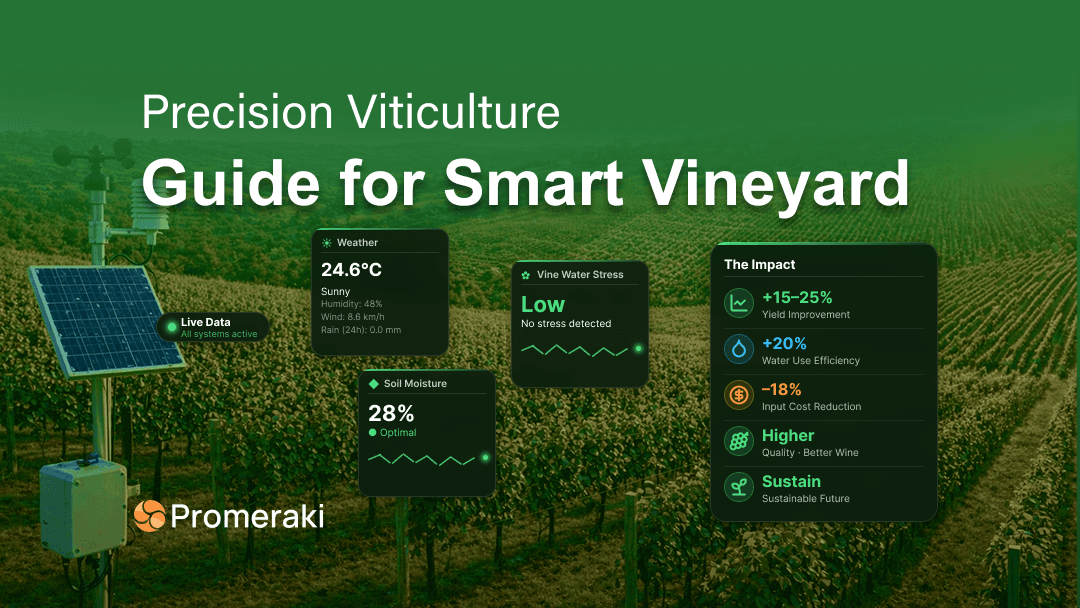
Introduction
Two vineyards. Same region. Same grape variety. The same weather all season.
One produces consistent, high-quality grapes year after year. The other struggles are uneven ripening in some blocks and disease pressure in others; water stress shows too late to address effectively. The winemaker knows something needs attention, but cannot pinpoint exactly where or why.
The difference between these two vineyards is rarely due to the soil or climate. It is the way they are managed.
The first vineyard treats every zone as an individual, monitoring each section with its own sensors, acting on its own data, and making decisions based on what is happening in the ground at that moment. The second treats the whole property as one unit and applies the same approach everywhere.
That difference has a name: precision viticulture.
In this blog, we explain exactly what precision viticulture is, how it works step by step, what tools it uses, and why it is becoming the standard approach for any vineyard serious about quality, efficiency, and long-term sustainability.
What is precision viticulture?
Precision viticulture is the practice of managing a vineyard zone by zone rather than a single, uniform piece of land.
The core idea is simple. Every vineyard has natural variation built into it. Soil type changes from one end of a block to the other. Drainage varies across slopes. Some rows receive more afternoon sun. Low-lying areas retain moisture longer. These differences affect how the vine grows, how the grape develops, and ultimately how the wine tastes.
Precision viticulture brings these differences into focus, identifying the natural zones within the vineyard, understanding what is happening in each one, and responding with exactly the right management for that zone at that moment.
The practice began to take shape in the 1990s as GPS technology and yield mapping tools became available to agricultural producers. Over the following two decades, advances in IoT sensors, drone imaging, and data analytics transformed it from a research concept into a practical, commercially viable approach that vineyards of all sizes are now adopting.
Today, precision viticulture is widely recognized as one of the most impactful developments in modern vineyard management, and the technology behind it is advancing faster than ever.
Why Modern Viticulture Calls for a Smarter Approach
For most of history, managing a vineyard meant walking the rows, reading the vines, and making decisions based on years of accumulated experience. Skilled vineyard managers developed an intimate understanding of their land, and that knowledge produced some exceptional wines.
Today, vineyard managers have access to something even more powerful: real-time data across every zone of their property.
Water access is increasingly regulated in major wine regions. Labour efficiency has become a key driver of profitability. Climate variability is creating growing seasons that require faster, more precise responses. And consumers, particularly in premium market segments, expect the same quality in every bottle, every vintage, regardless of what happened in the field that year.
Uniform management served the industry well for generations. Precision viticulture takes that foundation and builds something better on top of it, giving vineyard managers the tools to respond to each zone individually, act on live data, and make decisions that compound in quality over time.
The shift from managing the vineyard as one unit to managing it as many connected zones is the defining transition in modern viticulture today.
How Precision Viticulture Works
Precision viticulture is not a single tool or a single technology. It is a process, a connected system of data collection, analysis, and zone-specific action that runs continuously throughout the growing season.
Here is how that process works in practice:
Step 1: Map the Vineyard
Every precision viticulture program starts with understanding the land. Soil mapping using electrical conductivity (EC) sensors reveals how soil texture, clay content, and water-holding capacity vary across the property. This map becomes the foundation for every management decision that follows, clearly identifying which zones are structurally different from one another and benefit from individual management.
Step 2: Collect Real-Time Data
Once the zones are defined, IoT sensors are deployed across the vineyard to collect continuous data. Soil moisture probes track water availability at multiple depths. Microclimate weather stations monitor temperature, humidity, and leaf wetness. Drone flights capture NDVI imagery showing vine vigour and canopy density from above. Together, these data streams build a real-time picture of what is happening in every zone at every moment of the growing season.
Step 3: Analyze the Data
All this data flows into a central vineyard data platform. The platform processes readings from across the vineyard, identifies patterns, and generates alerts when conditions in a specific zone reach a point where action will deliver the best outcome, whether that is irrigation, targeted treatment, or a harvest assessment.
Step 4: Make Zone-Specific Decisions
With zone-level data available, vineyard managers apply variable rate management, delivering water, nutrients, and treatments based on what each zone actually needs. A block showing moisture levels that benefit from irrigation to get water at precisely the right time. A zone where disease risk indicators are rising gets targeted protection ahead of the outbreak window. A block ripening ahead of schedule gets flagged for early harvest assessment.
Step 5: Monitor, Learn, and Adjust
Precision viticulture delivers increasing value over time. Every action generates new data. Every season adds to the historical record. The system becomes progressively more accurate, identifying patterns that repeat, anticipating conditions before they develop, and building a richer picture of how each zone performs under different conditions. This continuous feedback loop is what makes precision viticulture one of the highest-return investments a vineyard manager can make.
TL;DR:
- From soil mapping to real-time decisions, precision viticulture is a five-step connected process that gets smarter every single season.
Key Tools and Technologies in Precision Viticulture
Precision viticulture draws on a connected set of tools, each contributing to a different layer of data and insight to the overall system.
| Tool | What It Does |
|---|---|
| IoT Soil Sensors | Monitor moisture, temperature, and salinity in real time at multiple depths across different zones |
| Microclimate Weather Stations | Track temperature, humidity, leaf wetness, and wind speed continuously throughout the vineyard |
| Drones & NDVI Mapping | Capture aerial imagery that reveals vine vigour, canopy density, stress areas, and disease pressure from above |
| EC Mapping Sensors | Reveal soil texture, clay content, and water-holding capacity across the entire property in one pass |
| Variable Rate Application Systems | Apply water, fertilizer, and spray treatments at different rates in different zones based on real-time data |
| Vineyard Data Platform | Connect all data sources into one centralized system the single place where decisions are made |
| AI & Predictive Models | Forecast disease risk, yield potential, and optimal harvest windows for each individual zone |
When all these tools work together through one connected platform, the data becomes more powerful, the decisions become sharper, and the results improve with every season.
This is where platform engineering plays a critical role. Building a system that connects field sensors, aerial data, weather feeds, and decision support tools into one coherent, reliable platform requires deep technical expertise across hardware, firmware, connectivity, and cloud architecture.
The Benefits of Precision Viticulture
The case for precision viticulture is built on measurable outcomes. Here is what vineyards consistently achieve after adopting a zone-based management approach:
Better Grape Quality
When each zone receives exactly what it needs, the right amount of water, the right nutrients, and targeted protection at the right time, the grapes ripen more evenly and consistently. The quality across blocks becomes more uniform, and the winemaker receives better raw material to work with, vintage after vintage.
Reduced Water Usage
Irrigation is delivered only where and when the data confirms it will have the greatest impact. Vineyards deploying precision monitoring reduced water and chemical input usage by up to 30% while consistently achieving higher grape quality.
Lower Chemical Applications
Spray programs guided by real-time disease risk data allow vineyard teams to apply treatments at the most effective moment and only in the zones where conditions warrant it. The UC Davis Powdery Mildew Risk Index demonstrated that model-guided spray programs reduced fungicide applications by 2 to 3 treatments per season with equal or better disease control.
Labour Efficiency
Vineyard teams direct their attention to the zones the data identifies as needing it most, making every hour in the field more productive and more impactful than a uniform walkthrough of the entire property.
More Consistent Harvests
Zone-by-zone ripeness monitoring means every picking decision is grounded in data. Each block is assessed individually and harvested now to deliver the best possible grape quality, building consistency that shows clearly in the glass season after season.
Sustainability
Fewer inputs across water, chemicals, and fuel all contribute to a measurably lower environmental footprint. In markets where sustainability credentials are increasingly important, particularly for export, precision viticulture gives producers the data to demonstrate responsible farming practices.
Better Data for Future Seasons
Every season of precision viticulture adds to the historical record. The system is learning. Patterns become clearer. Year three of precision management delivers better decisions than year one because the data foundation is deeper, richer, and more reliable.
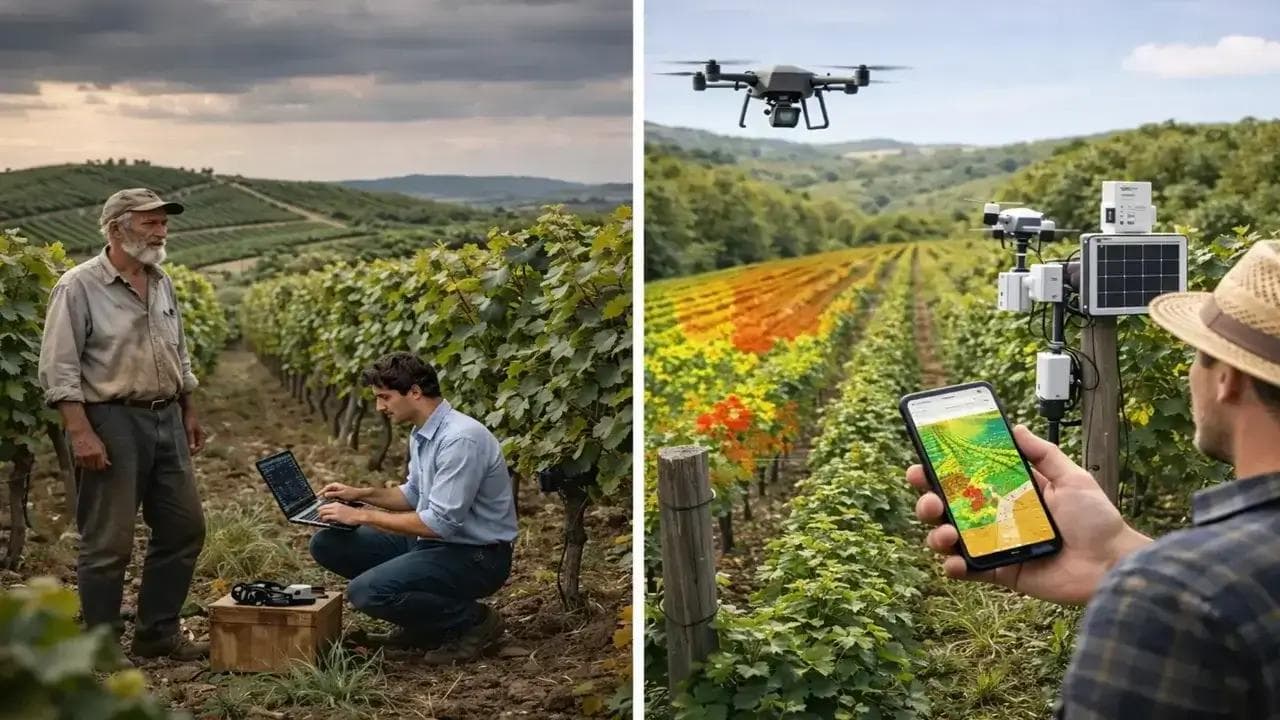
Precision Viticulture vs. Traditional Viticulture
| Factor | Traditional Viticulture | Precision Viticulture |
|---|---|---|
| Decision Making | Experience and intuition | Real-time zone-level data |
| Treatment Application | Uniform across whole vineyard | Variable per individual zone |
| Monitoring | Manual walkthroughs | Remote sensor alerts |
| Irrigation | Fixed calendar schedule | Soil-moisture triggered per zone |
| Disease Detection | Visual scouting | AI-powered early prediction |
| Labour Dependency | High | Significantly more efficient |
| Sustainability | Limited visibility over inputs | Measurable reduction in inputs |
| Data Accumulated | Minimal | Compounds in value every season |
Who Should Be Using Precision Viticulture?
Precision viticulture is not only for large estate wineries with deep technology budgets. The tools have become more accessible, more affordable, and easier to deploy than at any point in the history of the practice.
- Large estate wineries managing multiple blocks or properties across different regions gain the ability to monitor and manage quality at scale with full visibility across every zone from a single platform.
- Mid-size vineyards facing water restrictions, rising input costs, or recurring disease pressure often achieve the fastest return on investment because precision management directly addresses the decisions that have the greatest commercial impact.
- OEMs building connected equipment for the viticulture market, harvesting machines, smart irrigation systems, and spray rigs are increasingly integrating sensors and connectivity into their products to deliver real-time field data as a core feature of their offering.
- Agri-tech companies developing vineyard management platforms need reliable, scalable IoT infrastructure to connect field devices, process data in real time, and deliver clear decision support to the end user.
- Cooperative farming groups can adopt shared precision viticulture infrastructure to standardize grape quality and reduce individual member costs across a collective operation.
Your vineyard is generating data every single day. Make sure something is built to use it.
Promeraki takes OEMs and agri-tech companies from concept to fully deployed IoT platform, turning live vineyard data into smarter decisions at every level.
Conclusion
Precision viticulture is not a future trend. It is happening now in vineyards across Australia, California, Spain, South Africa, and every major wine region in the world.
The vineyards adopting it are producing better grapes, building more efficient operations, and creating a data foundation that grows more valuable with every season.
For OEMs and agri-tech companies, the opportunity is clear. The demand for connected vineyard technology is growing. The infrastructure to support sensors, platforms, data pipelines, and decision support systems needs to be built well, built reliably, and built to scale.
Promeraki builds that infrastructure. From IoT sensor integration and firmware development to cloud platforms and real-time dashboards, we engineer the complete digital backbone your precision viticulture solution needs.