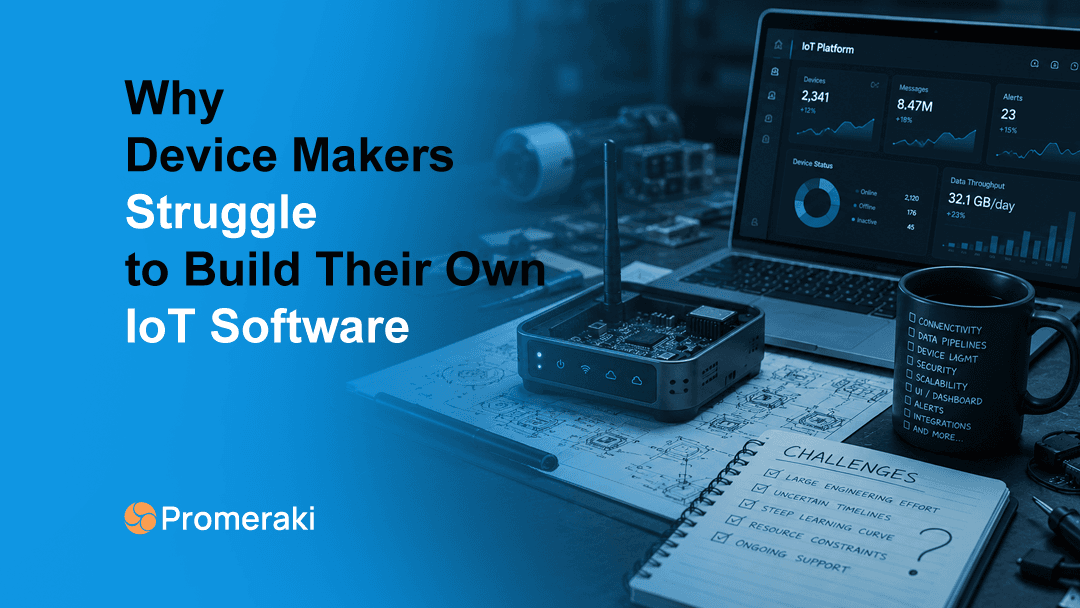
You know how to build a great device.
The hardware works. The sensors are accurate. The battery lasts. The product is ready for customers.
Then the questions start.
“Can I monitor it from my phone?”
“Will it alert me when something goes wrong?”
“Can I change the settings remotely?”
Suddenly, you are no longer building only a physical product. You are building a connected product, and the software behind it becomes almost as important as the device itself.
The opportunity is growing fast. For device manufacturers, this creates a clear opportunity. It also creates a challenge.
Building reliable hardware and building reliable IoT software require different skills, teams, infrastructure, and ways of thinking.
That is where many device makers struggle.
A Connected Device Is Really Two Products
Most teams start by thinking about the device.
What will it do? How will it look? Which sensors will it use? How long will the battery last?
But once connectivity enters the picture, you are building two products at the same time.
The first is the physical device your customer buys.
The second is the software system that keeps the device connected, collects its data, manages it remotely, and gives users something useful to do with that data.
The hardware might leave the factory once.
The software needs to keep working for every device you have sold, every hour of every day.
That changes the engineering challenge completely.
IoT Software Is Much Bigger Than an App
When people hear IoT software, they often think of a mobile app or dashboard.
The app is only the visible part.
Behind it sits an entire system.
| Layer | What it does | What makes it difficult |
|---|---|---|
| Device firmware | Controls device behaviour and communication | Limited resources, hardware dependencies, and firmware variations |
| Connectivity | Moves data between devices and the cloud | Networks drop, reconnect, slow down, and behave differently in the field |
| Cloud backend | Receives, processes, and stores device data | Must stay reliable as traffic and device fleets grow |
| Data processing | Turns telemetry into useful information | Large volumes of data often arrive continuously |
| Web and mobile apps | Give customers and operators access to the product | Must hide technical complexity behind a simple experience |
| Device management | Provisions, monitors, configures, and updates devices | Devices are remote and often run different firmware versions |
| Security | Protects devices, users, APIs, and data | Security has to work across the entire system |
| Monitoring and operations | Helps teams find and resolve problems | Failures often happen remotely and outside business hours |
Every layer affects the customer experience.
A well-designed device paired with an unreliable app still feels like an unreliable product.
Why Device Makers Struggle With IoT Software
Hardware talent isn't software talent
Brilliant electrical and mechanical engineers rarely double as cloud architects or app developers. The two fields think in different languages. Hiring the right mix is slow and expensive, and top software people usually choose software-first companies. So, teams stretch the engineers they have, and the software shows the strain.
The cloud never sleeps
A device ships once. Its software runs forever. Someone has to keep servers online, patch bugs, and absorb traffic spikes at 2 a.m. when your product sells in another time zone. That's a round-the-clock operations job most hardware teams simply aren't built to run.
Security is a moving target
Every connected device is a door into someone's home, car, or network, and attackers know it. Threats keep rising, yet only about 10% of organizations have a fully mature IoT security strategy in place. Weak security doesn't just risk a hack. It risks recalls, lawsuits, bad press, and the trust you spent years earning.
What works for 10 devices breaks at 10,000
A demo with a few units on the office desk feels great. Then real users show up. Data floods in, servers strain, and the setup looks ready to buckle. This is where projects quietly die. Cisco found 60% of IoT efforts o stall at the proof-of-concept stage and never scale. A pilot proves the idea. It doesn't prove the system can carry a crowd.
It costs more and takes longer than planned
Budgets assume a straight line. IoT software is full of turns of new hardware revisions, odd edge cases, and painful integrations with older systems. Each surprise adds weeks. Timelines slip, costs climb, and the "quick app" quietly becomes the priciest part of the whole product.
The work never really ends
Launch is the starting line, not the finish. Phones update and break your app. Security patches ship. Users ask for more. As a rule of thumb, keeping IoT software healthy adds another 15–20% of the build cost every year. Skip a plan for over-the-air (OTA) updates, and the product ages fast and starts to feel abandoned even when the hardware is perfect.
The Hidden Costs of Building IoT Software In-House
Most budgets focus on getting version one to market.
The higher cost often comes from everything needed to keep it running.
Common costs include:
- Cloud infrastructure that grows with your device fleet
- Engineers responsible for platform monitoring and incidents
- Security reviews, patches, and ongoing improvements
- Web and mobile updates as operating systems and browsers change
- Monitoring, logging, and troubleshooting infrastructure
- Device provisioning and fleet management tools
- OTA update infrastructure and firmware rollout management
- QA across different devices, firmware versions, and network conditions
- Customer support tools for remote diagnosis
- Rework when early architecture does not support production scale
Building internally still makes sense for some companies.
But the decision should be based on the full lifecycle of the platform, not only the cost of developing the first release.
Build, Buy, or Partner?
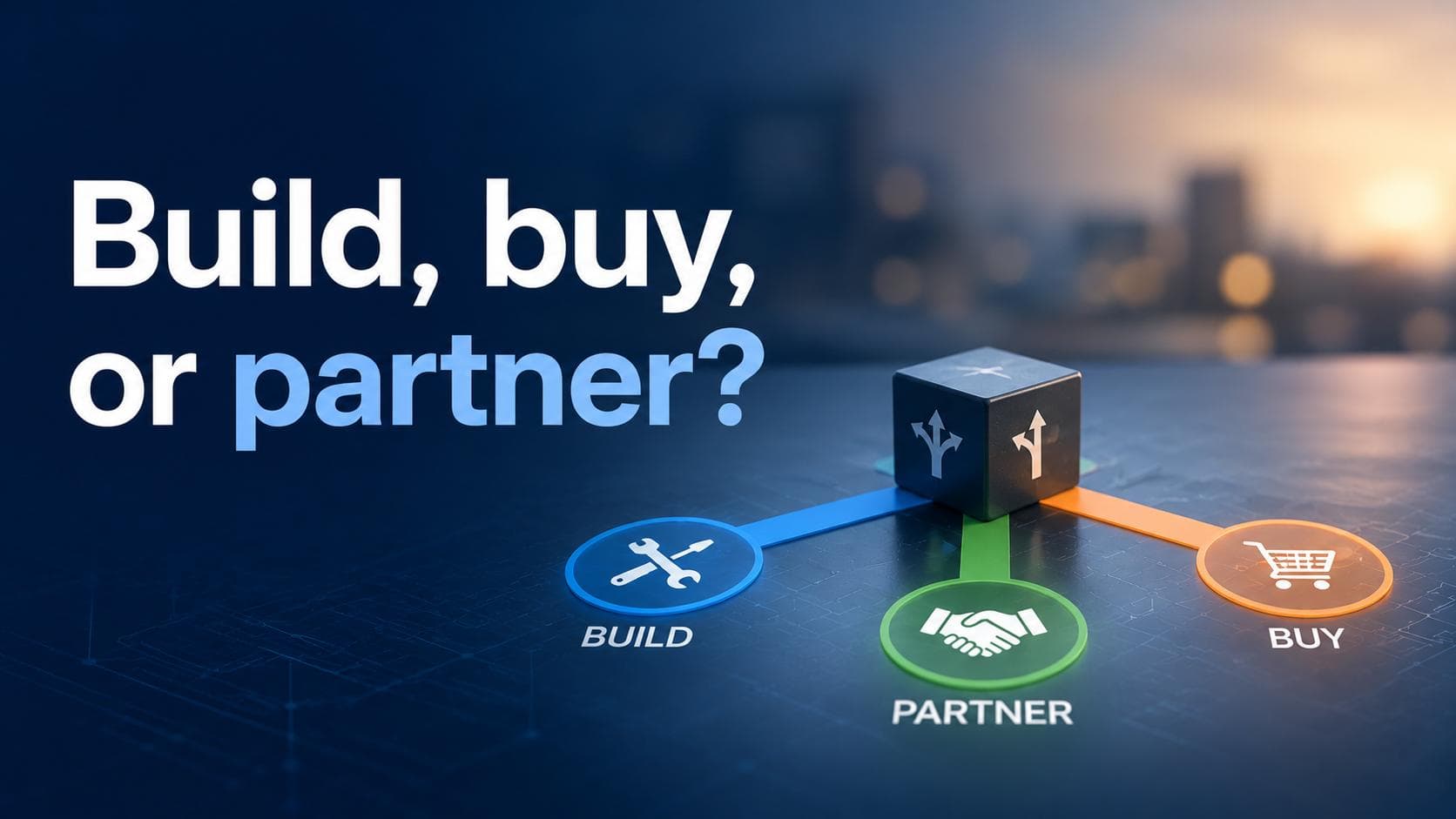
There is no single answer for every connected product.
The right model depends on your product, team, roadmap, and how much control you need.
| Approach | Best when | What to consider |
|---|---|---|
| Build in-house | Software is a core capability and you already have the required team | Hiring, development time, operations, and long-term ownership |
| Buy an IoT platform | Your requirements are standard and speed is the main priority | Platform limitations, recurring fees, customization, and vendor dependency |
| Work with an IoT engineering partner | You need a custom platform without building the full team internally | Technical depth, platform ownership, long-term support, and knowledge transfer |
For many device manufacturers, the third option offers a practical middle ground.
You retain control of your product, customer experience, data, and intellectual property while working with specialists on the software layers your internal team does not handle every day.
Conclusion
Building a connected device takes more than strong hardware.
The software behind it needs to manage connectivity, data, security, updates, users, and devices at scale.
For many device makers, the question is not whether they should build IoT software. It is how much they should build themselves.
A clear strategy, scalable architecture, and the right engineering support help you launch with fewer technical problems and reduce expensive rework later.
The strongest connected products treat hardware and software as one system from the beginning.
Planning a Connected Product?
If your hardware is ready but the software platform is slowing down your roadmap, Promeraki helps OEMs and device manufacturers build reliable IoT platforms around their products.
From firmware-to-cloud integration and device connectivity to telemetry, automation, OTA updates, fleet management, and customer applications, we help build the software foundation behind connected products.
Talk to our IoT development team about your product and platform requirements.