Introduction
Most businesses pick a proprietary IoT platform early. It feels like a safe choice at the time. Then the device fleet grows, the monthly bill grows faster, and switching platforms means rebuilding integrations from the ground up.
That is the vendor lock-in trap. It costs more than money. It limits flexibility, removes data ownership, and puts your product roadmap in someone else's hands.
Open-source IoT platforms solve this at the root. You host the software on your own infrastructure. You own your data. You pay for servers, not per-device licensing fees. And if your requirements change, you modify the source code to match them.
This guide covers the best open-source IoT platforms in 2026. You will learn what each platform does, who it suits, and what to watch out for before committing. Whether you are an OEM manufacturer, an industrial engineer, or a developer comparing options, this guide is built for decisions, not browsing.
What is an Open-Source IoT Platform?
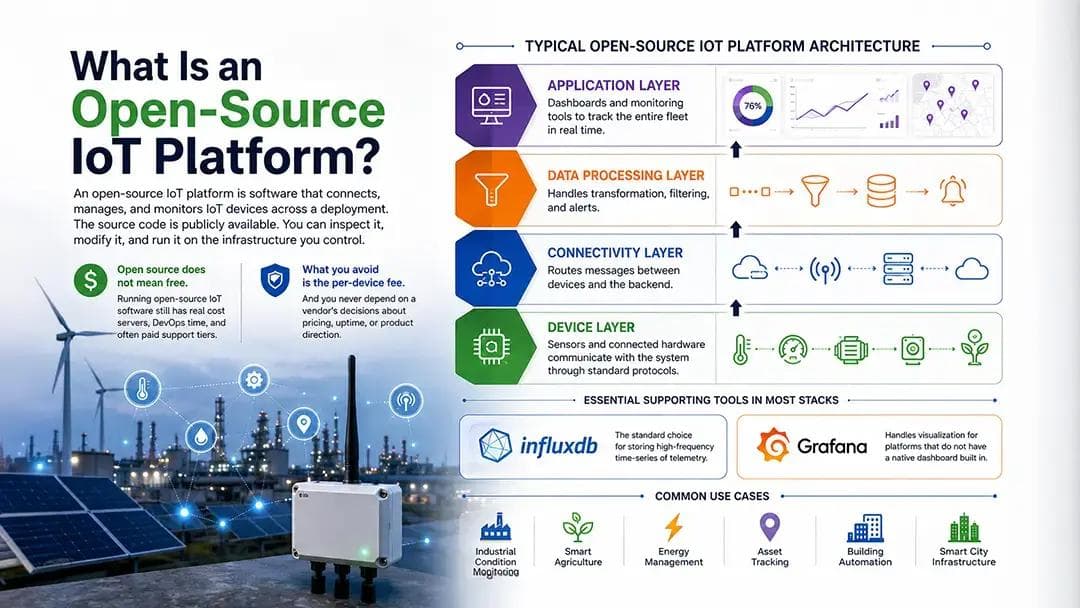
An open-source IoT platform is software that connects, manages, and monitors IoT devices across a deployment. The source code is publicly available. You can inspect it, modify it, and run it on the infrastructure you control.
Open source does not mean free. Running open-source IoT software still has real cost servers, DevOps time, and often paid support tiers. What you avoid is the per-device fee. And you never depend on a vendor's decisions about pricing, uptime, or product direction.
A typical open-source platform for IoT follows a layered architecture. The device layer is where sensors and connected hardware communicate with the system through standard protocols. The connectivity layer routes messages between devices and the backend. The data processing layer handles transformation, filtering, and alerts. The application layer gives teams dashboards and monitoring tools to track the entire fleet in real time.
Most production stacks also rely on supporting tools. InfluxDB is the standard choice for storing high-frequency time-series of telemetry. Grafana handles visualization for platforms that do not have a native dashboard built in. Both appear in nearly every serious open-source IoT deployment today.
Common use cases include industrial condition monitoring, smart agriculture, energy management, asset tracking, building automation, and smart city infrastructure.
Why Businesses Choose Open-Source IoT Platforms?
The move toward open-source IoT is not purely a cost decision. There are five solid reasons businesses make this shift.
Lower Long-Term Costs
Proprietary platforms charge per device, per message, or per feature tier. Those fees compound quickly at scale. An open-source IoT platform costs only what your infrastructure costs. For OEMs shipping thousands of connected units, the difference over three to five years is significant.
No Vendor Lock-In
With an open-source, you can migrate, fork, or self-host without asking anyone for permission. If a vendor raises prices, discontinues a feature, or shuts down a product line, your deployment stays intact.
Full Customization
Source code access means you can build proprietary features on a tested foundation. No IoT platform open-source alternative is as flexible as one where you own the codebase. Proprietary platforms simply cannot offer that level of control.
Greater Data Ownership
Your operational data stays on the infrastructure you control. For regulated industries like manufacturing, healthcare, and energy, this is a compliance requirement, not just a preference. No third-party vendor holds access to your device's telemetry.
Faster Innovation
Active open-source communities ship protocol extensions, integrations, and bug fixes faster than most vendor roadmaps. You can also contribute upstream, which means problems get fixed on your timeline rather than a vendor support queue.
Key Features to Look for in an Open-Source IoT Platform
Not every platform fits every situation. These are the features that matter most when evaluating your options.
IoT Device Management
At scale, manual provisioning is not workable. Strong IoT device management covers automated registration, remote monitoring, firmware state tracking, and group-level control. Eclipse Leshan handles LwM2M-based device management natively. Eclipse Hawkbit manages OTA firmware updates across large fleets. Both integrate cleanly into broader platform stacks without significant custom work.
Data Collection and Storage
IoT generates continuous, high-volume time-series data. Your platform must handle this without performance degradation. InfluxDB is the most widely deployed open-source time-series database in IoT production stacks today and pairs with most platforms on this list.
IoT Dashboard Software
Operations teams need real-time visibility. Good IoT dashboard software includes live widgets, trend charts, threshold alerts, and role-based access without requiring custom development for standard monitoring scenarios. Platforms without native dashboards typically pair with Grafana, which handles visualization cleanly across most data sources.
Rules Engine
A strong rules engine lets teams automate responses to device events without writing code for every scenario. Threshold alerts, conditional triggers, and multi-device actions should all be configurable through a clear interface.
Security and Authentication
TLS/SSL for data in transit, OAuth2 or certificate-based device authentication, and role-based access control are the minimum baseline for production IoT deployments. These should come standard, not require significant custom security setup.
Protocol Support
Your platform should support MQTT, HTTP, CoAP, OPC UA, and Modbus as a minimum. For LoRaWAN and LPWAN networks common in agriculture and smart cities, ChirpStack provides dedicated network server infrastructure that routes telemetry cleanly into the main platform layer.
Edge Computing Support
Edge capability means devices process data locally, operate offline, and respond without waiting for a cloud connection. FreeRTOS and Zephyr RTOS are the two leading open-source operating systems for microcontrollers and edge hardware that power this capability at the firmware level.
Before You Scroll
- Comparing nine open-source IoT platforms in 2026. ThingsBoard for enterprises. EdgeX for industrial. EMQX for MQTT scale. No per-device fees. No vendor dependency.
Best Open-Source IoT Platforms in 2026
1. ThingsBoard
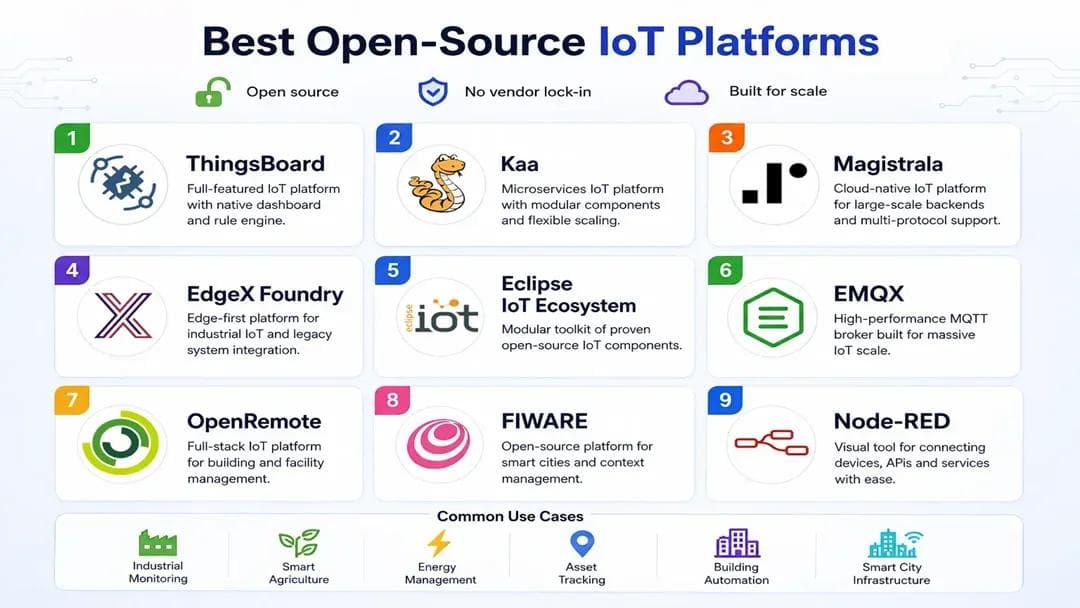
ThingsBoard is the most fully featured open-source IoT platform available today. It ships with a native dashboard, a visual rule chain editor, multi-tenant architecture, and support for MQTT, HTTP, CoAP, and LwM2M. The Community Edition is free under Apache 2.0. The Professional Edition adds white-labeling and dedicated support, making it the top pick for OEMs building branded connected products on a proven foundation.
Best for: OEM manufacturers and enterprise IoT teams
Pros: Rich native dashboard, large active community, strong protocol support, white-label option
Cons: Rule engine has a steep learning curve; Professional Edition pricing is not publicly listed
2. Kaa IoT Platform
Kaa runs a microservices architecture where every function operates as a separate service. Telemetry ingestion, device management, configuration, and analytics all run independently. Teams deploy only the components they need and scale each part without affecting the rest of the system.
Best for: Enterprises with custom data pipeline requirements and modular deployment preferences
Pros: Highly modular design, clean API coverage, flexible per-component scaling
Cons: Smaller community than ThingsBoard; more integration effort upfront for all-in-one teams
3. Magistrala (formerly Mainflux)
Worth clarifying before you read any comparison article: Mainflux rebranded to Magistrala in 2023. Most articles still use the old name. They are the same project, and magistrala.dev is the active documentation source.
Magistrala is cloud-native and containerized. It treats MQTT, CoAP, and HTTP as equal first-class protocols and runs cleanly on Kubernetes. It suits teams building scalable IoT backends from the ground up rather than those looking for an out-of-the-box operational solution.
Best for: Cloud-native teams building large-scale IoT backends from scratch
Pros: True cloud-native architecture, strong multi-protocol support, active development
Cons: No native dashboard; requires external tools for all visualization and reporting
4. EdgeX Foundry
EdgeX Foundry is a Linux Foundation project built specifically for open-source industrial IoT environments. Most platforms bolt on edge support as a feature. EdgeX is designed edge-first from the architecture.
Its device service layer connects natively to Modbus and OPC UA hardware, meaning legacy industrial equipment integrates without custom middleware. It pairs naturally with FreeRTOS or Zephyr RTOS at the device firmware level and Grafana for operational dashboards.
Best for: Industrial IoT platforms, brownfield deployments, and edge-heavy architectures
Pros: Best industrial protocol support in open source, strong Linux Foundation backing, edge-first design
Cons: No native dashboard; complex initial setup; requires solid DevOps experience to run
5. Eclipse IoT Ecosystem
Eclipse IoT is not a single platform. It is a working group of mature, independently deployable components that teams combine to build a custom stack. Think of it as a toolkit rather than a packaged product.
Eclipse Mosquitto provides lightweight MQTT brokering for embedded and edge hardware. Eclipse Ditto handles digital twin modeling and bidirectional device state synchronization. Eclipse Kura runs as an edge gateway connecting field devices to cloud services. Eclipse Leshan delivers LwM2M-based device management. Eclipse Hawkbit manages OTA firmware updates across large device fleets.
Best for: Teams who want best-of-breed open-source components and have the integration skills to wire them together
Pros: Every component is independently battle-tested; Apache and Eclipse licensing; no single vendor dependency anywhere in the stack
Cons: No unified interface or single deployment guide; integration planning is significant and should not be underestimated
6. EMQX
EMQX is an enterprise-grade MQTT broker built for high-scale deployments. It handles millions of concurrent device connections and includes a built-in rule engine for routing telemetry to databases, Kafka, or external APIs without additional middleware layers.
The distinction from Eclipse Mosquitto matters here. Mosquitto is lightweight and designed for embedded and resource-constrained environments. EMQX is built for infrastructure where connection volume is the primary challenge. They solve different problems and work best when used together rather than interchangeably.
Best for: High-volume MQTT infrastructure where broker throughput is the performance bottleneck
Pros: Exceptional connection throughput, clustering support, built-in rule engine for routing
Cons: Open-source version has notable gaps compared to the enterprise edition; not a complete IoT platform on its own
7. OpenRemote
OpenRemote is a full-stack open-source IoT platform with a strong native interface focused on built environment use cases. Asset management, automation rules, user management, and multi-tenant support all ship in one deployable package without requiring external tools for standard operations.
Best for: Smart building management, energy monitoring, and facility operations teams
Pros: Native dashboard, built-in asset management, stronger UI than most open-source alternatives
Cons: Smaller community than ThingsBoard; fewer third-party integrations available
8. FIWARE
FIWARE is an EU-backed open-source IoT platform built around the NGSI-LD standard for context data exchange. As an IoT cloud platform for public infrastructure, it dominates European smart cities and government deployments. It handles geospatial data and real-time context management particularly well. Grafana integrates cleanly with its Orion Context Broker where native visualization is needed.
Best for: Smart cities, public sector IoT projects, and EU regulatory environments
Pros: NGSI-LD standard alignment, strong EU ecosystem, proven at government deployment scale
Cons: Steep learning curve; NGSI-LD is unfamiliar to most MQTT-background teams; documentation quality varies across components
9. Node-RED
Node-RED is not a full IoT platform and framing it as one would mislead anyone evaluating production options. It is a flow-based programming tool on Node.js that connects devices, APIs, and services through a visual browser-based interface without requiring code for most tasks.
In production deployments, it typically sits between a device or broker layer and a backend platform, handling transformation and routing logic. It earns its place on this list because it is genuinely useful in real IoT work, especially at the prototyping and edge logic stage.
Best for: Rapid prototyping, edge data transformation, and concept validation before platform commitment
Pros: Visual development environment, large library of ready-made nodes, fast to configure, runs on edge hardware
Cons: Needs a separate data store, broker, and dashboard layer for any serious production deployment
Open-Source IoT Platforms Comparison Table
| Platform | Device Mgmt | Dashboard | Edge Support | Protocols | Best For | License |
|---|---|---|---|---|---|---|
| ThingsBoard | Full | Native | Partial | MQTT, HTTP, CoAP | OEM, Enterprise | Apache 2.0 |
| Kaa IoT | Full | Native | Partial | MQTT, HTTP | Custom workflows | Apache 2.0 |
| Magistrala | Full | External | Partial | MQTT, CoAP, HTTP | Cloud-native IoT | Apache 2.0 |
| EdgeX Foundry | Full | External | Full | MQTT, OPC UA, Modbus | Industrial Edge | Apache 2.0 |
| Eclipse IoT | Partial | External | Full | MQTT, LwM2M | Custom stacks | Eclipse/Apache |
| EMQX | Limited | Basic | Partial | MQTT, WebSocket | High-scale MQTT | Apache 2.0 |
| OpenRemote | Full | Native | Partial | MQTT, HTTP | Smart buildings | AGPL 3.0 |
| FIWARE | Partial | External | Partial | NGSI-LD, HTTP | Smart cities | Apache/AGPL |
| Node-RED | None | None | Edge logic | Any via nodes | Prototyping | Apache 2.0 |
Open-Source vs Proprietary IoT Platforms
| Factor | Open Source | Proprietary |
|---|---|---|
| Examples | ThingsBoard, EdgeX, Magistrala | AWS IoT Core, Azure IoT Hub, Particle, Losant |
| Cost | Infrastructure only | Per-device or subscription |
| Customization | Full source access | API-limited |
| Vendor lock-in | None | High |
| Data control | Fully yours | Vendor-controlled |
| Support | Community or paid tier | Vendor SLA |
Proprietary IoT cloud platforms like AWS IoT Core and Azure IoT Hub remove operational complexity. That is a genuine advantage for small teams or tight delivery timelines. But per-device costs compound as your fleet scales. And your data never fully belongs to you.
Choose open source when you have DevOps capacity; a growing device fleet, data ownership requirements, or long-term cost predictability is a priority.
Choose proprietary when your team is small, you need managed infrastructure with no internal ops burden, or your timeline cannot absorb self-hosted setup complexity.
Which Open-Source IoT Platform Should You Choose?
The right open-source IoT software matches your deployment context, not whichever platform has the longest features list.
- OEM Manufacturers → ThingsBoard. White-labeling and multi-tenant architecture built for products shipped under your own brand at scale.
- Industrial IoT / Brownfield → EdgeX Foundry. Native Modbus and OPC UA support handle legacy environments where other platforms need heavy custom work.
- Smart Cities / Public Sector → FIWARE. NGSI-LD alignment makes it the open standard for public infrastructure projects, particularly across Europe.
- High-Volume MQTT Infrastructure → EMQX. When broker-level throughput is the bottleneck, nothing on this list competes at the same level.
- Rapid Prototyping → Node-RED. Best for validating a concept before committing to a full production platform investment.
- Cloud-Native Backends → Magistrala. Kubernetes-first microservices architecture for teams building scalable IoT backends.
- Smart Buildings and Energy → OpenRemote. Full stack with a native UI purpose built for facility and energy management teams.
- Custom Component Stacks → Eclipse IoT Ecosystem. Best-of-breed tools for teams with strong integration capability who want no vendor dependency at any layer.
Conclusion
Open-source IoT platforms have moved well past the "cost-cutting alternative" stage. In 2026, they are the first choice for OEMs, industrial teams, and developers who want full control over their data, their stack, and their long-term costs.
The right platform depends on your context. ThingsBoard for OEMs and enterprise teams. EdgeX Foundry for industrial environments. FIWARE for smart cities. EMQX for high-volume MQTT infrastructure. Start with the comparison table in this guide, shortlist two or three options, and run a small proof of concept before committing.
With open source, that decision stays yours, and so does everything built on top of it.
Need help shortlisting the right platform?
We analyze your requirements and recommend the best open-source IoT stack for your use case.