Your connected devices are collecting data around the clock. But are they actually doing anything intelligent with it?
That is the exact gap AIoT fills, and it is changing how industries operate at a fundamental level.
Most IoT deployments today generate massive amounts of sensor data, then ship all of it to the cloud to figure out what to do next. AIoT changes that entirely. It puts intelligence directly into the system at the edge, in real time, without waiting for a cloud round-trip.
This guide covers everything: what AIoT is, how it works, where it is being used today, what makes it hard, and where it is heading next.
What Is AIoT?
AIoT (Artificial Intelligence of Things) is the convergence of AI and IoT into a single intelligent system.
Here is the one-line origin: the term emerged around 2017 when edge computing matured enough to run machine learning models outside the cloud for the first time. Before that, IoT and AI existed as separate disciplines. Edge hardware brought them together.
IoT gives machines the ability to sense and communicate. AI gives them the ability to learn and decide. Combine the two, and you stop getting raw data streams; you start getting autonomous, self-improving systems that act on information without human intervention.
Simple version: IoT = connected. AIoT = connected and intelligent.
Today, AI in the Internet of Things is already inside industrial sensors, smart cameras, medical wearables, agricultural monitoring platforms, and smart city infrastructure. It is not a future concept. It is running in production right now.
New to AIoT? Read This First.
- AIoT puts artificial intelligence directly inside IoT systems, so devices stop waiting for cloud instructions and start making decisions independently.
AIoT vs Traditional IoT: What Actually Changes
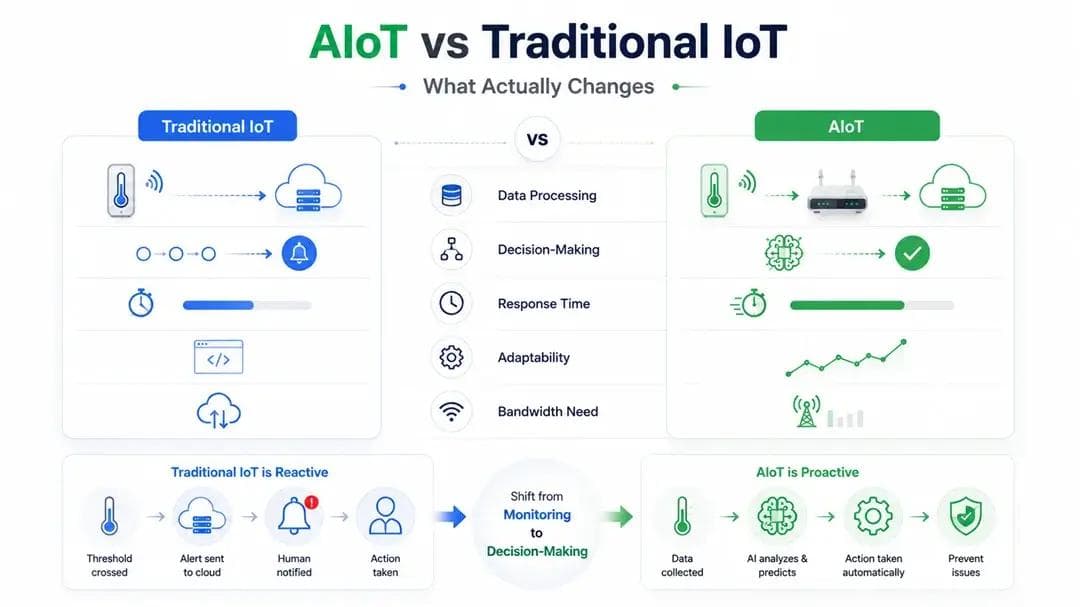
This is where most people get confused. Here is the clearest way to see the difference:
| Traditional IoT | AIoT | |
|---|---|---|
| Data processing | Cloud-dependent | Edge + Cloud |
| Decision-making | Rule-based triggers | ML-driven predictions |
| Response time | Seconds to minutes | Milliseconds |
| Adaptability | Fixed logic | Learns over time |
| Bandwidth need | High | Low processes locally |
Traditional IoT is reactive. A temperature sensor crosses a threshold and sends an alert. That is the full extent of its intelligence.
AIoT is proactive. The system learns your equipment's normal operating patterns, detects subtle deviation before failure occurs, and takes corrective action without waiting for a human to notice something on a dashboard.
The difference is not just technical. It is a shift from monitoring to decision-making.
How AI and IoT Work Together
Think of AIoT as a three-layer system working in continuous sync.
Layer 1: Perception (The Sensors)
Physical data enters the system here. Temperature, pressure, vibration, visual feeds, and humidity sensors are collected continuously. Modern AIoT sensors are meaningfully smarter than their IoT predecessors. Many now carry onboard microprocessors capable of running basic inference before any data is transmitted.
Layer 2: Network and Connectivity
Data moves across communication protocols, such as MQTT, Zigbee, 5G, LoRaWAN to either an edge node or a cloud platform. AIoT systems are deliberately bandwidth efficient. Not everything needs to travel. Only what matters does.
Layer 3: Intelligence (The AI)
This is where IoT and AI genuinely merge. Machine learning models deployed at the edge or in the cloud process data, recognize patterns, generate predictions, and trigger automated responses. The model does not just report what happened. It determines what should happen next.
The intelligence layer is what separates AIoT from plain IoT. And increasingly, that intelligence is moving closer to the device itself, which is why edge AI has become the dominant architecture pattern in serious AIoT deployments.
Core Components of an AIoT System
No single tool or product makes an AIoT system. Here is what a production-grade AIoT stack typically requires:
Smart Sensors
Sensors with embedded processors capable of pre-processing data locally before transmission
Edge Computing Nodes
Local hardware such as gateways, microcontrollers, or edge servers where AI inference runs without cloud roundtrips
Optimized ML Models
Compressed, efficient models built with TensorFlow Lite or ONNX, designed specifically to run on low-power hardware
Connectivity Layer
Protocols that handle data routing based on the specific use case: MQTT for lightweight messaging, 5G for high throughput, and LoRaWAN for long-range low-power environments
Cloud Integration
For model retraining, historical analytics, and enterprise-level dashboards
AIoT Platform
The orchestration layer managing devices, data pipelines, model deployment, and system-wide monitoring at scale
Each component carries its own failure risk. A weak connectivity layer neutralizes even the most sophisticated edge model. A poorly managed cloud pipeline converts real-time data into a growing backlog. AIoT performs at the level of its least optimized component.
Real-World AIoT Applications Across Industries
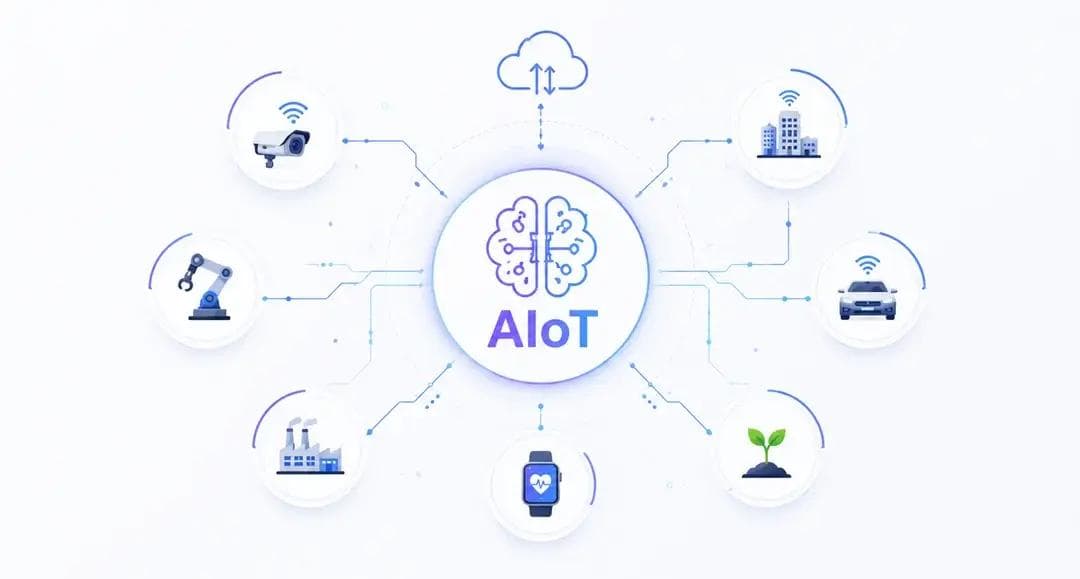
AIoT is not theoretical. It is already running in production across sectors that cannot afford to make decisions wrong.
Manufacturing: Predictive Maintenance
Vibration and acoustic sensors mounted on motors learn the normal operating signature of each machine. When deviation appears, even subtle shifts are imperceptible to human operators as the system flags it before a breakdown happens. Downtime drops. Maintenance becomes planned, not reactive. One unplanned production stoppage avoided can return the cost of an entire AIoT deployment.
Agriculture: Precision Farming
Soil moisture sensors, drone imagery, and weather data feeds combine machine learning to generate crop-specific irrigation and fertilization recommendations. Artificial intelligence of things in agriculture is not about robots in fields; it is about making every liter of water and every gram of input count precisely where it matters.
Healthcare: Wearable Intelligence
ECG monitors and continuous glucose sensors with onboard AI detect arrhythmias or dangerous glucose trends in real time without transmitting every heartbeat to a hospital server. Clinicians receive alerts only when data warrants genuine attention. For remote patient monitoring, this architecture is transformative.
Smart Cities: Traffic and Energy Management
AIoT traffic systems do not simply count vehicles. They predict congestion 15 minutes ahead and adjust signal timing dynamically across intersections. Energy grids use AI-driven sensors to balance load distribution across districts in real time, reducing waste without human intervention.
Retail: Shelf and Footfall Intelligence
Computer vision at shelf level detects out-of-stock conditions at the moment they occur. Footfall sensors combined with purchase data help retailers optimize store layouts based on actual behavioral patterns.
The common thread across every one of these: decisions happen at the speed of data, not at the speed of human review.
Still Scrolling? Here Is What Matters Most.
- AIoT is not an upgrade to IoT; it is a completely different system where devices sense, learn, and act without waiting for human review.
Key Benefits of AIoT for Businesses
When IoT artificial intelligence is deployed well, the operational and commercial case becomes difficult to argue against.
Real-Time Decision Making
Eliminating the cloud round-trip means decisions happen in milliseconds. In manufacturing, that speed difference means catching a defect before thousands more follow it down the line.
Lower Operational Costs
Predictive maintenance alone typically reduces unplanned equipment downtime by 30-50%. Across a large device fleet, saving compounds quickly leads to significant cost reduction.
Scalability Without Proportional Cost Growth
Once your AIoT architecture is established, adding hundreds more devices does not mean proportionally higher cloud processing costs. Edge intelligence scales efficiently by design.
Continuous Improvement Over Time
Unlike fixed rule-based IoT, AIoT models are retrained as new data arrives. The system does not stay static; it gets demonstrably smarter with operational time.
Reduced Bandwidth Dependency
Processing locally means you are transmitting insights rather than raw sensor streams. This matters enormously in remote deployments with limited or expensive connectivity infrastructure.
Challenges and Limitations You Should Know
Anyone presenting AIoT as straightforward to deploy is leaving out the difficult parts.
- Interoperability takes real engineering effort. Devices from different manufacturers rarely share protocols with native manufacturers. Building a unified AIoT system across mixed hardware requires deliberate integration of work; it does not happen automatically by connecting devices to the same platform.
- Edge hardware has genuine constraints. Computing, memory, and power budgets on edge devices are limited. Not every ML model can be compressed sufficiently to run on a microcontroller without meaningful accuracy loss. Model optimization for edge deployment is a specialized skill.
- Data quality problems amplify at scale. AI models are only as reliable as the data they are trained on. Noisy, inconsistent, or poorly labeled sensor data does not simply reduce accuracy; it produces confident wrong answers. Garbage in, confident garbage out.
- The skills gap is significant and real. A production of AIoT deployment requires expertise across embedded systems, ML engineering, cloud architecture, and domain knowledge simultaneously. Most teams are strong in one or two of these areas, not all four.
- Deployment is not a one-time event. Models drift as environments change. AIoT requires ongoing monitoring, retraining pipelines, and version control for models, not just for devices. Teams that treat deployment as the finish line tend to have failing systems within 12 months.
AIoT Security and Privacy: The Overlooked Risk
Most AIoT conversations focus on capability. The most important conversation is about vulnerability.
Every new device added to a network is a new attack surface.
A single compromised edge node in an industrial AIoT deployment can expose the entire operational layer. IoT devices have historically shipped with weak default credentials, infrequent firmware updates, and limited encryption in a combination that becomes significantly more dangerous when AI-driven automation is making real operational decisions.
There is also a less-discussed threat specific to AI systems: adversarial attacks.
These are inputs deliberately crafted to mislead an ML model. A manipulated visual feed in a security camera AIoT system could cause the model to simply stop detecting certain objects entirely without triggering any obvious system error.
Security practices that cannot be treated as optional in artificial intelligence and IoT systems:
- End-to-end encryption across the full device-to-cloud pipeline
- Secure boot and firmware signing on all edge devices
- Role-based access control enforced at every system layer
- Regular model integrity checks alongside standard network security monitoring
- Privacy-by-design data handling, particularly in healthcare and consumer AIoT contexts
Security is not a feature you add after the system is built. It must be designed from the first architecture decision.
The Future of AIoT: TinyML, Federated Learning, Digital Twins
The next generation of AI in the Internet of Things is being built on three converging technologies, all of which are already in active deployment today.
TinyML: Machine learning models are now being compressed and optimized to run on microcontrollers that cost less than five dollars and consume microwatts of power. TinyML makes AIoT viable for device classes that could never previously support on-AI devices.
Federated Learning: Instead of transmitting raw data to a central server, devices train local model updates and share only the parameter changes. The global model improves across thousands of devices without any single device's raw data ever leaving its local environment. For healthcare and industrial AIoT, this is a meaningful breakthrough for both privacy compliance and security posture.
Digital Twins: A digital twin is a real-time virtual replica of a physical asset, updated continuously by live AIoT sensor feeds. Engineers can simulate failure scenarios, test configuration changes, and run predictive models against the twin before making any change to actual equipment. This is where AIoT converges with enterprise-level decision intelligence and where the most sophisticated deployments are heading.
Platforms built on these three foundations will define AIoT's next five years.
Conclusion
AIoT is not IoT with a machine learning model added on top. It is a fundamental rethink of how connected systems process information, make decisions, and improve over time autonomously, at the edge, at operational speed.
The businesses that lead their industries over the next decade will not be the ones with the most sensors. They will be the ones with the most intelligent edge systems that act on data before a human sees a dashboard alert.
Technology is mature. The use cases are proven across manufacturing, agriculture, healthcare, and smart infrastructure. What separates the organizations moving forward from those still evaluating is simply where they choose to start.
If you are building connected product platforms and want to understand where AIoT fits your architecture, Promeraki's IoT Platform Engineering team works with OEM manufacturers to design and deploy production-grade connected intelligence systems.