Introduction
You walk through your vineyard in the late summer. The clusters look full. The color is deep. The berries are plump and heavy on the vine.
So, do you pick today?
That question is the most consequential one a grape grower makes all year. Pick too early, and you end up with thin, sharp wine that lacks depth. Wait too long, and the sugars spike, the acid collapses, and everything you worked for over the past twelve months starts to unravel in the heat.
Here's the good news: the grapes themselves tell you when they're ready. You just need to know how to listen.
This guide walks you through the exact science and field-tested methods behind successful grape harvesting from Brix readings to sensory checks to week-by-week monitoring routines. Whether you're harvesting wine grapes on a commercial block or managing a boutique estate, these principles apply.
TLD;R
- Short on Time? Track Brix, berry ripeness, and acid balance, and you'll hit the perfect harvest window for every vintage.
Why Harvest Timing Is Everything in Wine Grape Production
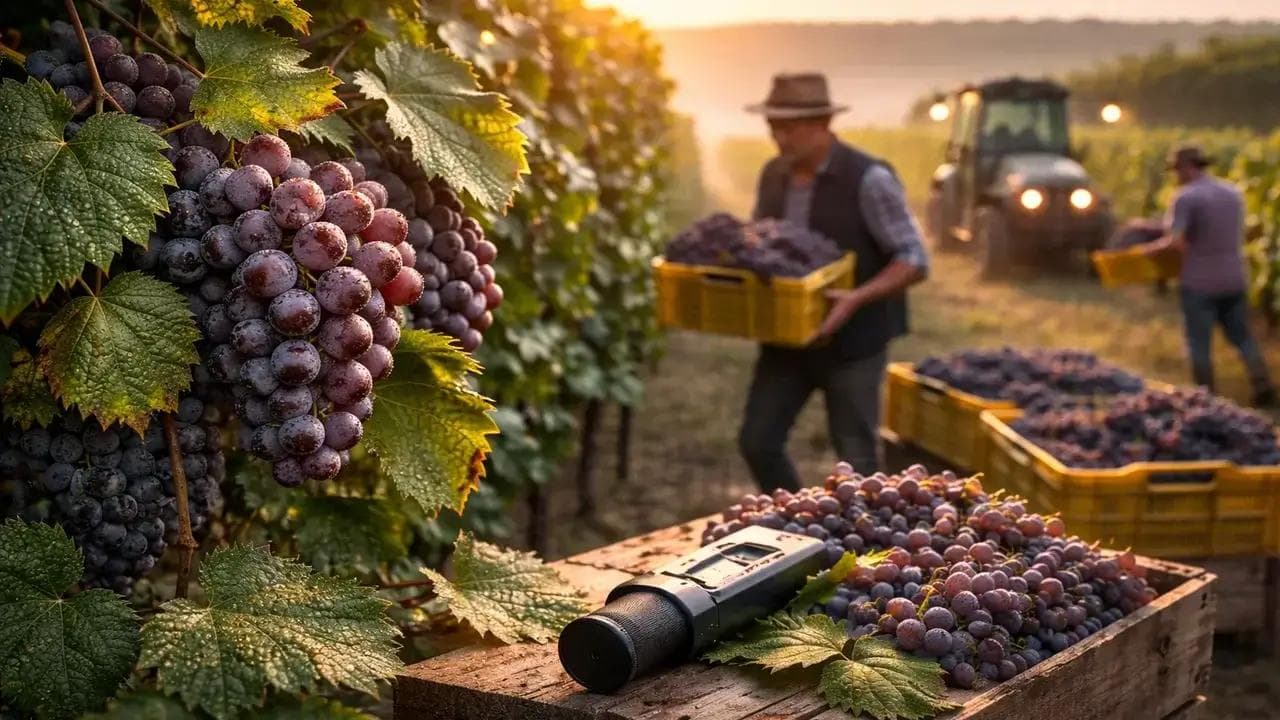
Ask any winemaker and they'll say the same thing: great wine is made in the vineyard, not the cellar. And nowhere is that truer than at harvest time.
According to the Wine Institute, California alone produces over 80% of all US wine, and harvest timing decisions across thousands of growers directly impact the quality of millions of bottles annually. Get the timing wrong and no amount of cellar intervention fully recovers the wine.
Here's what happens at the extremes:
Picking too early gives you grapes with high titratable acidity (TA), low sugar, and green, bitter tannins. The resulting wine is sharp, thin-bodied, and lacks aromatic complexity. Think unripe apple notes instead of rich berries.
Picking too late pushes sugars past the ideal range, collapses natural acidity, and produces flat, jammy wine that loses the varietal character that makes your grape variety worth growing in the first place.
The target window, the precise grape harvest time, is often just 5 to 10 days wide. Research published by UC Davis Viticulture and Enology consistently shows that harvest decisions made even 48 hours too late in hot-climate regions can reduce wine quality scores measurably.
Timing also shifts significantly based on variety. Chardonnay typically ripens 3 to 5 weeks before Cabernet Sauvignon in the same region. Riesling demands retention of natural acidity that would be unacceptable in a Zinfandel. There is no universal calendar, only field data.
The Three Pillars of Harvest Decision-Making
This stage is where real work happens. Experienced growers don't rely on a single measurement. They triangulate across three types of ripeness before they call harvest day.
Pillar 1: Sugar Ripeness (Brix Reading)
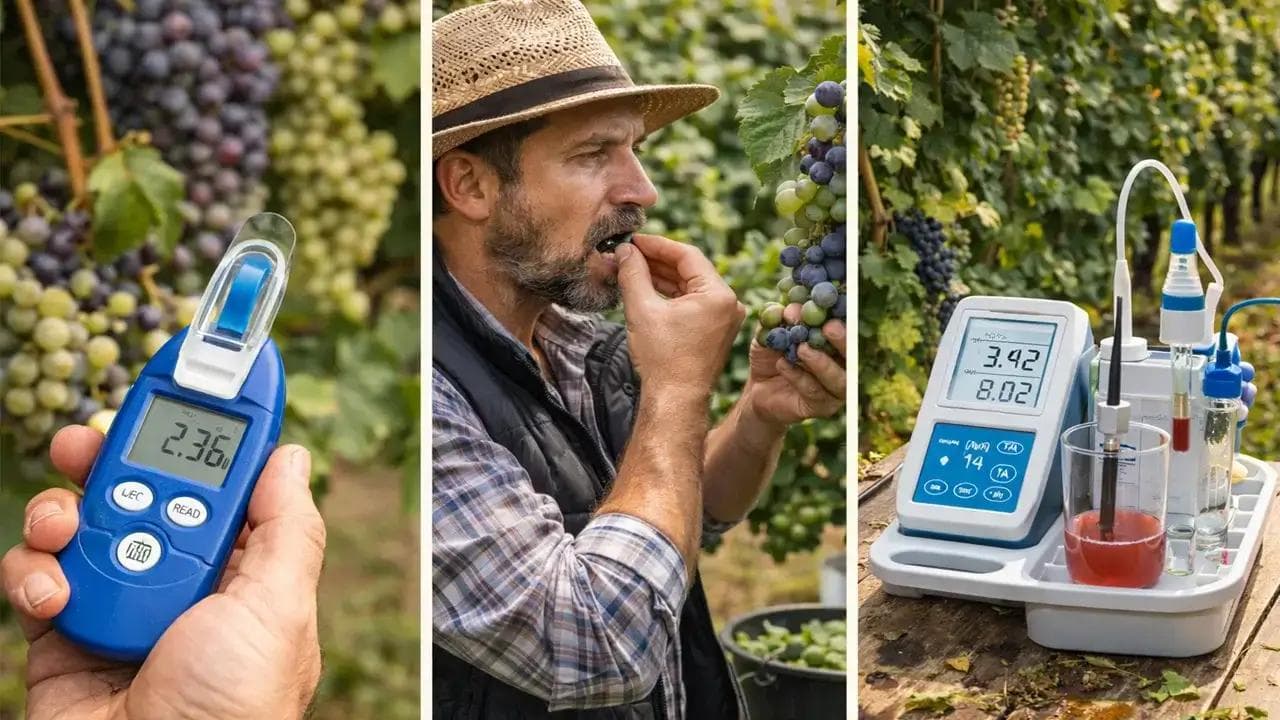
Brix is the percentage of sugar in the grape juice by weight. It's measured with a handheld refractometer, a simple tool that gives you a reading from a single drop of juice within seconds.
The higher the Brix, the more sugar available for fermentation, and the higher the potential alcohol in the finished wine.
General Brix targets by wine style:
| Wine Style | Target Brix at Harvest |
|---|---|
| Sparkling wine | 17° – 20° |
| Light white wines | 20° – 23° |
| Full-bodied whites | 22° – 24° |
| Light reds | 22° – 24° |
| Full-bodied reds | 24° – 26° |
| Dessert / late harvest | 28°+ |
Start taking weekly Brix readings about four to five weeks before your expected harvest date. In the final two weeks, shift to daily readings. A Brix increase of 0.5° to 1° per day in warm weather is normal. When Brix levels plateau or climb rapidly with a weather event, that's your alert to escalate monitoring.
It's crucial to remember that Brix alone doesn't provide a complete picture. A berry can hit 24° Brix and still have green, bitter seeds and astringent skins. That's why you always pair sugar data with the next two pillars.
A reliable refractometer for field use is available from suppliers like Hanna Instruments and costs under $50, one of the best investments per dollar in viticulture.
Pillar 2: Physiological Ripeness (The Sensory Check)
Physiological ripeness is about what's happening inside the berry tannin maturity, skin texture, seed development, and flavor complexity. No instrument replaces a trained human palate here.
How to do the field sensory check:
Seed color: Squeeze a berry and extract the seeds. Unripe seeds are green and taste sharply bitter. Ripe seeds are brown to dark brown and have a woody, almost nutty bitterness that is much softer. When 80–90% of seeds across sampled clusters show full brown color, tannin ripeness is close.
Berry skin texture: Gently squeeze a berry between your fingers. Unripe skin is firm and tough. Ripe skin separates easily from the pulp, feels soft, and tears cleanly. Skin that sticks tightly to pulp usually signals more time is needed.
The chew-and-spit method: Take 5 to 10 berries from different parts of the cluster (not just the sun-facing outside berries). Chew slowly for 20 to 30 seconds, then spit. You're looking for rich fruit flavor; soft tannin without a coating, gritty, or drying sensation; and an overall balance between sweetness and freshness. Green, stalky, or bitter aftertaste = more time needed.
According to Australian Wine Research Institute (AWRI), physiological ripeness assessments done consistently across multiple vineyard blocks in the final two weeks before harvest dramatically reduce the risk of picking too early or too late. Their research found that taste-based sensory evaluation, when combined with Brix data, improved harvest timing decisions across diverse growing conditions.
Pillar 3: Acid Balance (TA & pH)
Sugar and taste tell you what's ripe. Acid tells you what is balanced.
Titratable Acidity (TA) measures the total acid concentration in grape juice, expressed as grams per liter. pH measures acidity intensity, how sharp the wine will taste. Both are tracked through lab testing on juice samples.
As grapes ripen, TA naturally drops and pH rises. The goal is to harvest when both are within a range that produces balanced, stable wine.
General targets:
| Measurement | White Wine Target | Red Wine Target |
|---|---|---|
| TA | 6.5 – 8.0 g/L | 5.5 – 7.5 g/L |
| pH | 3.1 – 3.4 | 3.3 – 3.6 |
The Brix-to-acid ratio is a useful composite index. Divide your Brix reading with your TA value. Most winemakers target a ratio between 3.0 and 3.5. A ratio below suggests that the grapes are not yet ripe enough. Above 3.5 often means acidity is already falling faster than ideal.
One critical point: acid can drop dramatically overnight during a heat spike. A vineyard that reads perfectly balanced on a Tuesday morning can be 0.5 pH units higher by Thursday if temperatures push above 38°C (100°F). This is why weather forecasting is not optional in the final two weeks of the season.
TLD;R
- The Three Pillars in Short Brix tells you that sugar is ready. Brown seeds and soft skin confirm tannin maturity. TA and pH ensure your acid balance holds. When all three align, it's harvest day.
Environmental Signals That Influence Your Pick Window
Field data is your foundation. The weather is the frame it sits in.
Morning versus afternoon temperature: Cool nights preserve grape acidity. Warm daytime temperatures push sugar accumulation. Regions with high diurnal temperature variation like Napa Valley, Mendoza, and the Rhône Valley benefit from this natural balance. Extended heat events without cool nights accelerate ripening in ways that compress your harvest window significantly.
Rain forecast: Rain in the week before harvesting is one of the biggest risks to grape quality. Berries absorb water rapidly, which dilutes sugar concentration; can split skins; and dramatically increase susceptibility to botrytis (grey rot) and other fungal pressures. If a significant rain event is forecast within five to seven days, most experienced growers will pick ahead of it rather than wait for textbook Brix.
Humidity and fungal pressure: High relative humidity in the final ripening period creates conditions for botrytis cinerea and powdery mildew to spread rapidly through tight clusters. Regular scouting of berry and cluster health during this window is essential. Once botrytis takes hold, the decision to harvest often becomes urgent rather than strategic.
Smart vineyard technology: Modern IoT-based vineyard monitoring systems now allow growers to track temperature, humidity, soil moisture, and leaf wetness at the block level in real time, giving a previously unavailable data layer without expensive on-site labor. Platforms that place wireless sensors across vineyard blocks and surface dashboards accessible from a phone are becoming standard practice on quality-focused estates.
According to Precision Viticulture Research Cornell University, vineyards using block-level environmental monitoring showed a 15–20% reduction in weather-related harvest losses compared to those relying solely on generalized weather station data.
Variety-Specific Harvest Windows: A Quick Reference
Harvest timing varies for each variety. Each variety has its own ripening personality.
| Grape Variety | Typical Harvest Brix | Key Signal to Watch |
|---|---|---|
| Chardonnay | 22° – 24° | Acid drop rate, golden-green skin tone |
| Pinot Noir | 23° – 25° | Seed browning, soft silky tannin |
| Cabernet Sauvignon | 24° – 26° | Full-bodied brown, dark berry, refined tannin |
| Sauvignon Blanc | 21° – 23° | Aromatic peak, firm retained acid |
| Riesling | 18° – 22° | High acid retention, late sugar accumulation |
| Syrah / Shiraz | 24° – 26° | Spice aroma development, deep skin color |
| Merlot | 23° – 25° | Plum flavor depth, moderate tannin softness |
Keep in mind that regional climate shifts all of these windows. A Cabernet Sauvignon grown in Bordeaux harvests an average of 3 weeks later than the same variety grown in Australia's McLaren Vale. Your local baseline built from your own harvest logs over multiple years will always be more reliable than a generalized table.
Building Your Harvest Monitoring Routine (Week-by-Week)
Harvest readiness doesn't arrive as a surprise when you've built a structured monitoring routine. Here's a practical week-by-week framework:
4 Weeks Before Expected Harvest Begin weekly Brix tracking across all blocks. Note berry set uniformity within clusters; uneven berry size at this stage often signals uneven ripening to come. Document your baseline TA and pH from lab samples.
2 Weeks Before Expected Harvest Shift to twice-weekly Brix readings. Begin daily TA and pH lab checks if you have access to in-house testing. Walk every block, not just the representative sample rows, to catch any variation in ripening speed caused by soil type, sun exposure, or irrigation differences. Start weather monitoring on a 10-day rolling window.
1 Week Before Expected Harvest Daily sensory evaluation using the chew-and-spit method. Seed color assessment is done on every block of visits. The weather watch is now active and always knows the five-day forecast. Brief your harvest crew and equipment.
Harvest Week morning Brix reading plus weather forecast equals your final call. Pick decisions should be made before 9 AM, when berry temperatures are lowest and sugar concentration is most accurate. Log your final Brix, TA, pH, and sensory notes for every block; this data becomes the foundation for smarter decisions next vintage.
According to Wines & Vines Analytics, growers who maintain detailed harvest logs across three or more vintages make significantly more consistent timing decisions and produce measurably lower variations in finished wine quality year over year.
Common Mistakes Growers Make at Harvest Time
Even experienced growers fall into patterns that cost them quality. Here's what the top producers actively avoid:
Relying on calendar dates instead of field data is a common mistake among experienced growers. "We always pick in the second week of October" is not a harvest strategy. Every vintage is different; a cool spring, a hot August, or an early rain event can shift your ideal pick window by two to three weeks in either direction.
Sampling only sun-exposed edge rows. Berries on the vineyard perimeter receive more direct sunlight and typically ripen 5 to 7 days ahead of interior rows. Sampling only the outside rows presents a falsely optimistic picture of block-wide ripeness.
Ignoring block-level variation. Different soil types, rootstocks, vine age, and canopy density create meaningful ripening differences within a single vineyard. A 40-acre block with varied soils can have two distinct harvest windows. Block-by-block assessment is not optional for quality-focused properties.
Consider delaying for an additional day when the weather is on the verge of breaking. The grapes are ready. The forecast shows a 40% chance of rain in four days. Waiting is not patience; it's a risk. The best producers pick when the data says yes, not when the calendar says it's convenient.
Conclusion
The right day to pick your grapes is not a guess. It's a decision built on three converging signals: sugar ripeness through Brix, physiological ripeness through seed and skin evaluation, and acid balance through TA and pH. Layer that foundation with real-time environmental awareness and a consistent week-by-week monitoring routine, and harvest becomes a confident, data-driven call rather than an anxious one.
Growers who know what to look for and when to look consistently produce better wine from the same vineyard that others struggle with. The field holds all the answers. Your job is to read them.
Smart vineyard monitoring technology is making this even more achievable today, giving growers block-level data visibility that previously required constant manual labor. It's harvest day when the lab's science, the field's senses, and your dashboard's data align.
Tired of manual Brix walks and guesswork weather checks?
Smart vineyard sensors now give you real-time sugar, humidity, and temperature data at the block level right from your phone.