The Gist
- Your legacy IoT platform may be quietly capping your growth. Here's how to migrate safely, avoid downtime, and future-proof your device platform for the years ahead.
The platform that launched your product may not be the one that grows it.
A legacy IoT platform migration often starts with a familiar feeling: everything takes longer than it should. Releases slow down. New features fight the system. Scaling up feels harder than it used to. The platform still works; it just isn't keeping up.
The good news? Moving away from a legacy platform is far less risky than most teams fear, especially when it's planned well. This guide covers the signs it's time to move, how to migrate without downtime, and how to build a platform that's ready for whatever comes next.
What is a legacy IoT platform?
A legacy IoT platform is one that no longer fits your needs, whether it's outdated, locked to a single vendor, or simply outgrown.
It doesn't have to be old to be "legacy." A platform can be just a few years young and already hold you back if your device fleet has grown, your product has evolved, or your team spends more time working around the platform than building on it.
In short: if your platform is slowing your product down instead of speeding it up, it's legacy no matter its age.
6 signs it's time to replace your IoT platform
Not sure if you've outgrown your setup? These are the clearest signs to replace your IoT platform:
- Scaling hurts: Adding more devices causes slowdowns, instability, or rising costs that don't level off.
- Releases keep slipping: Every update takes longer than the last, and small changes feel risky.
- Every integration is a workaround: Connecting new tools or services always needs custom patching.
- Maintenance eats your time: Your team spends more effort keeping the platform alive than improving the product.
- Security and compliance gaps appear: Meeting modern standards takes up growing effort or isn't possible at all.
- You're boxed in by your vendor: Costs climb with device volume, and features depend on someone else's roadmap.
That last one vendor lock-in is often enough to trigger a migration on its own. We cover it in detail in our guide to open-source IoT platforms, but the short version is simple: if your growth depends on a vendor's permission, you don't fully own your product.
If two or three of these sound familiar, it's worth planning your next move now before the pressure forces a rushed one.
The real cost of waiting too long
It's tempting to put migration off. The platform still runs, and "later" always feels safer. But waiting has a quiet cost.
Old systems pile up technical debt, and that debt compounds. Every month you stay, the platform gets a little more tangled, a little harder to move off, and a little more expensive to maintain. You're not standing still; you're slowly building a bigger problem.
And this is a widely felt pressure, not a niche one. In one widely cited industry survey, around 52% of organizations said they planned to reduce technical debt by retiring legacy applications, while nearly 60% named cloud migration as a major priority. The direction of travel is clear: teams are moving off old platforms, not onto them.
The takeaway is simple. A planned migration today is easier, safer, and cheaper than an emergency one two years from now.
Legacy vs. modern IoT platform: a quick comparison
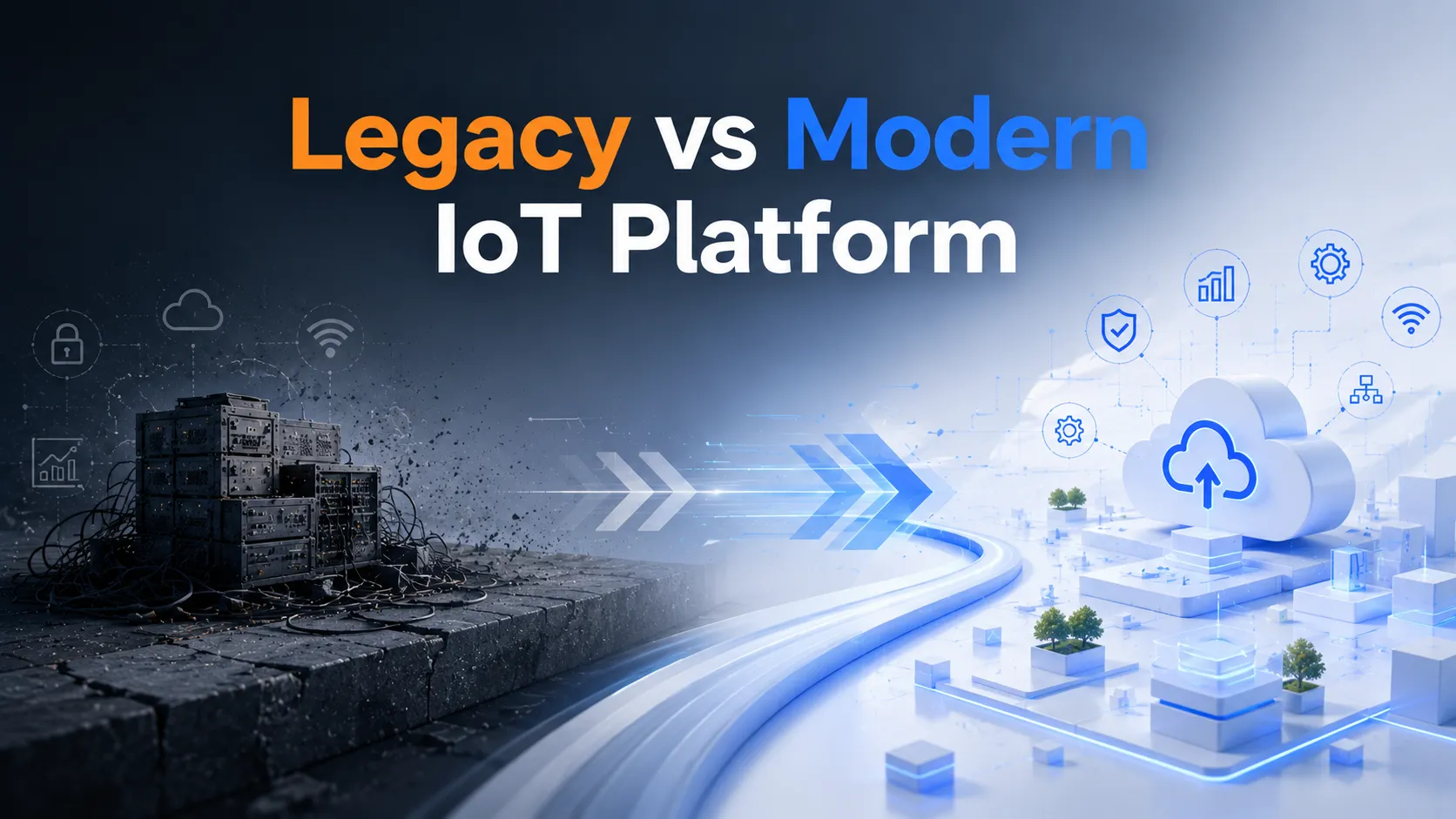
Before we get into how to migrate, it helps to see the gap clearly. Here's how a legacy platform stacks up against a modern one across the things that matter day to day:
| Factor | Legacy Platform | Modern Platform |
|---|---|---|
| Scaling | Slows down as devices grow | Scales smoothly to large fleets |
| Releases | Slow, risky updates | Fast, confident updates |
| Integrations | Custom workarounds needed | Connects cleanly |
| Maintenance | High effort, ongoing | Low effort, mostly automated |
| Security | Hard to keep current | Modern standards built in |
| Control | Tied to a vendor's roadmap | You own the direction |
The pattern is hard to miss: a legacy platform asks you to work around its limits, while a modern one gets out of your way. That difference is exactly what a migration is really buying for you.
How to migrate without downtime
The biggest fear about migration is the disruption of devices going dark, customers noticing, and operations grinding to a halt. It's a fair worry, but a well-run migration avoids it entirely.
The key is to move in stages, not all at once. A phased IoT platform migration without downtime usually looks like this:
- Assess: Map what devices, data, and integrations you have, and what's actually holding you back.
- Build alongside: Set up the new platform next to the old one, so nothing is switched off too early.
- Migrate in stages: Move devices and data in controlled batches, checking each step before the next.
- Keep devices live: Throughout the move, your fleet stays connected and running. No blackout.
This approach is proven in practice that a well-run migration can move an entire IoT backend to a modern architecture with no service interruption, keeping devices live the whole way through. If you'd like this handled end-to-end, that's exactly what our IoT platform modernization services are built for.
Future-proofing your device platform
Migration isn't just about escaping the old; it's about building something that lasts. A future-proof IoT platform grows with your product instead of fighting it.
Here's what a modern platform should give you:
- Room to scale from a small pilot to tens of thousands of devices, without a re-architecture.
- Multi-tenant support to serve multiple customers or brands cleanly from one platform.
- Faster releases ship new features quickly, without wrestling the system each time.
- Cloud flexibility runs where it makes sense for you, not where a vendor forces you.
- Built-in security modern standards and updates handled by design, not bolted on later.
How to plan your migration strategy
A good IoT platform migration strategy doesn't have to be complicated. It comes down to four clear moves:
- Audit what you have. Know your devices, data, and the exact limits you're hitting.
- Define what "good" looks like. Decide what your platform must do a year and five years from now.
- Choose a phased path. Plan the move in safe stages so devices stay live throughout.
- Pick the right partner. Work with a team that has done this before and can keep operations stable while they move you.
Answer these four before you start, and the migration itself becomes far smoother because the hard thinking is already done.
Conclusion
It's easy to see migration as a cost. It's more accurate to see it as removing a ceiling.
A legacy platform quietly limits how fast you ship, how far you scale, and how freely you build. Moving to a modern, future-proof platform lifts that limit and is done in stages; with the right plan, your devices stay live, and your team stays calm through the whole move.
The best time to migrate is before you're forced to. A little planning now saves a lot of pressure later and sets your platform up for the next stage, not just today.