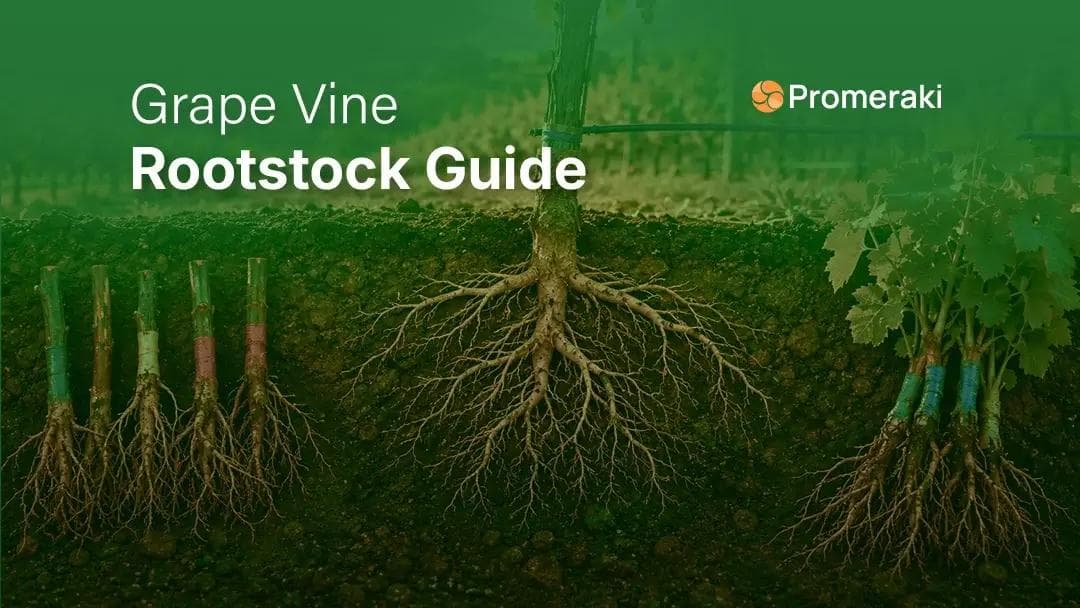
Take two vineyards. Same grape variety. Same region. Same rainfall. Same irrigation setup.
Visit them both ten years later and you would think they were on different continents. One has balanced, healthy vines pushing consistent yields every season. The other is struggling with uneven growth, patchy ripening, and a replanting conversation nobody wants to have.
Ask what went wrong in the second vineyard and you will often trace it back to a single decision. One that was made before a single vine went into the ground. One that most growers do not spend nearly enough time on.
Rootstock selection.
It does not get the attention it deserves. But here is the truth your grape rootstock is the foundation for everything else that is built on. It determines how your vines access water. How they handle dry spells. How they respond to disease pressure in the soil. How long they stay productive. And quietly, indirectly, it shapes what ends up in the glass.
Get it right and you are setting your vineyard up for decades of strong, consistent performance. This guide walks you through everything you need to know - what rootstock is, what drives the selection decision, and how the right choice pays off in vine health and longevity for years to come.
New to viticulture? Start with a guide on What is Viticulture; it gives you the full picture of how a vineyard works before we go underground.
What is Grapevine Rootstock and Why Does It Exist?
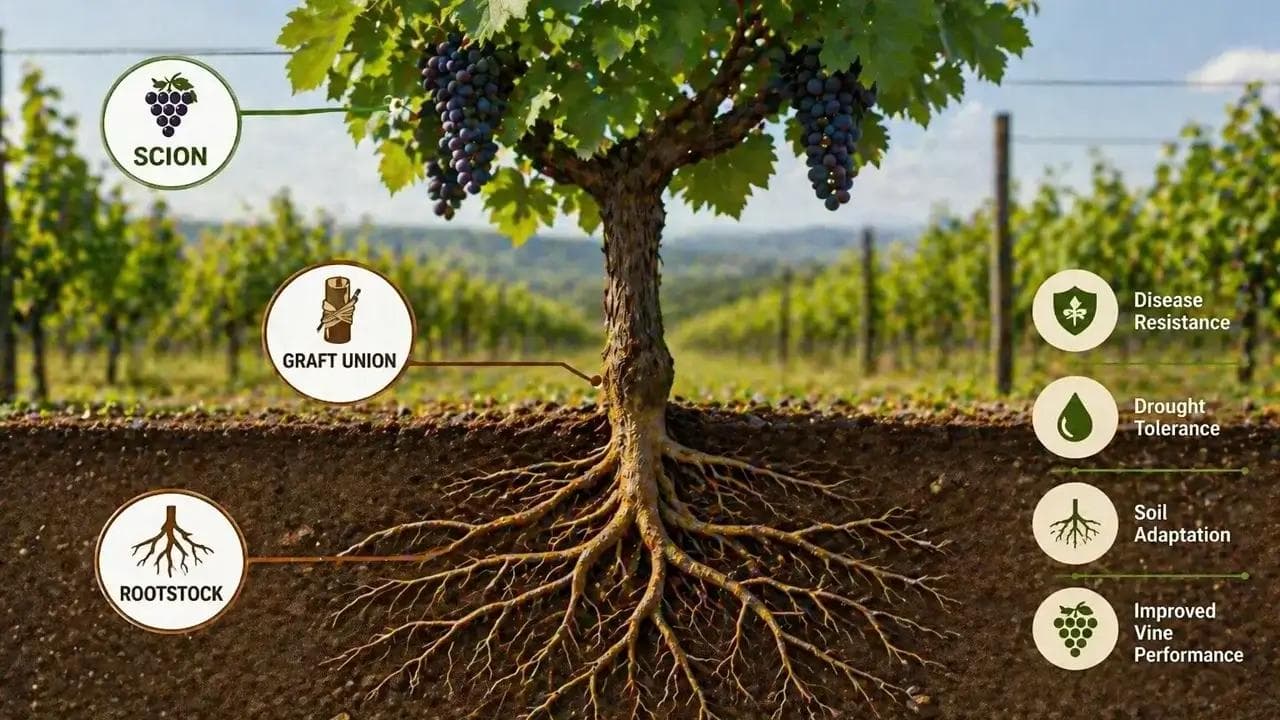
Here is something that surprises a lot of people when they first learn it; most commercial grapevines are two plants grafted together.
The rootstock is what lives underground. It is the root system, grown from a different grape species entirely, usually an American Vitis variety or a hybrid bred specifically for its toughness and adaptability. The scion is the above-ground part of the fruiting variety that produces the grapes. Your Chardonnay. Your Cabernet Sauvignon. Your Pinot Noir. The two are physically joined through grafting, and once that union takes hold, they grow as one vine for the rest of their life.
So why go to all this trouble? Why not just plant the variety you want and let it grow on its own roots?
One word: phylloxera.
In the 1860s, a tiny root-feeding insect called Daktulosphaira vitifoliae tore through European vineyards and wiped out nearly two-thirds of all grapevines on the continent. European Vitis vinifera varieties, the ones that produce all the great wines, had no natural resistance to it whatsoever. American vine species, on the other hand, had evolved alongside phylloxera for centuries and could handle it. The solution was to graft European varieties onto American rootstocks. It saved the global wine industry. And it is still how the vast majority of commercial vineyards operate today.
Here is the thing people find fascinating: once they understand it, the rootstock never produces a single grape. It contributes no flavour, no tannin, and no aroma to the wine. And yet it shapes almost everything about how the vine above it performs. Water access. Nutrient uptakes. Drought resilience. Pest resistance. Vine balance. All of it flows from what is happening underground.
That is why this decision matters so much.
Key Takeaways
- Rootstock is a 40 to 80 year decision. Get it right from the start; your soil, vigor, and scion compatibility matter most.
The 6 Key Factors That Drive Rootstock Selection
Rootstock selection is not something you can do from a catalog. There is no universal best option. The right choice depends on your specific soil, your climate, your pest pressures, and what you are trying to produce.
Here are the six factors that matter most.
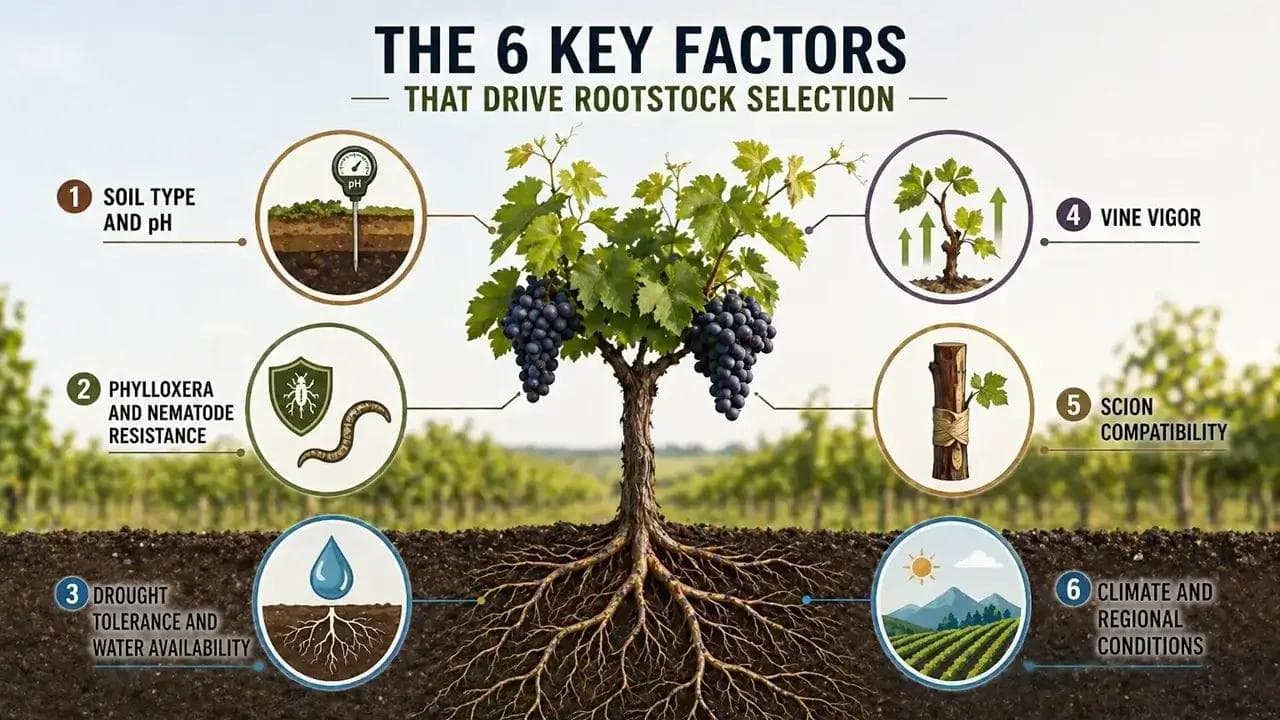
1. Soil Type and pH
Everything starts with the soil. Sandy soils, heavy clay, high-limestone ground, waterlogged zones, and free-draining loam each create a completely different environment for roots to grow in. Some rootstocks handle alkaline, lime-rich soils beautifully. Others would show iron deficiency in those same conditions within a few seasons.
Soil conditions can also vary dramatically across a single vineyard. A rootstock that suits one block perfectly might struggle in another block just 50 meters away. That is why knowing your soil zone by zone before any planting decision is such a valuable investment.
2. Phylloxera and Nematode Resistance
In most wine regions, phylloxera is not a risk to manage; it is a reality to plan around. The question is never really if own-rooted vines will decline in phylloxera-present soils. It is how quick it is.
Nematodes deserve equal attention. Certain soil-dwelling species damage root systems directly and transmit viral diseases that permanently reduce productivity. If your site has been previously planted, a pest-pressure assessment is needed before finalizing it. Any rootstock decision is non-negotiable. Rootstock is your first line of defense, and you only get one opportunity to deploy it.
3. Drought Tolerance and Water Availability
How your rootstock behaves underground directly determines how your vine copes when water gets tight. Deep-rooting rootstocks suit dry-farmed vineyards where vines rely on stored soil moisture. Shallower but water-efficient rootstocks perform well in irrigated blocks where delivery is controlled.
The key point is your rootstock's rooting behavior, and your irrigation infrastructure should be planned together, not separately.
4. Vine Vigor
Vigor is about how much vegetative push a rootstock gives to the scion above it. High-vigor rootstocks drive strong shoot development, which is useful in poor soils but can create canopy management problems in fertile, well-watered sites. Low-vigor rootstocks moderate growth and suit premium, high-density production blocks well.
The goal is always balanced. A vigorous site with a vigorous rootstock is a headache waiting to happen. A lean site with a low-vigor rootstock will underperform from day one.
5. Scion Compatibility
Not all rootstock and scion pairings work well together. Compatibility affects how cleanly the graft union forms, how efficiently water and nutrients move between root and shoot, and how the vine holds under stress across its lifetime. Poor compatibility can mean weak graft unions and premature decline even when everything else about the site looks fine.
Rootstock selection and variety selection need to happen in one conversation. Chardonnay, Pinot Noir, Cabernet Sauvignon, Shiraz, and Riesling all have pairings that are known to work well and combinations that experienced growers know to avoid. A quick conversation with a viticulture specialist before ordering plant material is always worth it.
6. Climate and Regional Conditions
Climate shapes rootstock performance well beyond drought tolerance alone. Cold-climate vineyards need rootstocks that handle frost during dormancy. Warm, arid regions need rootstocks built for sustained water stress. Coastal vineyards face different disease pressures than inland continental sites.
It is also worth thinking ahead. Choosing a rootstock that suits your climate as it is today and as it is likely to be in 20 or 30 years is a smarter long-term approach than selecting only for current conditions. The 7 Pillars of Vineyard Management gives a solid overview of how climate fits into whole-vineyard decision-making.
How Rootstock Affects Long-Term Vine Longevity
A well-managed vineyard on the right rootstock can produce for 40, 50, and sometimes 80 years. The wrong rootstock? Real problems can show up within 10 to 15 years declining vigor, falling yields, and disease pressure that keeps building no matter what you do above ground.
Replanting is expensive. Site preparation, new plant material, establishment costs, and years of reduced yield while the block recovers add up fast. And when you dig into why many replants happen, the trail usually leads back to a rootstock mismatch made right at the very start.
The right rootstock keeps the root system healthy in the specific soil the vine lives in, supports efficient nutrient uptake, keeps vigor balanced, and provides ongoing protection against soil-borne pests across decades of productive life.
One connection grower often overlooks is that rootstock vigor directly affects the canopy above. Too much vigor in a fertile site creates dense, shaded growth that demands constant management. More leaf pulling, more hedging, more labour. Getting that balance right from the start reduces that burden for the vine's entire life.
Rootstock Selection and Disease Pressure
Phylloxera gets most of the attention. But a well-chosen rootstock does quite a bit more than protect against phylloxera alone.
Certain rootstocks resist crown gall, a bacterial disease that thrives in frost-prone regions where pruning wounds give it easy entry. Others hold up significantly better against Armillaria root rot, a soil-borne fungal disease that is very difficult to manage once established. Nematode-resistant rootstocks reduce the vine exposure to viruses that those nematodes carry including leafroll disease and other persistent conditions that quietly chip away at productivity season after season.
The result is fewer spray runs, lower input costs, healthier wood as the vine ages, and a vineyard that starts every season from a position of strength. That compounds over decades in ways that show up clearly in both fruit quality and profitability.
Rootstock is the starting point, not an afterthought, in any serious approach to disease and pest management. You build the defense from the ground up. Literally.
Rootstock, Terroir, and Wine Quality
Here is the part that tends to stop people; rootstock affects wine quality, even though it never produces a single grape.
Rootstock controls how the scion accesses water and nutrients from the soil. That directly shapes berry size, sugar accumulation, acid retention, and the concentration of phenolics that define a wine structure and depth.
High-vigor rootstock in a fertile site pushes larger berries and higher yields, lower skin-to-juice ratios, and less concentrated flavour. Low-vigor rootstock in a leaner site produces smaller berries, thicker skins, and more complexity. That is the profile premium wine production is built around.
This is why rootstock is increasingly treated as part of terroir, not romantically, but practically. Soil, climate, variety, and rootstock together determine what the vine draws from the earth. Modern precision viticulture tools make it easier than ever to track how rootstock choices play out block by block, so every future planting decision gets better informed by real data.
When to Reassess Replanting and Rootstock Change
Sometimes, even with the best intentions at planting, things do not go the way you hoped. Soils shift. Pest pressure builds. Climate changes.
Signs a rootstock may be underperforming include yields declining without clear explanation; persistent vigor imbalance that does not respond to adjustments; uneven ripening getting worse each season; or vine appearance that refuses to improve despite nutrition and irrigation changes.
These are not always rootstock problems. But they are always worth investigating from the ground up first.
If replanting is on the table, the soil assessment before a replant is just as critical as the original one, maybe more so. Soil conditions change over decades, pest populations shift, and the lessons from the first planting feed directly into a smarter rootstock decision the second time around.
Closing Thought
Rootstock selection is the one vineyard decision you make once and live with for the next 40 to 80 years. Irrigation schedules, spray programs, and canopy management all of it can be adjusted as conditions change. Rootstock cannot.
The growers who build vineyards that last generations are not always the ones with the biggest budgets. They are the ones who understand their soil, match rootstock to their site honestly, and think in decades rather than seasons.
A vine planted today on the right rootstock can produce exceptional fruit long after the person who planted it has retired. That kind of longevity starts underground before the first shoot ever breaks the surface.
If you are planning a new block, an expansion, or a replant, start with the right data. Soil maps, vine health monitoring, and precision viticulture tools make rootstock selection more accurate and outcomes more predictable.
Explore how Promeraki helps vineyard operators and agri-tech companies build the data infrastructure that makes these decisions sharper.
Get in touch with our team today.
Want to know what your vineyard data is telling you?
Soil maps, vine health, and water use the right data makes every rootstock decision sharper.