TL;DR
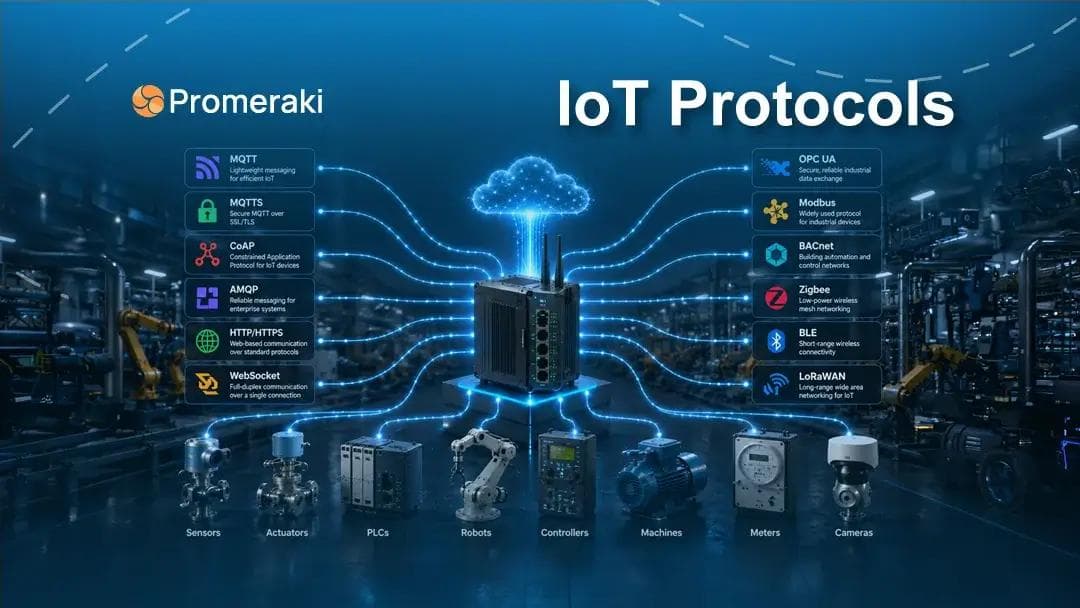
- 20+ IoT protocols, three layers, one decision that shapes your entire product architecture.
IoT protocols are the standardized rules that define how your device sends and receives data - from the radio signal leaving the hardware to the message arriving at your cloud platform. Choosing the wrong one at the design stage means reworking firmware, re-architecting cloud integrations, and in some cases, replacing hardware entirely.
Every connected device speaks a language. The protocols you choose determine how reliably it communicates, how long the battery lasts, how far the signal reaches, and how securely data travels. Getting this right before development begins makes everything downstream - firmware, cloud, compliance, significantly simpler.
This guide covers 20+ IoT protocols across application, wireless, and industrial layers, with a comparison table, a five-step decision framework, and direct answers to the questions manufacturers ask most.
What Are IoT Protocols?
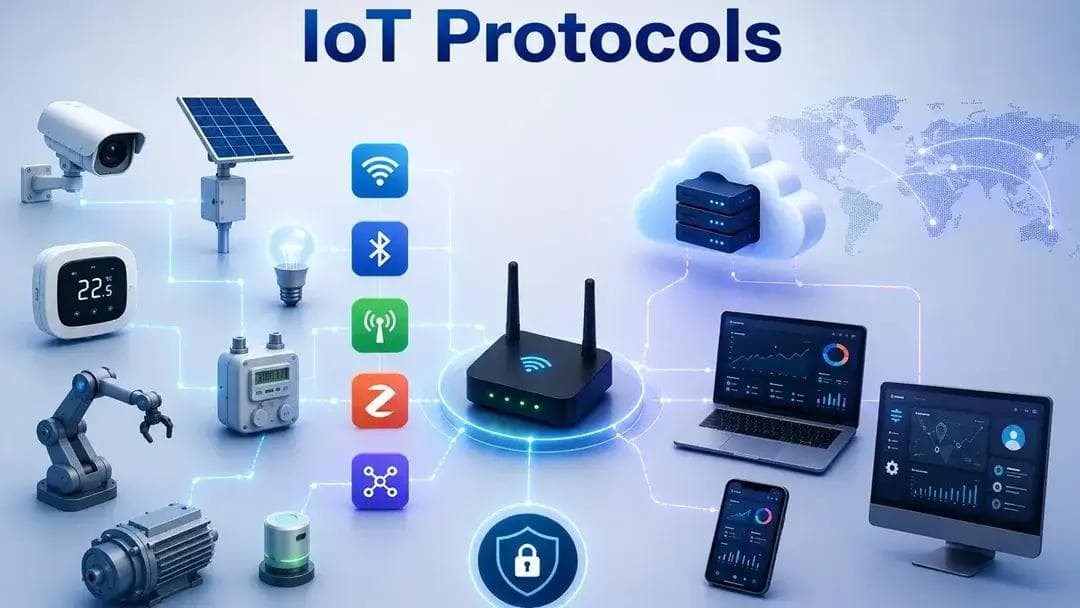
IoT protocols are standardized rules that define how connected devices package, transmit, and receive data across a network. They operate at different layers of the connectivity stack, from the physical radio signal that carries data wirelessly to the application-layer messaging format that tells a cloud server what a sensor just measured.
Without protocols, devices from different manufacturers cannot talk to each other. With the right protocols in place, a temperature sensor built in Germany can send data to a cloud platform hosted in Singapore, processed by software built in Australia, reliably, securely, and automatically.
There are 20+ widely used IoT protocols across three main categories: application layer, network and wireless layer, and industrial layer. Most connected products use two or three simultaneously, one to move data locally, one to send it to the cloud, and one to manage the device remotely.
The protocol you choose directly affects battery life, communication range, data throughput, network cost, and regulatory compliance. It is a product architecture decision, not a software detail, and it is one of the most consequential choices you make before a product enters development.
The IoT Protocol Stack: Understanding the Layers
IoT connectivity works in layers. Each layer handles a specific part of how data moves from a device to its destination.
Application layer
Handles how data is formatted and delivered between a device and a cloud platform or server. IoT communication protocols here include MQTT, CoAP, HTTP, AMQP, LwM2M, and OPC UA. This is the layer most developers interact with directly.
Network and wireless layer
Handles how data travels over a physical distance through radio signals, cellular towers, or mesh networks. Protocols here include LoRaWAN, NB-IoT, LTE-M, Sigfox, Zigbee, Z-Wave, Thread, Matter, and BLE. Range, power consumption, and frequency band are all determined at this layer.
Industrial and link layer
Handles communication between machines, sensors, and controllers on a factory floor or processing plant, often over wired connections. Protocols here include Modbus, Profinet, and HART.
Understanding which layer, a protocol belongs to helps you build the right IoT protocol stack for your product. A smart agricultural sensor, for example, might use LoRaWAN at the network layer to transmit data over long distances and MQTT at the application layer to deliver that data to a cloud dashboard.
Application Layer Protocols Cloud Connectivity and Messaging
Application layer protocols define the rules for how data is structured, queued, and delivered between your device and your cloud infrastructure. These are the core IoT messaging protocols used across connected products worldwide.
MQTT (Message Queuing Telemetry Transport)
MQTT is the most widely adopted IoT protocol in the world, used in roughly 70% of cloud-connected IoT deployments across industrial, smart home, and enterprise environments.
It works on a publish-subscribe model. Devices publish data to topics on a central MQTT broker. Other devices or cloud applications subscribe to those topics and receive the data automatically. The brokers handle all routing; devices and never need to know each other's addresses. For teams evaluating cloud infrastructure, pairing the right MQTT broker with the right IoT cloud platform makes a significant difference to long-term scalability.
MQTT supports three Quality of Service (QoS) levels: fire-and-forget (QoS 0), delivered at least once (QoS 1), and delivered exactly once (QoS 2). This makes it reliable even on unstable networks. Security runs over TLS/SSL with username and password authentication or certificate-based identity.
Best for: Real-time cloud telemetry, industrial monitoring, bidirectional device control, and any application where message delivery needs to be guaranteed.
CoAP (Constrained Application Protocol)
CoAP is designed for devices that are too resource-constrained to run MQTT efficiently with minimal RAM, slow processors, or connections where every byte of data costs money.
Unlike MQTT, CoAP uses a RESTful request-response model similar to HTTP but runs over UDP instead of TCP. This makes it significantly lighter. It supports multicast messaging, block-wise data transfer, and DTLS encryption for security over UDP.
MQTT vs CoAP in two sentences: Use MQTT when you need a broker to manage message queuing and guarantee delivery across many devices. Use CoAP when your device is severely constrained, runs on a cellular link where bandwidth is expensive, or needs RESTful semantics without the overhead of HTTP.
Best for: Battery-powered edge sensors, NB-IoT devices, and deployments where bandwidth and power are primary constraints.
HTTP/HTTPS
HTTP is the same protocol that powers the web. In IoT, it is not the most efficient choice for continuous telemetry; its overhead is too high for battery-powered sensors to send data every few seconds. But it has a clear and important role in connected product architecture.
HTTP is the standard choice for OTA (over-the-air) firmware updates, cloud API integrations, and device dashboards where a browser is involved. Its universal support across every cloud platform and programming environment makes it straightforward to implement without custom tooling.
Best for: Firmware OTA update pipelines, cloud API communication, device management dashboards, and one-time configuration calls.
AMQP, LwM2M, and OPC UA
AMQP (Advanced Message Queuing Protocol) is built for enterprise environments where message reliability is non-negotiable, such as financial systems, industrial monitoring platforms, and enterprise IoT middleware. It offers stronger transactional guarantees than MQTT at the cost of higher resource requirements.
LwM2M (Lightweight Machine-to-Machine) is purpose-built for remote device management over cellular networks. It handles device registration, configuration, firmware updates, and monitoring through a standardized object model. It is the right choice when you need to manage thousands of deployed field devices remotely.
OPC UA (Open Platform Communications Unified Architecture) is the interoperability standard for industrial IoT and Industry 4.0. It is vendor-neutral, secure, and designed for machine-to-machine communication across different manufacturers' equipment. If your product connects to factory automation systems, OPC UA is the protocol that makes it possible.
Network and Wireless Protocols Long-Range, Mesh, and Smart Home
Wireless IoT protocols determine how far your device signal travels, how much power it consumes, and what kind of network infrastructure it needs. Here are the protocols that matter most across LPWAN, cellular, and short-range categories.
LoRaWAN
LoRaWAN (Long Range Wide Area Network) is the leading protocol for battery-powered sensors that need to communicate over long distances without cellular infrastructure.
Its architecture moves data from end devices through LoRaWAN gateways to a network server and then to your application server or cloud platform. The radio signal travels 2 to 15 kilometers in open environments and penetrates buildings reliably. Devices operate for up to 10 years on a single battery. LoRaWAN operates on unlicensed spectrum, so there are no SIM card costs or operator agreements required.
LoRaWAN is particularly well suited as an IoT protocol for agricultural sensors; soil moisture sensors, weather stations, irrigation controllers, and livestock trackers can all operate across large farms or rural areas without cellular coverage or gateway-dense infrastructure.
LoRaWAN vs NB-IoT: LoRaWAN is the stronger choice for private networks, agricultural deployments, and smart city infrastructure where you control the gateway setup. NB-IoT is the stronger choice when you need nationwide coverage from day one, and your operator already has the network in place.
Best for: Agriculture and precision farming sensors, smart city environmental monitoring, industrial asset tracking, and water and utility metering across wide geographic areas.
NB-IoT and LTE-M
Both are cellular IoT protocols that run on licensed spectrum through mobile network operators, delivering strong security, deep building penetration, and managed quality of service.
NB-IoT (Narrowband IoT) is optimized for low-power devices that send small amounts of data infrequently. It offers nationwide coverage through existing cellular towers, the practical choice for large-scale deployments like smart meters, asset trackers, and environmental sensors where installing private gateway infrastructure is not feasible.
LTE-M (LTE Cat-M1) supports higher bandwidth than NB-IoT and adds mobility support, allowing devices to maintain connectivity while moving between cell towers. This makes it suitable for vehicle telematics, connected wearables, and any application that needs a balance of mobility, bandwidth, and low power consumption.
Both protocols require a SIM card and an operator's data plan.
Sigfox
Sigfox is an ultra-low-power LPWAN protocol built for devices that send tiny amounts of data very infrequently, such as environmental sensors, track-and-trace tags, and tamper detection devices that transmit a few bytes at a time. Its signal range reaches 10 to 40 kilometers in open environments. It operates on an unlicensed spectrum using a subscription-based network operated by Sigfox and its partners. The trade-off is a very limited uplink capacity. Sigfox suits applications where battery life and simplicity outweigh data volume.
Best for: Ultra-low-power asset tracking, supply chain monitoring, and environmental sensing at the absolute edge of connectivity.
Zigbee and Z-Wave
Both Zigbee and Z-Wave are low-power mesh network protocols designed for smart homes and building automation. In a mesh network, every device acts as a signal repeater. The more devices in the network, the more robust and self-healing the coverage becomes.
Zigbee operates on the 2.4 GHz band, supports networks of up to 65,000 nodes, uses AES-128 encryption, and has the broadest global adoption across smart home devices. It is an open standard with a large ecosystem of compatible devices.
Z-Wave operates on the sub-1 GHz band, which means less interference from Wi-Fi and Bluetooth networks in the same space. It supports up to 232 nodes per network and has historically had a stronger market presence in the United States. Z-Wave requires certification, ensuring consistent interoperability across devices from different manufacturers.
Choosing between them: Zigbee for larger installations and international markets. Z-Wave when interference avoidance and proven interoperability in a smaller network are the higher priorities.
Thread and Matter
Thread and Matter work together and are rapidly becoming the foundation of next-generation smart home products.
Thread is an IPv6-native mesh protocol built on the IEEE 802.15.4 radio standard for the same radio layer Zigbee uses. It is self-healing, low-powered, and designed specifically to run the Matter application layer on top of it. Every Thread network includes a border router device that bridges Thread devices to IP networks and the cloud.
Matter is not a wireless protocol; it is a unified application-layer standard that runs over Thread, Wi-Fi, or Ethernet. Matter solves the fragmentation problem that has defined smart home IoT for the past decade. A single Matter-certified device works with Apple HomeKit, Google Home, Amazon Alexa, and Samsung SmartThings without separate integrations or custom firmware.
Matter 1.4, released in late 2024 and the active standard throughout 2026, is the dominant specification for new smart home products launched in the EU and US markets. For any manufacturer building consumer smart home products today, Matter support is a market expectation, not an optional feature.
Bluetooth Low Energy (BLE)
BLE operates at a sub-100-meter range in either star topology (one central device coordinating several peripherals) or mesh topology (devices relay messages across the network). It consumes very little power and integrates naturally with smartphones; every modern mobile device has BLE built in.
Best for: Wearables, asset tags, short-range environmental sensors, and any device that pairs with a smartphone for configuration, data export, or control.
Wi-Fi and Wi-Fi HaLow
Standard Wi-Fi (802.11 b/g/n/ac/ax) remains the right choice for IoT devices that need high bandwidth, connected cameras, display panels, and dashboard devices that stream video or large data payloads to the cloud. Its power draw makes it unsuitable for battery-operated sensors, but for main-powered devices with a local router available, Wi-Fi delivers the highest throughput of any wireless IoT protocol.
Wi-FiHaLow (802.11ah) extends Wi-Fi into the sub-1 GHz band, dramatically reducing power consumption and extending range to several hundred meters. It bridges the gap between standard Wi-Fi and LPWAN protocolssuitable for battery-powered sensors in warehouse or campus environments where LoRaWAN throughput is too low, but cellular costs are unnecessary.
Best for: Wi-Fi for high-bandwidth mains-powered devices; Wi-Fi HaLow for medium-range battery sensors in contained environments.
Industrial IoT Protocols
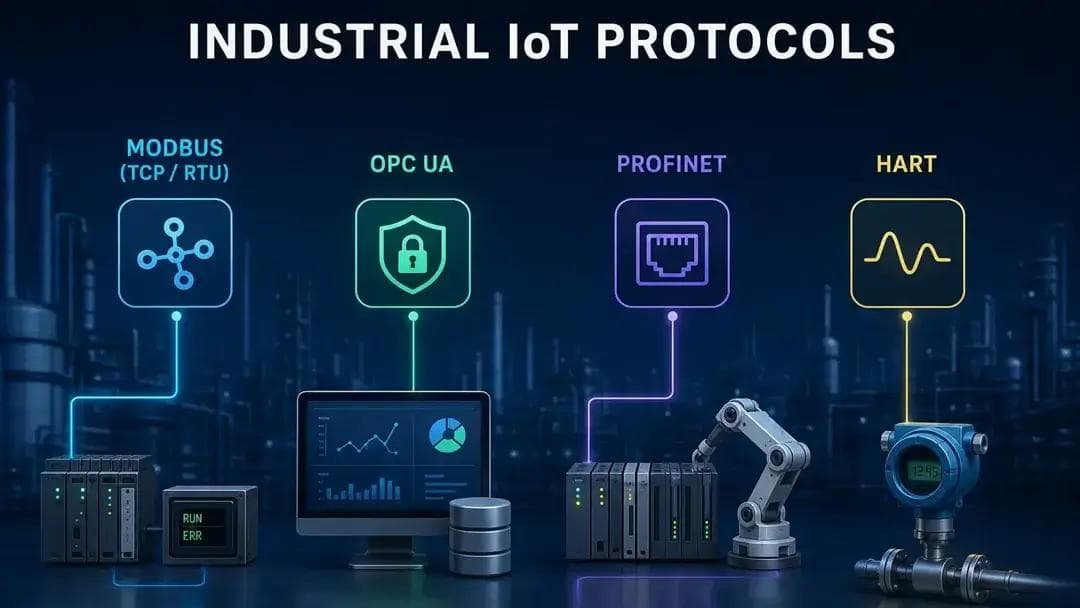
Industrial environments have unique requirements: deterministic timing, fault tolerance, and decades-long device lifecycles. These protocols were built for that context.
Modbus (TCP and RTU) is the foundational protocol of industrial automation. Developed in 1979, it remains in active use across PLCs, SCADA systems, and factory floor equipment because it is simple, reliable, and universally supported. Modbus RTU runs over serial connections; Modbus TCP runs over Ethernet. If your product connects to existing industrial infrastructure, Modbus support is often a mandatory requirement.
OPC UA is the modern standard for industrial interoperability. It is vendor-neutral, supports complex data modeling, includes built-in security, and is the protocol of choice for Industry 4.0 and smart manufacturing deployments. OPC UA replaces older proprietary protocols with a unified, open standard that different manufacturers' systems can speak without custom bridges.
Profinet is a real-time Ethernet protocol for factory automation. It supports deterministic communication timing critical in manufacturing lines where microsecond delays affect product quality or machine safety.
HART (Highway Addressable Remote Transducer) runs digital communication over traditional 4–20 mA analogue wiring, making it the practical upgrade path for legacy process automation equipment in oil and gas, chemical, and pharmaceutical plants. It enables two-way digital communication without replacing existing cabling infrastructure.
IoT Protocol Comparison Table
Key Takeaways
- Every major IoT protocol, one table range, power, data rate, and best use case side by side.
| Protocol | Layer | Range | Power | Data Rate | Best For |
|---|---|---|---|---|---|
| MQTT | Application | IP-based | Low–Med | Med–High | Real-time telemetry, industrial IoT |
| CoAP | Application | IP-based | Very Low | Low | Constrained devices, cellular M2M |
| HTTP | Application | IP-based | Medium | High | OTA updates, cloud APIs |
| AMQP | Application | IP-based | Medium | High | Enterprise messaging |
| OPC UA | Application | IP-based/Wired | Medium | Med–High | Industrial automation, Industry 4.0 |
| LoRaWAN | Network | 2–15 km | Very Low | 0.3–50 Kbps | Agriculture, smart cities |
| NB-IoT | Network | Nationwide | Very Low | 20–250 Kbps | Asset tracking, smart meters |
| LTE-M | Network | Nationwide | Low | 1 Mbps | Wearables, vehicle telematics |
| Sigfox | Network | 10–40 km | Very Low | 100 bps | Ultra-low-power tracking |
| Zigbee | Link | 10–100 m mesh | Very Low | 250 Kbps | Smart home, building automation |
| Z-Wave | Link | 30–100 m mesh | Very Low | 40–100 Kbps | Smart home locks, HVAC |
| Thread | Link | 10–100 m mesh | Very Low | 250 Kbps | Matter smart home |
| Matter | Application | Depends on transport | Depends | Depends | Unified smart home standard |
| BLE | Link | 10–100 m | Very Low | 1–2 Mbps | Wearables, smartphone pairing |
| Modbus | Industrial | Wired/IP | N/A | Low–Med | PLCs, SCADA, factory floor |
No single protocol wins every scenario. Most connected products use two or three IoT protocols together, one for local communication, one for cloud connectivity, and one for device management.
How to Choose the Right IoT Protocol for Your Product
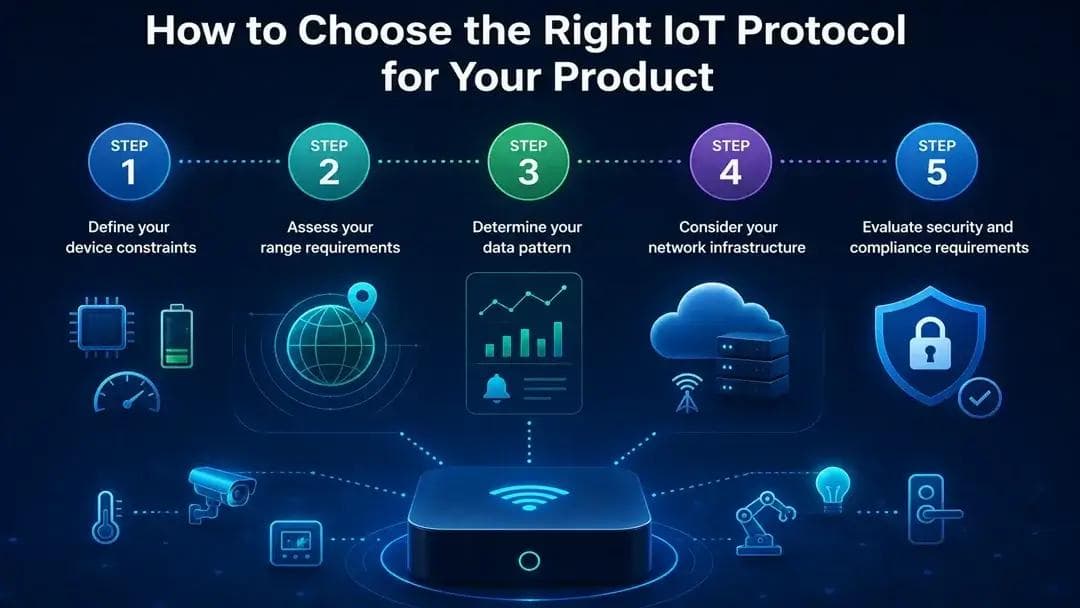
The right protocol depends on what your product needs to do, where it operates, and what constraints it works within. Work through these five decisions before finalizing your connectivity architecture.
Step 1: Define your device constraints
How much battery power does your device have? How much is memory and processing capacity? Protocols like CoAP, Zigbee, and LoRaWAN are built for severely constrained devices. MQTT and HTTP work better when you have more headroom.
Step 2: Assess your range requirements
Under 100 meters: Zigbee, BLE, Z-Wave, or Thread. Up to 15 kilometers with LoRaWAN on a private network. Nationwide NB-IoT or LTE-M over cellular. Your range requirement often determines your protocol category before any other factor.
Step 3: Determine your data pattern. Real-time continuous streams point toward MQTT or LTE-M. Periodic sensor readings work well with CoAP or LoRaWAN. Event-driven alerts from short-range devices suit BLE or Zigbee.
Step 4: Consider your network infrastructure
Do you need to deploy your own gateways, or do you need coverage from day one through existing cellular networks? Private LoRaWAN networks give you control and cost efficiency at scale. NB-IoT and LTE-M give you a reach without any infrastructure investment.
Step 5: Evaluate security and compliance requirements
The EU Cyber Resilience Act and the US FCC Cyber Trust Mark, both active in 2026, require connected devices sold in those markets to meet secure-by-design standards. Encryption, authenticated device onboarding, and secure firmware update mechanisms are regulatory requirements built in from day one, not retrofitted later.
Not sure which IoT protocol fits your product architecture?
Promeraki's IoT consulting helps manufacturers design the right connectivity stack from the earliest stage of product development.
IoT Protocol Security What You Need to Know
Every major IoT protocol today includes encryption as a built-in requirement, not an add-on.
Encryption protocol AES-128 for Zigbee and LoRaWAN. AES-256 for NB-IoT and LTE-M cellular connections. TLS 1.3 for MQTT over TCP. DTLS for CoAP over UDP. These are the baseline standards for any production IoT deployment in 2026.
Authentication matters as much as encryption. X.509 digital certificates, OAuth tokens, and API key management each serve different roles depending on your device type and cloud architecture. Certificates are the strongest option for device identity; API keys work for cloud-to-cloud integrations where full certificate management is not practical.
Secure OTA firmware updates are where manufacturers gain the most by investing early. A device that receives authenticated firmware updates over the air is a device you can patch, improve, and secure throughout its lifecycle without a service recall or a field visit. In 2026, the EU Cyber Resilience Act makes this a regulatory requirement for connected products sold across the EU.
Encryption is one layer of security. Device onboarding, firmware update mechanisms, and key lifecycle management to complete the picture.
Conclusion
Choosing the right IoT protocol is a product architecture decision with long-term consequences. It affects how your device performs in the field, how long it runs on battery, how securely it communicates, and whether it meets the regulatory requirements of the markets you sell into.
The frameworks in this guide, application layer protocols for cloud messaging, wireless protocols for range and power, industrial protocols for factory connectivity, and the five-step decision framework, give you the foundation to make that choice with confidence.
Every product has its own constraints. The right answer depends on your specific requirements. But you do not need to work alone.
Promeraki engineers end-to-end IoT platforms with multi-protocol support, including MQTT, HTTP, LoRaWAN, Modbus, OPC UA, and more. We help OEMs build connected products that work reliably at scale from firmware integration to cloud connectivity.