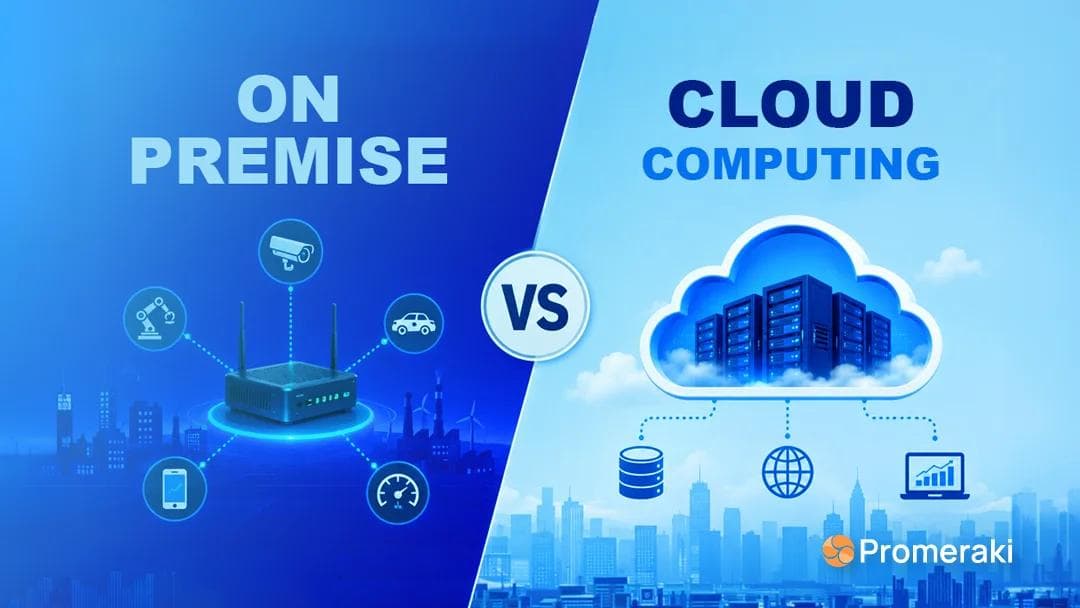
Ask anyone building an IoT deployment where the data should live, and you'll usually get a quick answer followed by a longer explanation. That's because on-premise computing and cloud computing aren't really competing options. They're two different ways of solving the same problem: where should your sensor data be processed, stored, and acted on?
On-premises means processing happens close to your devices, often right on-site. Cloud computing means that data travels to a provider's servers, where it's processed and stored remotely. Most successful IoT deployments today use a thoughtful mix of both, and knowing why makes the decision much easier.
Here's what each model actually offers, where they genuinely differ, and how to figure out which one fits your deployment.
What Is On-premises Computing?
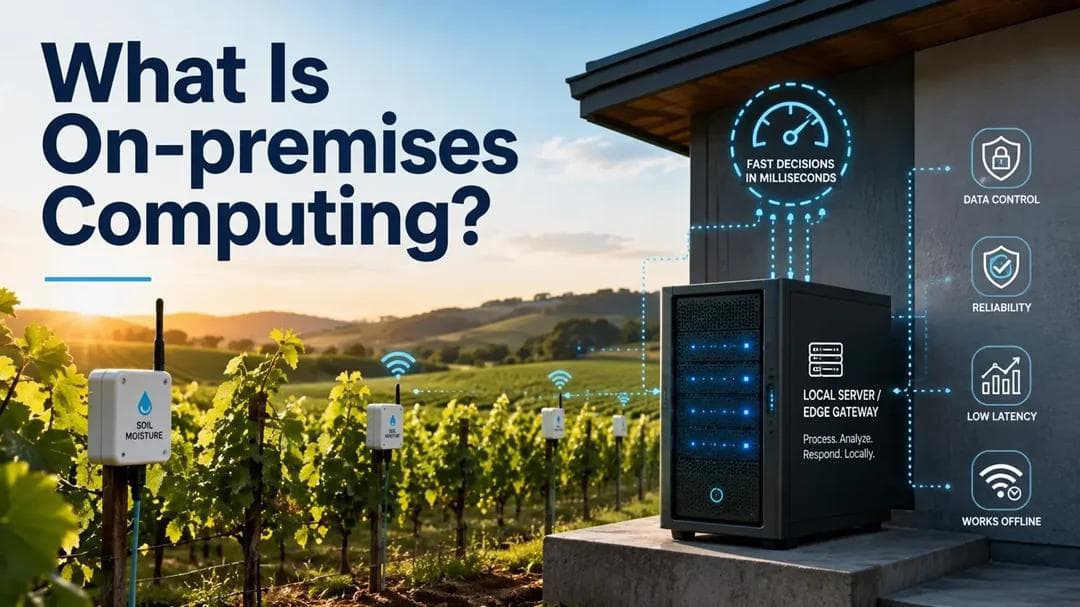
On-premises computing keeps your hardware and processing close to where your devices live, on-site, under your own team's care. Sensors send data to a local server or gateway, and decisions happen right there, often in milliseconds.
A vineyard running with soil moisture sensors across hundreds of acres is a good example. Irrigation decisions need to happen fast, and a local processing setup means the system can respond to the moment conditions change, without waiting on a round trip to a distant server.
What Is Cloud Computing?
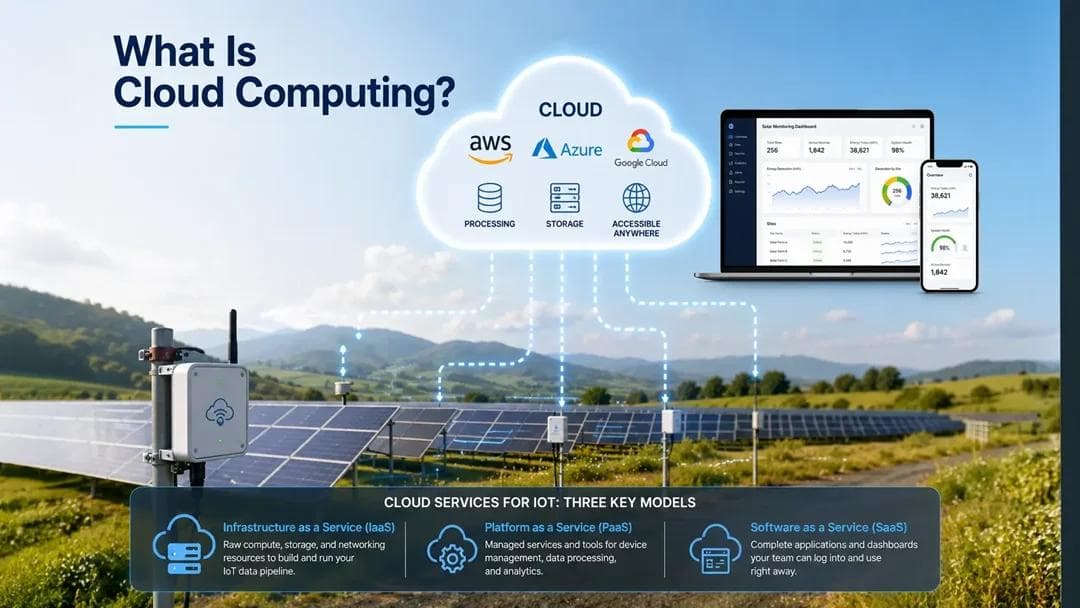
Cloud computing takes a different approach. Your sensors send data over the internet to a provider's infrastructure, AWS, Azure, or Google Cloud, where it's processed, stored, and made available from anywhere. There's no local server to maintain, and your team can pull insights from a dashboard no matter where they're sitting.
The U.S. National Institute of Standards and Technology describes cloud computing as on-demand network access to a shared pool of computing resources that scales up with minimal effort. For IoT specifically, that means a solar monitoring platform can add a hundred new sites without anyone provisioning new hardware first.
Cloud services for IoT usually fall into three categories. Infrastructure as a service gives raw compute and storage for your data pipeline. Platform as a service gives ready-made tools for device management and analytics. Software as a service gives a finished dashboard your team can log into right away.
In a Nutshell
- Choose on-premises computing for instant decisions and tight control; choose cloud computing for fast growth and easy access; most IoT projects use both.
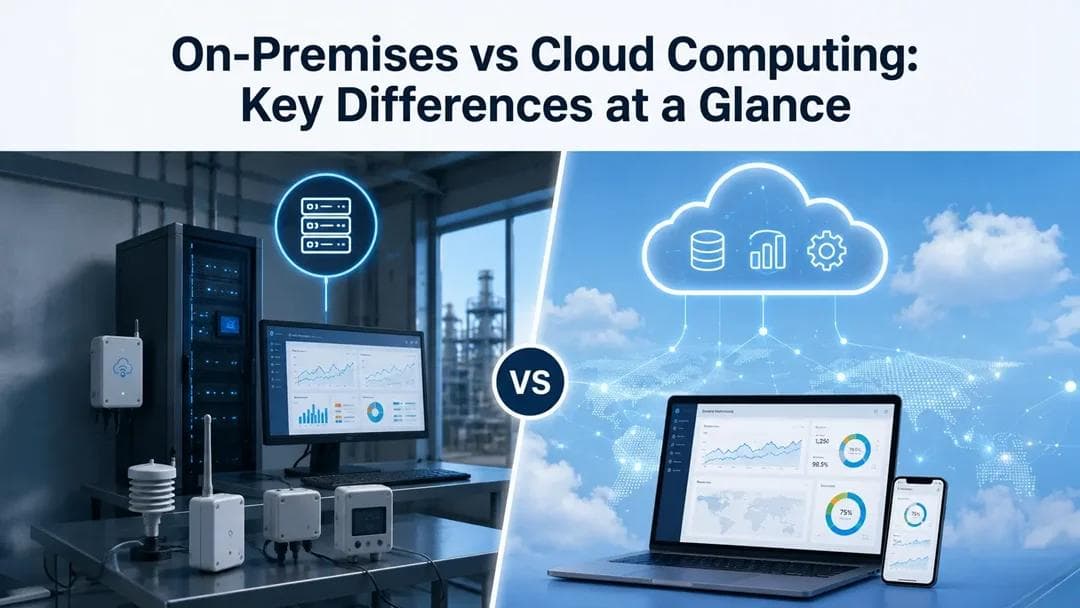
On-Premises vs Cloud Computing: Key Differences at a Glance
| In a Nutshell | On-site, near your devices | Remote, in the provider's data center |
|---|---|---|
| Response time | Near-instant, ideal for real-time decisions | Slightly slower, depends on connectivity |
| Upfront cost | Higher, hardware and setup | Lower, pay-as-you-grow |
| Scalability | Takes planning to add capacity | Scales quickly with demand |
| Data control | Full, on-site | Shared with the provider |
| Best for | Time-sensitive, steady deployments | Fast-growing, distributed deployments |
A table like this simplifies things nicely, but most real IoT deployments end up wanting both. That's exactly why hybrid and edge computing setups have become the practical default for many industrial and agricultural projects.
On-Premises: What It Brings to an IoT Deployment
On-premise computing shines were speed and independence matter most. A factory floor monitoring vibration sensor on critical machinery needs real-time decisions, since a few seconds of delay could mean the difference between catching a fault early and dealing with it later. Processing locally removes the round trip to a distant server, which keeps response times tight.
It also means your data stays where you can see it. For deployments tied to compliance requirements or sensitive operational data, direct control is genuinely valuable, not just a technical preference.
The trade-off is an upfront investment. Setting up local servers or edge gateways takes planning, budget, and a team who knows how to maintain them. It's a worthwhile investment for the right deployment, and it pays off fastest when the workload is steady and well understood from the start.
Cloud Computing: What It Brings to an IoT Deployment
Cloud computing makes scaling refreshingly simple. A solar monitoring platform that starts with ten installations can grow to a thousand without anyone needing to plan for new hardware.
The provider handles heavy lifting, storage, redundancy, and uptime, so your team can focus on building features instead of maintaining infrastructure.
It's also the easier starting point for new IoT projects.
There's no large upfront purchase, and most cloud IoT platforms offer pay-as-you-grow pricing, which keeps early-stage costs aligned with actual usage rather than a guess about future scale.
The one thing to plan around is connectivity. Cloud-dependent devices need a stable connection to function fully, so deployments in remote agricultural or industrial settings often pair cloud computing with some local processing to keep critical functions running smoothly even when the connection briefly drops.
CapEx vs OpEx: Planning the Real Cost
Here's a simple way to frame it. On-premises computing works like a mortgage, a larger payment upfront that becomes a long-term asset, with smaller ongoing costs after that. Cloud computing works like a subscription, no big upfront number, but a monthly cost tied to how much you use.
For a young IoT deployment with an uncertain growth curve, cloud computing flexibility usually wins early on. For a mature deployment with a steady, well-understood device count, on-premises computing can become more cost-effective over a longer stretch.
Either path is worth budgeting carefully. Cloud costs can grow with data volume as a sensor network expands, so it's worth checking in on usage regularly as a deployment scale. On-premises costs show up differently, in hardware refreshes, added storage, and the IT time spent keeping local systems running smoothly. A five-year view of either option gives a much clearer picture than the first invoice alone.
Security and Data Control
With on-premises computing, your team holds every key, every firewall rule, and every access setting. That level of control is a strong fit for IoT deployments handling sensitive operational data, where direct oversight matters as much as the technology itself.
Cloud providers bring serious security resources to the table, including encryption in transit and at rest, automated threat detection, and infrastructure mirrored across regions; the kind of protection most teams couldn't easily build alone.
Getting the most from that protection comes down to configuring device access and permissions correctly from day one, which is a quick step worth building into any rollout plan.
For IoT projects working with regulated data, healthcare monitoring, or industrial compliance, for example, a hybrid approach often gives the best of both: sensitive processing kept local, while broader analytics and dashboards run in the cloud.
Choosing What Fits Your Deployment
A few questions make this decision easier. Does your system need split-second responses, like a factory safety sensor or an irrigation controller reacting to live conditions? On-premises or edge processing is usually the better fit.
Is your deployment growing fast, or are you still finding out how big it needs to be? Cloud computing gives you room to grow without overcoming early.
And if your project needs both fast local decisions and easy remote visibility, which describes a large share of modern IoT deployments, a hybrid setup lets you keep critical processing on-site while sending broader data to the cloud for analytics and reporting.
Hybrid and Edge Computing: The Practical Middle Ground
Most growing IoT deployments end up blending on-premises and cloud computing rather than choosing one exclusively.
Edge devices handle time-sensitive decisions on-site, while the cloud takes care of long-term storage, trend analysis, and dashboards your whole team can access.
This approach has become the practical default for a good reason: it lets a vineyard react instantly to a moisture sensor while still giving the operations team a clean, cloud-based view of the entire season. The setup takes a bit more planning upfront, and it tends to pay off well once a deployment moves beyond its earliest stage.
Conclusion
Choosing between on-premises and cloud computing for an IoT deployment comes down to what your project needs right now. On-premises computing offers speed and direct control, ideal when decisions need to happen on-site, in real time. Cloud computing offers flexibility and easy scaling, ideal when growth is the priority and remote visibility of matters.
The best starting point is usually your own priorities: how fast decisions need to happen, how much is the deployment expected to grow, and how much hands-on control does your team want to keep. A hybrid approach, increasingly the norm for IoT projects, often captures the strengths of both without asking you to choose just one.
If you're planning an IoT deployment and weighing where your data should live, Promeraki's platform engineering team can help you map out the right mix of edge and cloud computing for your specific use case reach out to start the conversation.
Curious Where Your Data Should Live?
On-premise, cloud, or a mix of both, the right answer depends on your deployment.