Here's something most people don't think about every smart device you interact with starts its life as a physical signal.
A factory machine is slowing down before it breaks. The greenhouse is getting too hot. A water pipe is losing pressure somewhere underground. None of this becomes useful information until a sensor picks it up.
IoT sensors, also called Internet of Things sensors, are the hardware that make all of this possible. They sit at the edge of your system, detecting changes in the physical world and turning them into data. Temperature, motion, pressure, light, gas, or whatever the environment throws at them; they measure it and pass it on.
When it comes to IoT and sensors, think of it this way. The sensors are the eyes and ears. The platform is the brain. You need both.
This guide covers the main IoT sensor types, how they work, how they're classified, where they're actually being used, and what to think about before you choose one.
At a Glance
- IoT sensors detect physical changes in the world and convert them into digital data so connected systems can monitor, respond, and act automatically.
How IoT Sensors Work
All IoT sensor devices follow the same basic path from the physical world to the cloud. It happens in four steps.
First, detection. The sensing element picks up a change. A rise in heat, a shift in pressure, vibration, and gas in the air.
Then conversion. That physical signal becomes an electrical one. Usually, a change in voltage, resistance, or current, depending on what the sensor is built to detect.
After that, processing. A small analog-to-digital converter, or ADC, inside the sensor translates the electrical signal into digital data that the system can use.
Finally, communication. The data goes wireless via Wi-Fi, Bluetooth Low Energy, Zigbee, LoRaWAN, or cellular to a gateway or cloud platform.
Everything after that happens at the platform level. The alerts, dashboards, and automation, all of them. The sensor's job is just to capture what's real. The platform decides what to do with it.
How IoT Sensors Are Classified
Before exploring the types of sensors in IoT, it helps to understand the four main ways they're grouped. These aren't just technical labels. They affect which sensor you should choose for a given application.
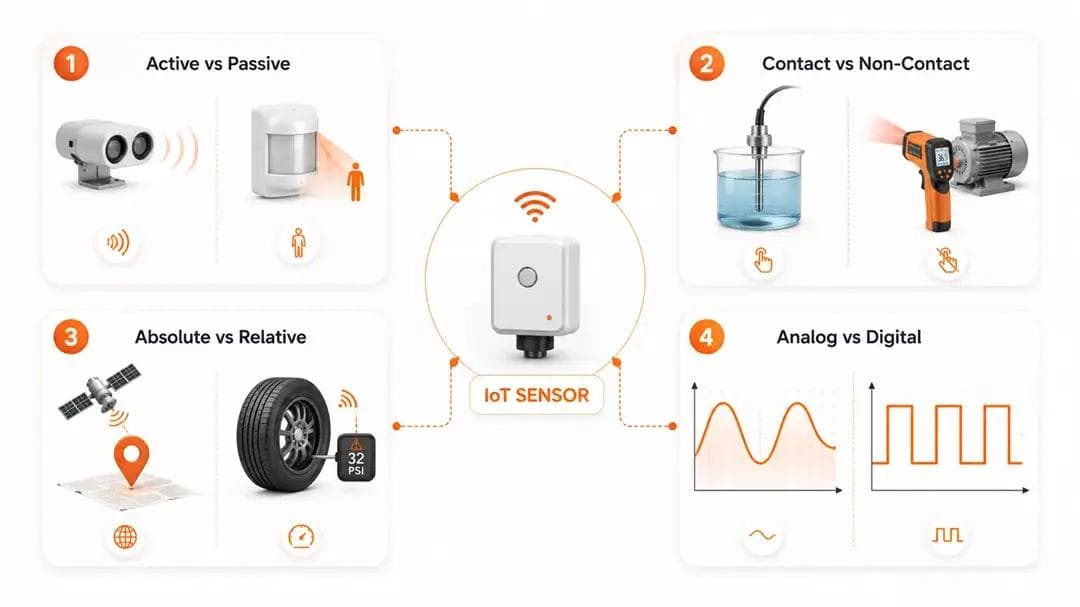
Active vs. Passive Sensors
Active sensors put energy into the environment to take measurements. An ultrasonic sensor, for example, emits sound waves and measures how long they take to bounce back.
Passive sensors do the opposite. They don't emit anything; they just respond to energy that's already there. A PIR motion sensor detects the infrared heat radiating naturally from the human body. No signal was sent, just received.
For battery-powered deployments where power consumption matters, passive sensors are usually the better fit. They're simpler, and they tend to last longer between charges.
Contact vs. Non-Contact Sensors
Some sensors need to physically touch what they're measuring. A temperature probe submerged in liquid. A pressure transducer bolts to a pipe. These are contact sensors.
Non-contact sensors work from a distance. An infrared thermometer reads a machine's surface temperature without touching it. That matters a lot in environments where contamination is a concern or where the equipment is constantly moving.
Absolute vs. Relative Sensors
An absolute sensor gives you a reading against a universal reference. GPS is the clearest example that your location coordinates don't depend on where you started.
A relative sensor measures change from a baseline. A tyre pressure sensor works this way. It tells you how far you are from the target pressure rather than giving you absolute physical value.
Analog vs. Digital Sensors
Analog sensors produce a continuous signal that mirrors a continuous change in the environment. As the temperature rises gradually, the output signal rises with it.
Digital sensors snap to discrete values, usually binary. Most modern IoT systems prefer digital sensors. They're far easier to integrate with microcontrollers and cloud platforms without needing extra conversion hardware in between.
IoT Sensor Types and Their Applications
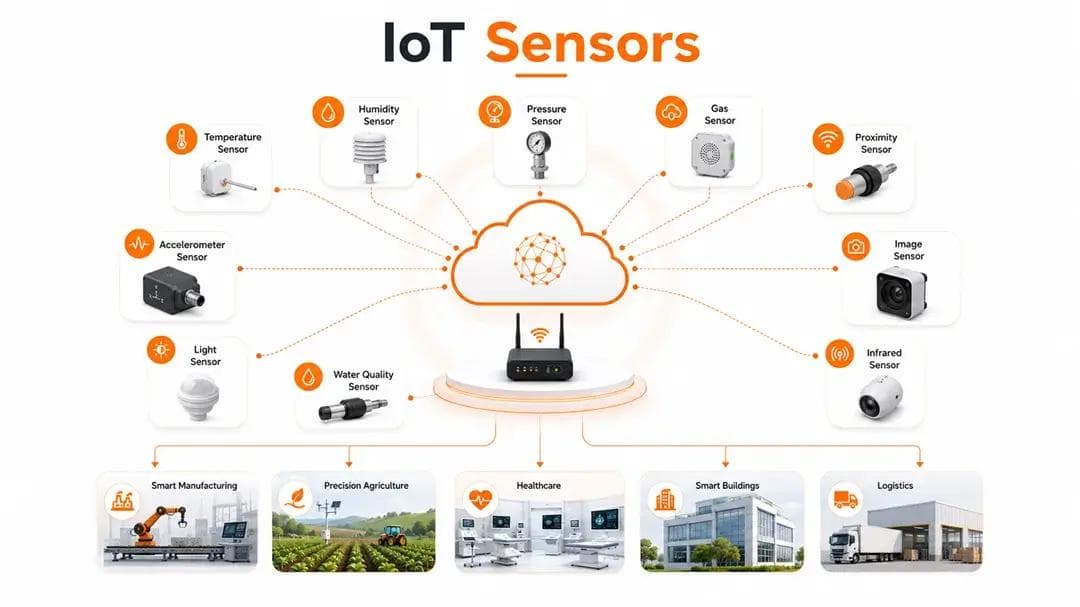
There are many IoT sensor types in use today. Each one is purpose-built for a specific job. Here's a quick reference before we get into the details:
| Temperature | Heat levels | Agriculture, HVAC, Cold chain |
|---|---|---|
| Humidity | Moisture in air | Farming, Food storage, data centers |
| Gas | Gas concentration | Industrial, Buildings, Agriculture |
| Smoke | Combustion particles | Buildings, Warehouses, Manufacturing |
| Proximity | Object presence | Retail, Manufacturing, Parking |
| Accelerometer | Vibration and motion | Industrial, Wearables, Logistics |
| Gyroscope | Rotation speed and direction | Drones, Robotics, Vehicles |
| Hall Effect | Magnetic field strength | EVs, Automation, Smart homes |
| Pressure | Force of gas or liquid | Pipelines, Healthcare, Agriculture |
| Level | Material fill height | Water management, Oil & Gas, Chemical |
| Water Quality | pH, TDS, Dissolved oxygen | Aquaculture, Utilities, Agriculture |
| Image | Visual data | Manufacturing, Agriculture, Smart cities |
| Infrared | Heat radiation | Security, HVAC, Industrial |
| Electro-Optical | Light-based detection | Automation, LiDAR, Infrastructure |
| Light | Ambient light intensity | Smart lighting, Farming, Buildings |
Now let's get into each one.
1. Temperature Sensors
An IoT temperature sensor is probably the most common sensor you'll come across in any industry. It works by detecting changes in electrical resistance or voltage as heat rises or falls.
They show up everywhere. Pharmaceutical companies rely on them to track cold chain conditions during shipment. Smart HVAC systems use live temperature readings to keep building climates stable without manual input. Farmers install them inside greenhouses to trigger ventilation or heating automatically. And on factory floors, they sit on motors and compressors as an early warning system flagging overheating long before a shutdown happens.
2. Humidity Sensors
Moisture in the air is invisible. But it affects almost everything about crops, server hardware, stored food, and pharmaceutical products. That's what humidity sensors are built to monitor. The reading they produce is called relative humidity, or RH.
Here's the thing about humidity sensor IoT deployments: you almost never see one working alone. It's almost always paired with a temperature sensor in the same module. A greenhouse sitting at 28°C with 90% humidity needs a very different response than that same greenhouse at 28°C with 40% humidity. One reading without the other gives you an incomplete picture.
Beyond agriculture, they protect server hardware from condensation, keep food storage conditions consistent, and help pharmaceutical manufacturers maintain product integrity during production.
3. Gas Sensors
Some of the most critical monitoring applications involve things you can't see at all. CO₂ is building up in an enclosed space. Methane is leaking from a pipe. Ammonia levels are rising in a livestock shed. Gas sensors exist precisely for this reason to detect what human senses can't catch in time.
The detection of technology inside varies electrochemical for some gases, catalytic bead for others, and infrared absorption for a third group. That last point matters more than it sounds. A sensor built to detect methane won't reliably catch CO₂. Matching the right technology to the right gas is one of the more consequential decisions in any gas monitoring project.
In industry, these sensors are an essential safety layer in refineries, chemical plants, and mining environments. In smart buildings, CO₂ sensors drive demand-controlled ventilation; the system only activates when air quality calls for it. In livestock facilities, ammonia monitoring keeps both animals and workers safe.
4. Smoke Sensors
A standard smoke alarm tells you there's smoke. That's where it stops.
An IoT-connected smoke sensor does quite a bit more. It sends a real-time alert to the building management system. It can trigger a sprinkler response. It logs to every incident automatically for compliance records. Advanced models can even differentiate between smoke types, which significantly reduces false alarms in industrial environments where dust and steam are constant.
You'll find them in warehouses, server rooms, manufacturing plants, and commercial buildings, typically integrated into centralized fire safety platforms rather than operating as standalone units.
5. Proximity Sensors
You'll find proximity sensors in more places than you'd expect, and they all solve the same basic problem: knowing whether something is there without touching it. The technology inside depends on the material being detected. Inductive sensors work for metal. Capacitive sensors handle almost any material. Ultrasonic sensors cover larger distances using sound reflection.
Smart retail uses them to understand how customers move around product displays. Manufacturing lines use them to verify part positioning before the next assembly step runs. Parking systems display available spaces in real time based on proximity sensor data. And on conveyor systems, they handle high-speed counting and sorting automatically.
6. Accelerometers
IoT sensors for predictive maintenance rely heavily on accelerometers, and it's easy to see why once you understand what they do. An accelerometer measures changes in velocity across one, two, or three axes. In industrial use, that means detecting vibration patterns in machinery running around the clock.
Unusual vibration is often the earliest sign of a developing problem. Bearing is starting to fail. A shaft is going slightly out of balance. These patterns show up in accelerometer data weeks before any visible damage appears. Catching it at that stage keeps lines running and avoids costly unplanned shutdowns.
Away from industry, accelerometers power step counting in fitness wearables, detect falls in elderly care devices, and record rough handling events in shipments.
7. Gyroscope Sensors
If accelerometers tell you how fast something is moving, gyroscopes tell you how it's rotating. They measure angular velocity, speed, and direction of rotation across three axes.
On their own, they're useful. Paired with an accelerometer, they become genuinely powerful. Together, the two sensors give you a complete picture of orientation and movement in three-dimensional spaces. Drones use this combination to hold stable during flight. Autonomous vehicles rely on it when the GPS signal isn't precise enough for safe navigation. Industrial robots depend on it for accurate, repeatable movements. Sports performance devices use it to analyze athletic techniques at a level of detail that wasn't achievable before.
8. Hall Effect Sensors
The operating principle here is straightforward. When a magnetic field passes through a Hall effect sensor, it produces a voltage change proportional to the field's strength. That's it.
What makes it useful is what it enables. You can track rotating components, motor shafts, gear positions, and wheel speeds without the sensor ever touching the moving part. In electric vehicles, Hall Effect sensors are embedded in motor controllers to manage speed and torque. In industrial automation, they handle position sensing in actuators and robotic joints. And in smart home systems, they're typically the technology behind door and window open/close detection.
9. Pressure Sensors
A pipe is losing pressure. A hydraulic system is running beyond its limits. A ventilator is not maintaining the right airflow. Pressure changes are often the first detectable sign that something is developing into a problem, and pressure sensors are what catches it early.
They measure the force a gas or liquid applies to a surface, with readings in Pascal, bar, or PSI. Industrial pipelines and HVAC networks use them for continuous health monitoring. In agriculture, soil pressure feeds into irrigation optimization. Healthcare devices embed them in blood pressure monitors and ventilators. And across water distribution networks, a pressure drop pattern can help pinpoint a leak before anyone needs to dig.
10. Level Sensors
Most facilities don't have someone walking around physically checking tank fill levels every hour. Level sensors do it automatically, measuring how much liquid or solid material is inside a container and reporting it in real time.
Ultrasonic variants are particularly common in IoT applications because they measure without touching the material inside. The sensor sits at the top of the tank and bounces sound waves off the surface below. That's important when the contents are in hazardous, corrosive, or pressurized situations where you don't want a probe making direct contact.
Water management systems use them to automate pump cycles. Oil and gas facilities track storage inventory continuously. Chemical plants rely on them to stay within safe fill limits. Smart irrigation systems monitor water availability for crops.
11. Water Quality Sensors
Manual water testing has a timing problem. Someone collects a sample, sends it to a lab, and waits days for results. By then, conditions may have already shifted significantly.
IoT water quality sensors solve this by measuring pH, dissolved oxygen, turbidity, electrical conductivity, and total dissolved solids continuously, from fixed locations, in real time. Aquaculture farms use this to keep fish healthy. Water utilities use it to detect contamination before it reaches consumers. Industrial wastewater facilities use it for ongoing compliance monitoring. In precision agriculture, it helps make sure irrigation water isn't creating more problems than it solves.
12. Image Sensors
For a long time, visual inspection meant putting a trained person in front of a production line. Image sensors have changed significantly.
They convert light into digital images or video, and in IoT systems, they bring consistent, always-on visual intelligence to processes that previously depended entirely on human presence. Manufacturing quality inspection is one of the bigger applications for catching surface defects, dimensional errors, and packaging faults at speeds and consistency levels that human inspection simply can't replicate at scale.
In precision agriculture, drone-mounted image sensors use multispectral imaging to assess crop health across large fields in a single flight. Smart cities use them for traffic flow analysis and pedestrian counting. Retail analytics platforms use them to understand movement patterns and monitor shelf stock levels automatically.
13. Infrared Sensors
Infrared sensors detect heat, the radiation that all objects emit naturally. In IoT, they actually serve two quite different purposes depending on how they're designed.
PIR-based sensors detect presence. They pick up changes in heat patterns in their field of view and are the technology behind lighting systems that switch off when a room is empty and HVAC systems that stop conditioning spaces no one is using.
Thermal infrared sensors measure surface temperature without any contact. This is what makes them useful for industrial equipment monitoring, fever screening in busy locations, and electrical panel inspections anywhere you need a temperature reading from a safe distance.
14. Electro-Optical Sensors
Light travels fast and precisely. That's what makes electro-optical sensors valuable for applications where speed and accuracy matter most distance measurement, high-speed object detection, and light-based data transfer.
On manufacturing lines, they handle fast, accurate part counting and positioning. In autonomous vehicles and mobile robots, LiDAR technology uses electro-optical principles to build real-time 3D maps of the surrounding environment and the spatial awareness that makes safe navigation possible. In structural health monitoring, laser-based electro-optical sensors can detect sub-millimeter movements in bridges and tunnels that traditional inspection methods would never catch.
15. Light Sensors
Light sensors, also called ambient light sensors or photodetectors, measure visible light intensity in an environment. Conceptually simple. Practically very useful.
Smart street lighting is the most widespread IoT application. Lights dim or switch off automatically based on how bright it is outside. Building systems balance natural daylight against artificial lighting throughout the day to cut energy use. Indoor farms track photosynthetically active radiation to get the most from their growing lights. Display devices adjust brightness based on the room around them. All this runs on light sensor data.
IoT Sensors Across Key Industries
Same sensors, very different outcomes depending on the context they're used in.
| Agriculture | Temperature, Humidity, Soil Moisture, Water Quality | Automated irrigation, greenhouse control, precision farming |
|---|---|---|
| Manufacturing | Accelerometer, Pressure, Temperature, Image | Predictive maintenance, defect detection, production monitoring |
| Smart Buildings | Occupancy, CO₂, Light, Smoke | Automatic lighting, HVAC control, energy savings |
| Healthcare | Accelerometer, Pressure, Temperature, Gas | Remote patient monitoring, smart beds, air quality control |
| Logistics | Temperature, Humidity, Accelerometer | Cold chain visibility, handling accountability, real-time alerts |
| Water & Utilities | Pressure, Level, Water Quality | Leak detection, tank monitoring, continuous safety checks |
What to Look for When Choosing an IoT Sensor
Getting your sensor selection right upfront saves time, cost, and a lot of reworks later. These six specifications matter most in practice.
| Accuracy | Margin of error vs. true value | Verify under real operating conditions datasheet numbers are best-case |
|---|---|---|
| Sensitivity | Smallest detectable change | Match to your actual threshold not the highest spec available |
| Power Consumption | Battery life for wireless devices | Look for sleep modes and duty cycling support |
| Operating Range | Min and max measurable values | Must cover all real conditions including seasonal extremes |
| Protocol Compatibility | Works with your gateway and platform | Confirm before purchasing mismatches; add cost and complexity |
| Environmental Durability | Dust and water resistance | Outdoor and industrial use typically needs IP65 or higher |
Conclusion
Sensors are where the physical world becomes data.
Every automated decision your IoT system makes, a valve that opens, an alarm that fires, a machine that adjusts, starts with a sensor measuring something real. Get the sensor layer right, and everything downstream works better.
Promeraki builds custom IoT cloud platforms around the sensor ecosystems our clients use. Whether you're working with one sensor type or many, across one site or hundreds, we build the infrastructure that turns sensor data into something your business can act on.
Your sensors generate data. We build a platform that makes it useful.
Promeraki designs custom IoT cloud platforms for OEM manufacturers and connected product teams.