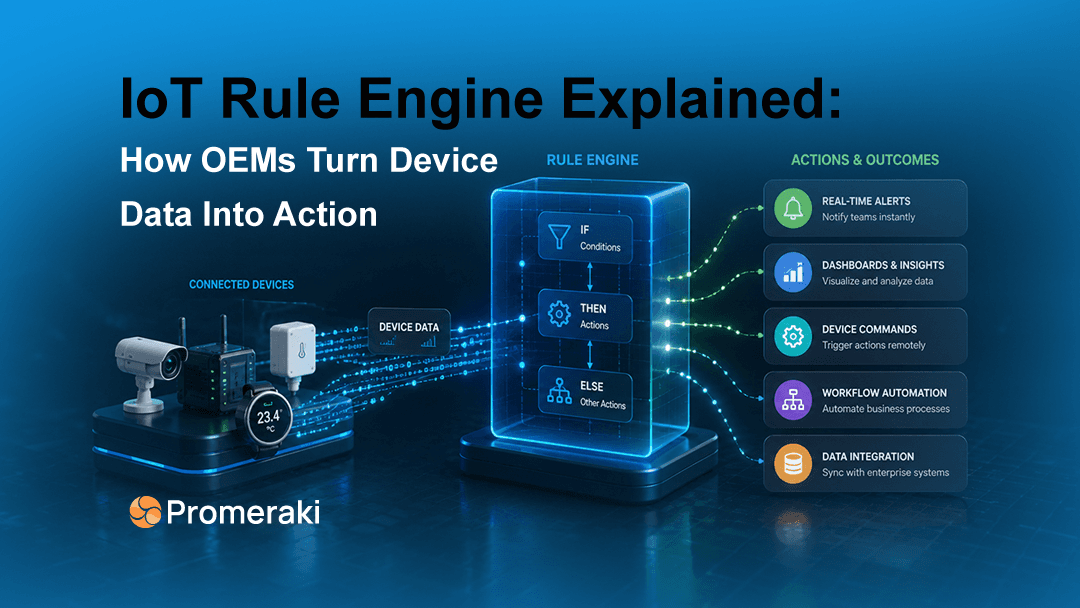
Your devices collect data every second. But data on its own doesn't do anything; someone, or soething, has to act on it.
That "something" is an IoT rule engine. It's the quiet workhorse that watches your device data, spots the moments that matter, and acts on its own with no human needs. For OEMs building connected products, it's often the difference between a product that just reports and one that responds.
Here's what a rule engine is, how it works, the kinds of rules it can run, and what to look for when you build one into your product.
What is an IoT rule engine?
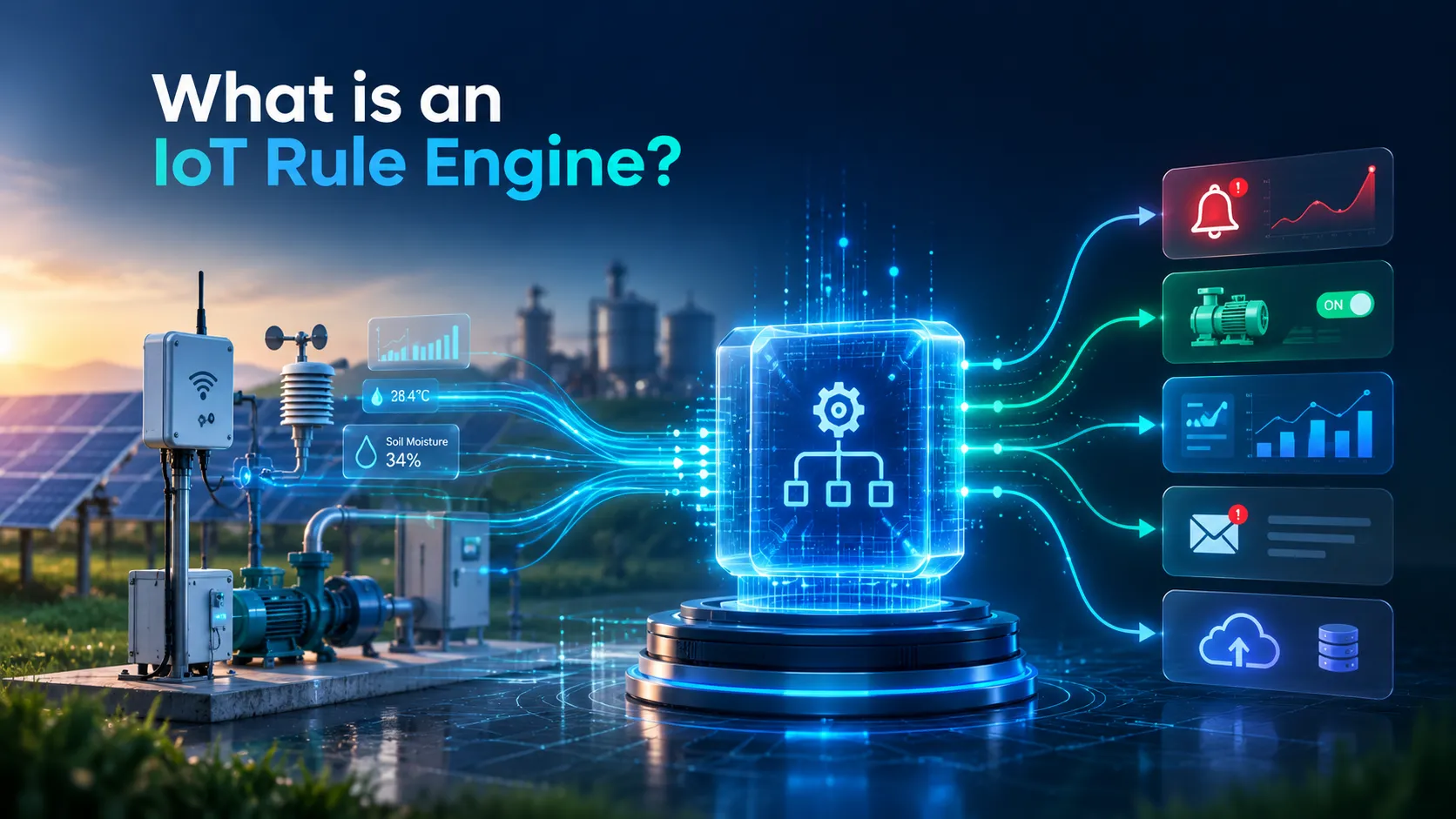
An IoT rule engine is the part of your platform that automatically acts on device data using simple "if this, then that" logic.
You set the rules once. The engine then watches every incoming reading, and the moment a rule’s conditions are met, it fires off the action you defined as an alert, a command to another device, a data update, or whatever you need. No one has to sit and watch a dashboard.
Put simply: it's the decision-making brain of your connected product. Sensors gather the data, and the rule engine decides what to do with it.
How does an IoT rule engine work?
Every rule follows the same simple three-part shape:
- Trigger: something happens (a sensor sends a new reading).
- Condition: the engine checks it against your rule (“Is the temperature above 80°C?").
- Action: if the condition is true, the engine acts (send an alert, shut a valve, log the event).
Here's a real-world example. A leak sensor reports water. The rule engine checks the rule "if a leak is detected" and instantly sends a command to shut the water valve. All in a fraction of a second, with no person in the loop.
The power comes from stacking many of these rules together. One product can run hundreds of them at once, handling routine decisions so your team doesn't have to.
Types of rules an IoT rule engine can run
Not every rule is a simple over-the-limit check. A good rule engine handles several kinds, and knowing them helps you design smarter automation:
- Threshold rules: act when a value crosses a set limit. If pressure goes above 5 bar, send an alert. The simplest and most common type.
- Event rules: act when a specific event happens, not a number. If a door opens or if a leak is detected.
- Time-based rules: act on a schedule or after a delay. Every night at 2 a.m., run a system check, or if a fault lasts more than 10 minutes, escalate.
- Composite rules: combine several conditions at once. If the temperature is high and the cooling fan is off, shut down the machine. These handle the real-world situations a single condition would miss.
Most useful products lean on a mix of all four. Threshold and event rules cover the obvious cases, while time-based and composite rules catch the subtler situations that actually prevent problems.
What OEMs use rule engines for
A rule engine isn't a single feature; it's a toolkit for automating almost anything your product needs to do. The most common uses:
- Automated alerts: notify the right person when a reading crosses a limit.
- Device-to-device actions: let one device trigger another, like a leak sensor closing a valve.
- Data routing and filtering: send only the data that matters to storage, dashboards, or other systems, and skip the noise.
- Safety and shutdowns: automatically power down or protect equipment before damage is done.
- Workflow triggers: kick off an action in another system, like creating a support ticket or updating a customer's app.
The common thread: turning raw data into a real response. As the saying in the industry goes, nobody wants the data itself; they want the outcome it leads to.
A quick example: rules working together
Say you're an OEM building a smart water system. On its own, each rule is simple. Together, they run the product:
- A leak sensor triggers - the engine shuts the valve and alerts the owner.
- Water pressure drops too low - the engine flags a possible pipe issue.
- No usage for 24 hours - the engine sends a check your system nudge.
None of these needs a person. That's the real value of a rule engine dozens of small, sensible decisions handled automatically, all day long.
Where the rule engine runs: cloud vs. edge
Rules can run in two places, and OEMs often use both.
A cloud rule engine runs on the server. It's easy to manage, simple to update, and works best with a steady connection, perfect for rules that pull in data from many devices or outside systems.
An edge rule engine runs on or near the device itself. It reacts instantly and keeps working even with no internet, which makes it ideal for safety-critical actions like an emergency shutdown.
The best products usually split the work. Time-critical, safety-related rules run at the edge so they respond instantly, while broader, data-heavy rules run in the cloud where they're easy to manage. Choosing the right split for your product is one of the more important design decisions you'll make.
Rule engine vs custom code: why OEMs choose a rule engine
You could hardcode all this logic directly into your product. Many teams start that way. But as the product grows, hardcoded logic becomes harder to manage; every small change means a developer, a new build, and a firmware update pushed to every device.
A rule engine takes a different path. The logic lives in a configurable layer you can change any time, without touching the core code. Here's how the two compare:
| Factor | Custom-Coded Logic | Rule Engine |
|---|---|---|
| Changing a rule | Needs a developer and a new build | Update it in minutes, no rebuild |
| Speed to launch | Slower, everything is bespoke | Faster rules are configured, not coded |
| Who can manage it | Developers only | Product and ops teams too |
| Scaling logic | Harder as rules pile up | Handles many rules cleanly |
| Updating devices | Firmware push every time | Often no device update needed |
For OEMs shipping products at scale, that flexibility is the whole point. Your product can evolve new rules and new behaviours without a firmware update for every tweak.
What to look for in an IoT rule engine
Not all rule engines are equal. If you're building or choosing one for your product, these are the features that matter most:
- Flexible conditions: support for simple thresholds and more complex, multi-step logic.
- Low-code setup: So, product and ops teams can create rules, not just developers.
- Real-time speed: Actions fire the instant when a condition is met.
- Easy integrations: Connect cleanly to alerts, dashboards, and outside systems.
- Scalability: Run thousands of rules across a large fleet with ease.
- Multi-tenant support: Manage rules cleanly across different customers or product lines.
- Edge and cloud options: Run rules where each one makes the most sense.
Get this right, and your rule engine becomes a genuine product advantage, one that lets you ship smarter features faster.
Conclusion
A connected product that collects data is good. One that acts on it is complete.
The rule engine is what makes that leap, turning every reading into a response, automatically and in real time. For OEMs, it's the layer that lets your product do something useful without a person watching over it and lets you add new behaviour without rebuilding the whole thing. Get your rule engine right, and your product gets smarter every time you add a rule.