Introduction
Manufacturing has always been about doing more with less waste, less downtime, and less guesswork. But for a long time, the tools available to manufacturers made that genuinely difficult. Machines broke without warning. Energy got wasted without anyone noticing. Quality issues showed up too late to fix cheaply.
Industrial IoT is changing that.
It connects your factory equipment to real-time data, so instead of finding a machine failed after it stops your production line, you know it's heading toward failure days in advance. Instead of estimating energy waste, you see it happening live. Instead of reacting to problems, you start preventing them.
This guide walks you through everything what Industrial IoT actually is, how it works inside a real manufacturing setup, and what it can realistically deliver for your business.
What Is Industrial IoT (IIoT)?
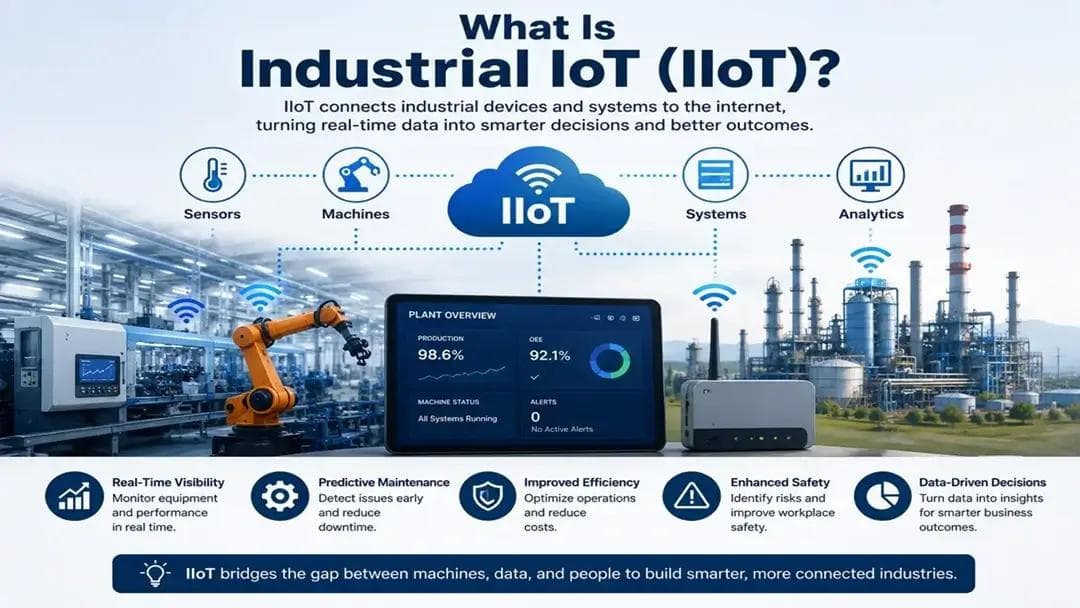
Industrial IoT, or IIoT, is the use of connected sensors and smart devices in factories, plants, and industrial facilities to collect and use real-time data from machines.
In plain terms, your machines start talking to your business systems automatically, continuously, and in real time.
Instead of an operator manually checking equipment and recording numbers on paper, sensors attached to machines do that job around the clock. They track temperature, vibration, pressure, energy use, and more. That data flows into a platform that analyzes it, spots problems, and sends alerts before anything goes wrong.
IIoT doesn't just collect data. It helps you act on it.
TL;DR
- Industrial IoT connects factory machines to real-time data, helping manufacturers reduce downtime, cut costs, and improve operations.
IIoT vs. IoT: What's the Difference?
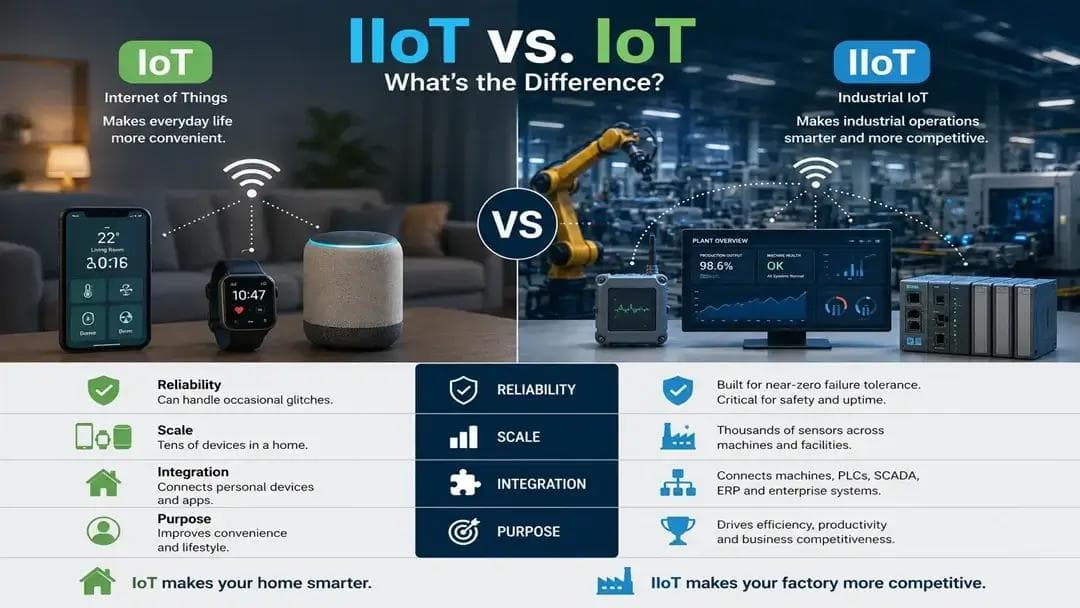
IoT stands for Internet of Things, and it includes everyday smart devices like your phone, fitness tracker, or smart home speaker.
IIoT is the industrial version of that. The underlying technology is similar, but the application and the stakes are completely different.
Your smartwatch telling you to stand up is IoT. A sensor on a factory machine detecting a vibration pattern that signals a bearing failure three weeks before it happens that's IIoT.
The key differences are:
Reliability. Consumer IoT devices can handle occasional glitches. In a manufacturing plant, sensor failure or data delays can mean safety risks and costly production loss. IIoT systems are built for near-zero failure tolerance.
Scale. A smart home has maybe 20-30 devices. A single manufacturing facility can run thousands of IIoT sensors across dozens of machines simultaneously.
Integration. IIoT connects not just devices but entire systems, machines, PLCs, SCADA, and ERP platforms into one unified view of your operations.
Simply put: IoT makes your home smarter. IIoT makes your factory more competitive.
How Does IIoT Work?
IIoT follows a simple logical flow from your machines to the insights that drive better decisions.
Step 1: Sensors capture data
Sensors attached to machines measure physical variables like temperature, pressure, vibration, and energy. They do this continuously, 24/7, without manual input.
Step 2: Data travels through the network
That data needs to be moved somewhere. Common industrial protocols like MQTT (a lightweight messaging format ideal for sensors) and OPC UA (a standard for secure machine-to-machine communication) handle this. Connectivity can be wired or wireless depending on your setup.
Step 3: Edge computing processes data locally
Not everything needs to go to the cloud before being acted on. Edge computing processes data at or near the machine. This speeds up response times and is especially useful for real-time decisions like stopping a defective product before it moves down the production line.
Step 4: Cloud platforms store and analyze
Data that needs deeper analysis goes to a cloud or on-premises IIoT platform. This is where machine learning models identify patterns; dashboards are built, and enterprise-wide visibility is created.
Step 5: Insights drive action
Maintenance teams get alerts. Operations managers see live OEE scores. Energy managers spot waste. The whole point is that your team gets the right information at the right time without manually hunting for it.
Key Benefits of IIoT for Manufacturers
1. Predictive Maintenance
This is the most popular IIoT use case for good reasons. Instead of waiting for machines to break (reactive) or servicing them on a fixed schedule whether they need it or not (preventive), predictive maintenance uses sensor data to flag a problem before it causes downtime.
Unplanned downtime costs industrial manufacturers $50 billion every year, and a single hour of downtime at one factory can cost over $260,000. Predictive maintenance directly addresses this. Research shows that 95% of companies that adopt predictive maintenance report a positive ROI, with 27% recovering their full investment within 12 months.
2. Better Equipment Efficiency
IIoT gives you real-time visibility into how every machine is performing. Bottlenecks get caught faster. Idle time is reduced. Production targets are met more consistently without adding headcounts.
3. Energy Cost Reduction
IIoT monitors energy consumption at the machine level. You can see exactly where energy is being wasted, schedule high-consumption processes during off-peak rate periods, and reduce overall utility costs. Manufacturers using IIoT-powered operations tools have reported up to a 25% reduction in their environmental footprint.
4. Real-Time Quality Control
Catching defects at the end of a production line is expensive. IIoT enables continuous in-process quality monitoring sensors to check conditions, cameras inspect products at production speed, and alerts fire the moment something drifts out of spec. Less scrap. Less rework. Fewer customer complaints.
5. Supply Chain Visibility
Connected tracking across your supply chain means you know where your materials are, when they arrive, and whether in-transit conditions (like temperature for sensitive goods) are within an acceptable range. Fewer surprises. Fewer production stoppages caused by supply issues.
6. Workplace Safety
Sensors can monitor hazardous conditions, gas leaks, excessive heat, and dangerous noise and trigger immediate alerts or automatic shutdowns. Wearables can track worker location in high-risk zones. The result: a safer workplace with fewer incidents.
Top IIoT Use Cases in Manufacturing
- Predictive maintenance sensors monitor rotating equipment, motors, and pumps. Companies using AI-driven analytics on equipment data can cut unplanned downtime by up to 50%, reduce maintenance costs by around 25%, and extend asset life by 20 to 40%. Tetra Pak, for example, used predictive analytics on its packaging machinery and saved one client over 140 hours of potential downtime through preemptive maintenance scheduling.
- Asset tracking real-time location of tools, molds, pallets, and equipment using RFID or Bluetooth tags. No more time was lost searching. Faster changeovers. Fewer losses.
- Remote monitoring manufacturers with multiple sites can monitor all facilities from one dashboard for equipment health, alarms, and KPIs visible in one place without requiring on-site presence.
- Energy management sub-meters track energy per machine. Automated controls switch off idle equipment or shift loads to low-tariff windows automatically.
- Quality inspection machine vision cameras catch defects at production speed. Environmental sensors ensure process conditions stay within specifications in clean rooms and precision environments.
- SCADA integration IIoT doesn't replace your SCADA system; it extends it. Legacy SCADA infrastructure connects with modern cloud analytics, enabling AI-driven insights and remote access that traditional SCADA wasn't designed to provide.
Common IIoT Challenges and How to Solve Them
Legacy Equipment
Most factories have machines that weren't built to be connected. Industrial gateways act as translators collecting data from older equipment and converting it into formats modern IIoT platforms can use. You don't need to replace everything to get started.
Cybersecurity
Every connected device is a potential entry point. Cybersecurity concerns affect 36% of IoT deployments. The answer is network segmentation (keeping your OT and IT networks separate), end-to-end encryption, strict access controls, and regular security audits.
Data Overload
IIoT generates enormous data volumes. Without the right setup, it becomes noise. Edge computing filters data from the source. Clear KPI frameworks ensure only actionable data reaches your team.
Skills Gap
IIoT needs people who understand both operations and technology. Training existing staff is often more practical than hiring from scratch. Working with an experienced IIoT implementation partner is the fastest path in the early stages.
High Upfront Cost
Full-scale IIoT deployment takes real investment. The solution: start small. A focused pilot on your most critical equipment can prove ROI quickly and build confidence for a broader rollout.
IIoT Market Size & Trends in 2026
The global IIoT market was valued at USD 514 billion in 2025 and is projected to reach approximately USD 2,430 billion by 2035, growing at a CAGR of 16.8%. In 2026 alone, the market is assessed at USD 309.71 billion, with manufacturing leading adoption.
The trends shaping IIoT right now:
Edge AI: AI processing is moving closer to the machine, enabling real-time intelligence without cloud roundtrips.
Private 5G: High-speed, low-latency wireless is making new use cases possible, from autonomous robots to live video analytics on the factory floor.
Digital Twins: Real-time virtual replicas of machines, fed by IIoT data, let manufacturers simulate changes and test scenarios before touching anything physical.
Sustainability: IIoT's energy optimization and waste reduction capabilities are aligned with corporate ESG goals, adding another business driver to adoption.
How to Get Started with IIoT: A Simple Roadmap
Starting with IIoT doesn't mean overhauling your entire factory at once. The most successful implementations are focused and phased.
Define your problem first
What costs you the most downtime, energy waste, or quality failures? Start there.
Audit your current setup
Know what equipment you have, what data (if any) it already generates, and what connectivity infrastructure exists.
Run a pilot
Pick one machine, one production line, or one high-value problem. Deploy sensors, connect to a platform, and measure results against a clear baseline.
Choose the right platform
Evaluate IIoT platforms on integration capability, protocol support, security, and scalability, not just features.
Train your team
Technology doesn't deliver value on its own. Make sure your maintenance and operations staff know how to use the tools and interpret the data.
Measure and scale
Once your pilot proves ROI, use that data to expand more machines, more facilities, and more use cases.
Conclusion
IIoT is not a future concept; it's happening on factory floors right now. Manufacturers who are adopting it are reducing downtime, cutting costs, improving quality, and building operations that can adapt faster to change.
Technology is more accessible than ever. And the starting point is simpler than most people think: find your biggest operational pain point, run a focused pilot, and build real results.
The factory of the future runs on data. IIoT is what makes that data work for you.
Ready to connect to your factory floor?
Promeraki helps manufacturers implement IIoT solutions that deliver real, measurable results.