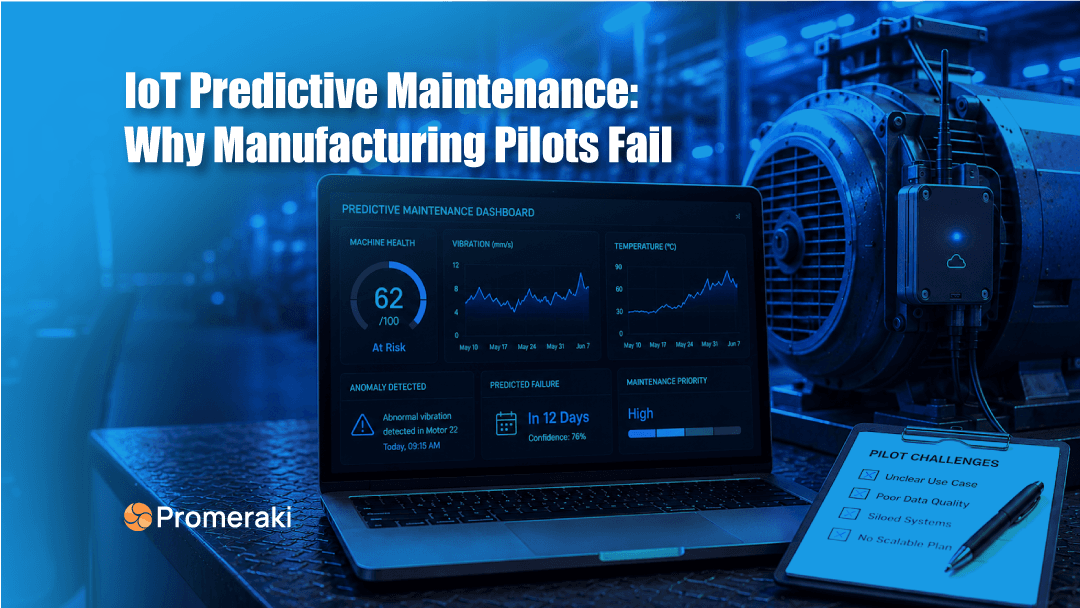
Most predictive maintenance pilots work. That's the strange part.
A manufacturer picks one critical machine, wires it with sensors, streams the telemetry to a model, and within a few months the model catches a fault before it becomes a breakdown. Everyone's happy. The pilot gets a green light.
Then the rollout begins and stalls.
IoT predictive maintenance in manufacturing has a quiet failure pattern, and it's the same one that breaks IoT platforms in general: the proof of concept works at 50 devices, then production falls apart at 5,000. If you're building the platform that's supposed to deliver predictive maintenance to your own plant or to your customers, this is about why those rollouts stall and how to design so yours doesn't.
In a Nutshell
- Predictive maintenance pilots rarely fail on tech. They stall on messy data, old machines, missing failure history, and alerts nobody owns at scale.
The Pilot-to-Production Gap
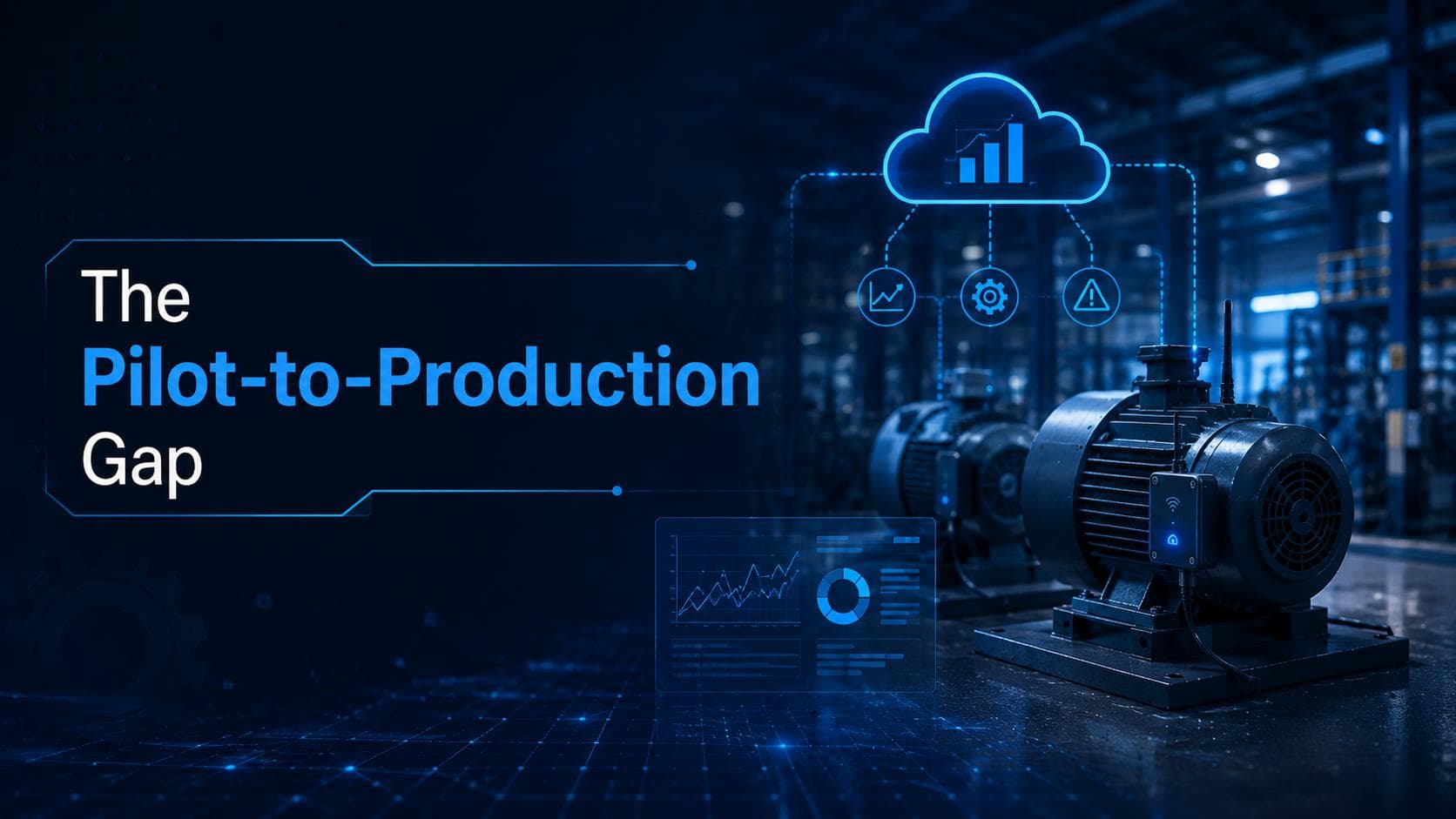
A pilot and a production system aren't the same project at different sizes. They're different projects.
A pilot is one machine, watched closely by one engineer who cares about the outcome. Data gaps get patched by hand. The model gets babysat. Nobody has to trust it yet, because a human is standing right next to it.
Production is thousands of machines across multiple device types, firmware generations, and protocols monitored by a team that never asked for any of this. Nobody's babysitting anything. The telemetry must arrive clean on its own; the model has to earn trust it hasn't earned yet, and every alert must land somewhere a person will act on it.
So why do predictive maintenance pilots fail? Mostly, they don't. The pilot works fine. What fails is everything the pilot was allowed to ignore messy data, old machines, missing failure records, and alerts nobody owns. Here are those four, to bite.
Failure 1: Your Data Isn't Ready
Predictive maintenance runs on data. The pitch decks make that data sound like it's already sitting there, ready to use. It is almost never.
Sensor Data Isn't Usable Data
A vibration sensor produces a stream of numbers. A model needs something different: a clean, evenly sampled, labeled record of how the machine behaves when it's healthy and how it behaves when it's about to fail.
The gap between those two is where projects sink. Sampling rates are too low to catch the fault. Uplinks that drop out for hours with nobody noticing. Timestamps drifting between devices. The data exists, but it can't answer the question you're asking it.
Getting Data Out of SCADA and Historians
Most plants already collect machine data. It lives in a SCADA system or a historian, often behind a protocol built in a different decade. Pulling it out cleanly, continuously, without disrupting the line is real engineering work, and it's exactly the firmware-to-cloud seam where platforms tend to leak.
This is where data integration swallows timelines. Bridging OPC-UA, wiring MQTT at the edge, and standing up a gateway that doesn't fall over none of it is glamorous, and all of it has to work before the model sees a single row.
Failure 2: Legacy Machines Resist Retrofit
The machines that most need predictive maintenance are usually the oldest ones. They're also the hardest instruments.
What Retrofitting a 20-Year-Old Machine Involves
A modern machine ships with sensors and a data port. A twenty-year-old press ships with neither. You're adding condition monitoring to something that was never designed to be monitored.
That means external sensors; careful placement so vibration analysis reflects the fault you care about; and a way to get the signal out without touching the control system that keeps the machine running. Non-invasive sensors help, but every added machine is its own small project, not a copy-paste. Across a mixed fleet with several firmware generations, that variance is the real cost.
When Retrofit Costs More Than the Failure
Here's the question most vendors won't ask out loud: is this machine worth instrumenting at all?
If a full retrofit costs more than the downtime it prevents, the answer is no. Some machines fail rarely, or fail cheaply, or are near the end of life. Predictive maintenance on those is a cost, not a saving. Knowing which machines to skip is as valuable as knowing which to watch.
Failure 3: No Labeled Failure History
This is the failure nobody sees coming and often the one that kills the model outright.
To predict a failure, a model needs to have seen failures before enough examples, correctly labeled, to learn the pattern that leads to one. Most plants don't have that.
What they have is eighteen months of clean operating data and almost no labeled breakdowns. The machines have been running fine, good for the business and terrible for the model. This is the cold-start problem, and it's the gap most vendor content quietly skips.
You can work around it: anomaly detection instead of failure classification, physics-based thresholds, or a deliberate period of collecting and labeling faults as they occur. But you have to design it from day one. A pilot on one well-understood machine hides this completely. Scale to machines you have no failure history for, and it surfaces all at once.
Failure 4: Nobody Owns the Alert
Say the data is clean, the machines are wired, and the model works. You can still fail here, and this failure is organizational, not technical.
The model fires an alert. It lands in an inbox, or a dashboard, or nowhere in particular. The maintenance team, already busy, isn't sure whether to trust it. They ignore one. Nothing breaks. They ignore the next. Within six weeks, the alerts are noise, and the system is dead, not because it was wrong but because no one owned the response.
From Alert to Work Order
An alert that doesn't turn into action is worthless. The fix is to connect the model to the systems the maintenance team already uses. When a prediction automatically opens a work order through a CMMS integration or a platform rule engine, it enters a workflow people already follow. It stops being a suggestion and becomes a task.
Alert Fatigue and Threshold Tuning
Too many alerts is as fatal as too few. A model tuned to catch everything cries wolf, and the team stops listening. Getting thresholds right, sensitive enough to catch real faults and quiet enough to stay trusted, is ongoing work, not a one-time setting. Trust is the real product here, and it's fragile.
What Predictive Maintenance Actually Costs and Returns
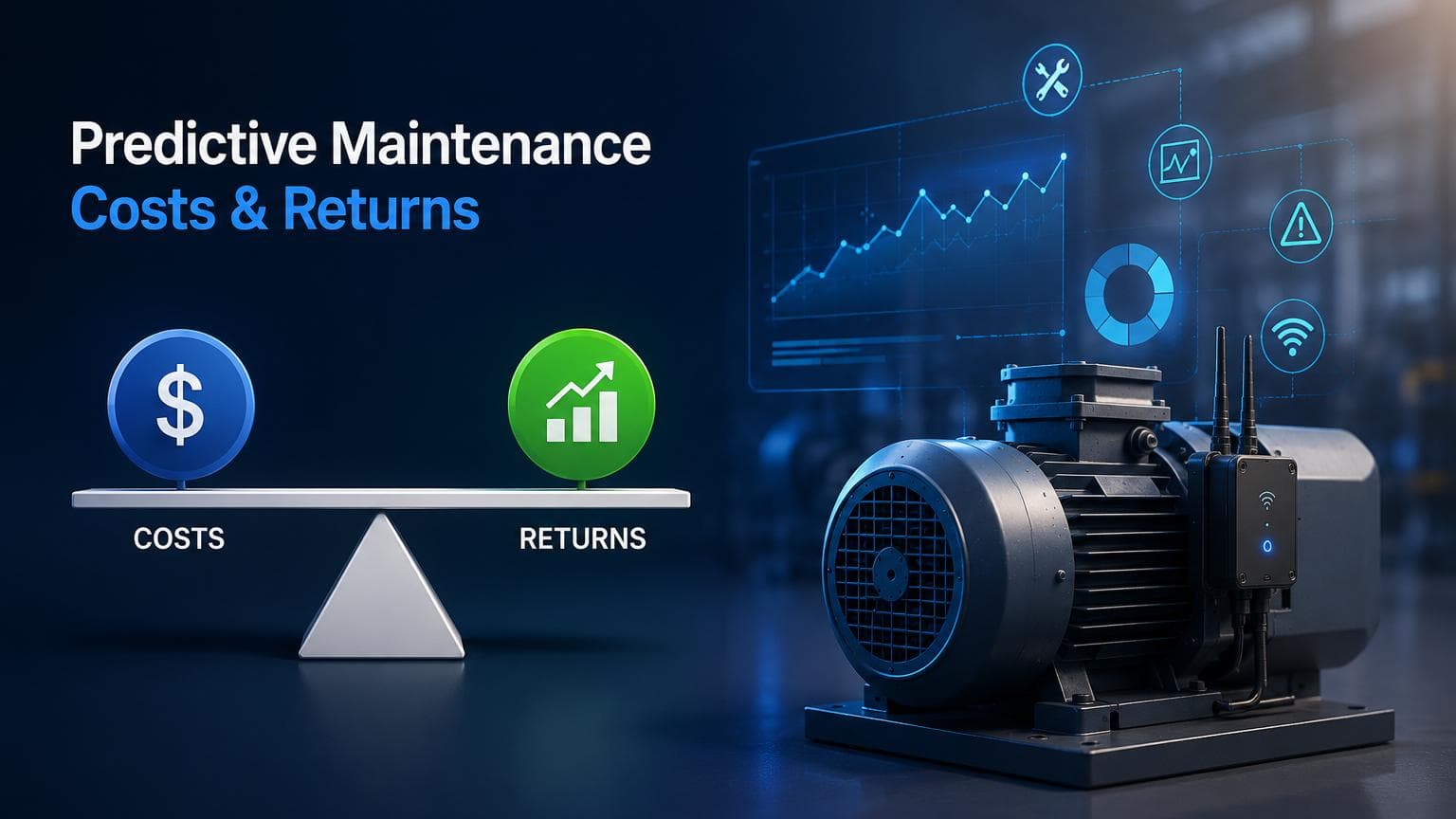
Every stalled rollout above has a budget behind it that was set too low because the pilot cost got mistaken for the production cost.
The real bill has more lines: sensors, edge gateways, integration work, the model itself, and the one everyone forgets ongoing tuning and upkeep. The return is real, but it shows up after that full cost, not before it.
The Downtime Cost Calculation Most Manufacturers Get Wrong
The savings side gets miscalculated too. Manufacturers count the repair cost of a breakdown and stop there. The real cost of unplanned downtime is bigger: lost production hours, idle staff, missed delivery dates, rushed replacement parts, and the delays that ripple down the line. Predictive maintenance pays itself against that number, the full cost of the line being down, not just the price of the broken part.
An Architecture That Survives Production
Pilot architecture and production architecture look nothing alike. The pilot can be held together by hand. Production has to run on its own, the same principle behind any platform designed for scale from day one rather than patched into it later.
The shape that survives moves data along a clear path: from sensors at the machine to an edge gateway that handles collection and buffering; to a platform where the model runs, and telemetry is stored; and finally into the systems where predictions become work orders. Each stage does one job and hands off cleanly to the next. Built this way, the cost per device falls as the fleet grows instead of climbing.
A Realistic Sequence: Pilot to Plant-Wide
Rollouts that work tend to follow the same order:
- Start with one machine class, not one machine, so what you learn transfers to its siblings.
- Collect and label failure data deliberately, knowing the cold-start problem is coming.
- Validate the model against real faults before you trust it anywhere.
- Wire alerts into a real workflow so they become work orders from the start.
- Then scale, one machine class at a time, carrying the integration work forward instead of rebuilding it.
The order matters. Most stalled projects tried to scale before step four and drowned in alerts nobody owned.
Conclusion
Predictive maintenance pilots don't fail because technology doesn't work. They fail in the gap between a machine watched by hand and a plant that has to run on its own messy data, stubborn old machines, missing failure history, and alerts with no owner. It's the same gap that separates a 50-device demo from a production fleet, which is where most of this hard-won lesson comes from.
Get those four rights, and IoT predictive maintenance in manufacturing does exactly what it promises. Get them wrong, and you have a successful pilot that never ships.
If you're staring at that gap right now or building the platform that has to cross it, talk to an IoT expert at Promeraki. Tell us your fleet and your machine mix, and we'll tell you what's worth instrumenting first.