Connected devices now power factories, vehicles, buildings, energy systems, and healthcare infrastructure. Sensors monitor operations. Controllers automate actions. Software transforms device data into real decisions.
Connecting those physical devices to reliable software platforms is exactly what custom IoT development delivers.
The number of connected devices continues to rise rapidly. Behind every connected device sits a critical platform decision.
The architecture chosen today determines whether a connected product scales successfully or struggles under operational complexity.
Many companies start with generic IoT platforms such as AWS IoT, Azure IoT, or ThingsBoard. These tools work well for early experiments and prototypes. But as device fleets grow and products mature, limitations appear. Protocol mismatches, rigid data pipelines, and vendor pricing structures begin to slow innovation.
Custom IoT development solves this challenge.
Instead of adapting your product to fit a platform, engineers design a platform specifically for your product. Every layer, from device firmware to cloud analytics, aligns with your hardware, your data, and your operational workflows.
This guide explains what custom IoT development means, how custom IoT solutions are designed and implemented to meet specific business needs, and how the development lifecycle works.
What Is Custom IoT Development?
Custom IoT development is the engineering practice of designing and building a complete connected system from the ground up, including firmware, connectivity, cloud platform, data pipelines, and applications, specifically for one company's product, hardware, and operational requirements.
The distinction from using a ready-made IoT platform is architectural, not cosmetic. A generic platform gives you building blocks you configure to approximate a solution. Custom IoT platform development gives you a system where every component, from the bytes in your device firmware to the queries powering your dashboards, exists for your use case and no one else's.
IoT software development at this level covers five domains, and each one is engineered for your product, not adapted from a template:
A fully custom IoT system covers five domains:
- Device firmware
Embedded software running on the hardware that manages sensors, power usage, communication, and on-device logic.
- Connectivity architecture
The protocol stack and networking layer that move data securely and reliably from devices to the cloud.
- Edge processing
Computation is performed on the device or gateway before data reaches the cloud, enabling faster responses and reduced network load.
- Cloud platform
Backend infrastructure is responsible for device management, data ingestion, storage, processing, and analytics at scale.
- Applications and dashboards
User interfaces are used by operators, customers, and analysts to monitor devices, analyze data, and manage connected systems.
Custom IoT Development vs Generic IoT Platforms
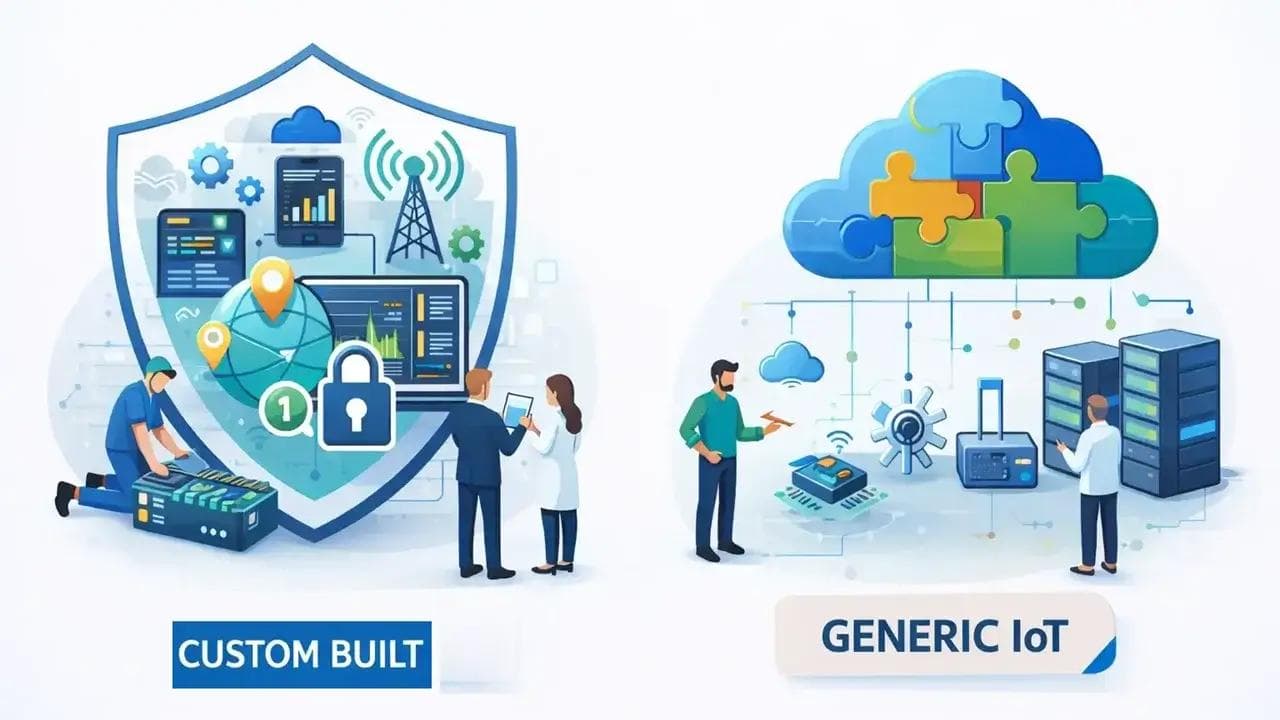
| Feature | Custom IoT Development | Generic IoT Platform |
|---|---|---|
| Product fit | Designed specifically for your product | Configured from generic building blocks |
| Hardware support | Works with any hardware and protocol | Limited to supported devices |
| Scalability | Architecture built for your fleet size | Platform-defined limits |
| Enterprise integration | Deep native integrations | Connector-based integrations |
| Data ownership | Full control over infrastructure and data | Data stored in vendor systems |
| Vendor dependency | None | High |
| Security model | Tailored to industry requirements | Standardized policies |
| Initial investment | Higher upfront development cost | Lower startup cost |
| Long-term cost | Infrastructure controlled by you | Vendor pricing scales with usage |
Why Companies Choose Custom IoT Development
Most companies do not start with custom IoT development on day one. Many begin with a generic platform to test ideas and launch early versions of their product.
The shift to custom development usually happens when the product grows. Device fleets are expanding. Data volumes increase. Systems need deeper integrations. At that stage, companies need architecture designed specifically for their product.
Here are the main reasons businesses move toward custom IoT platforms.
Architecture That Scales with Your Device Fleet
A small deployment with a few hundred devices works well on most platforms. But large device fleets create different challenges.
When a system manages tens of thousands of devices, the platform must handle high volumes of messages, large data streams, and large-scale device updates.
For example, an agricultural platform with 200,000 sensors or an industrial monitoring system with 50,000 machines needs infrastructure designed for that scale.
Custom IoT platforms are built to support the exact device volumes and data flows a business expects.
Native Integration with Enterprise Systems
IoT data often connects with many other business systems.
Maintenance alerts may flow into SAP. Equipment performance data may update Salesforce workflows. Energy data may feed into energy management platforms. Production data may sync with ERP systems.
A custom IoT platform integrates directly with these systems. Engineers design integrations to match how the company already operates. This removes the need for complex middleware and repeated data conversions.
Firmware Designed for the Hardware
Every connected device has different technical constraints.
Some devices have run on batteries for years. Others operate in harsh environments. Many devices communicate over unreliable networks.
Custom firmware development allows engineers to design software specifically for the device hardware.
For example, firmware can manage power consumption to extend battery life, retry communications when networks fail, or store data locally when connectivity drops.
This level of optimization is difficult to achieve with generic solutions.
Full Control Over Data
Device data becomes valuable over time. It supports analytics, automation, and product insights.
When companies rely entirely on third-party platforms, their data pipelines often run inside vendor infrastructure.
With custom IoT platforms, companies design and control the entire data pipeline. They define how data is collected, processed, stored, and analyzed.
This level of control is especially important in industries such as healthcare, manufacturing, and energy, where data compliance and long-term analytics matter.
Product Ownership and Long-Term Control
Platform vendors evolve their products constantly. Pricing models change. APIs change. Features get replaced or removed.
When a connected product depends heavily on a third-party platform, those changes can affect the product's roadmap.
Custom IoT development gives companies full ownership of their platform. They control the architecture, features, and future development.
The platform evolves with the product instead of following a vendor’s roadmap.
Ready to Move Beyond the Generic Platform?
If your device fleet is growing, integrations are getting complex, and generic solutions are slowing you down, it's time to go custom.
Key Components of a Custom IoT System
A custom IoT system works as a layered architecture. Each layer supports the others and is designed specifically for the devices, data flow, and operations of the business.
The decisions made at every layer directly affect system performance, reliability, and scalability.
IoT Devices and Sensors
Devices are the starting point of any IoT system. Sensors collect real data that the platform later processes and analyzes.
Common examples include temperature sensors, vibration monitors, energy meters, humidity sensors, location trackers, and gas detectors.
Choosing the right hardware is critical because it determines how accurate the data will be, how long the device can run on battery, and how reliable the system remains in real environments.
In custom IoT development, engineers select hardware that matches the deployment environment or design custom boards when existing hardware does not meet the requirements.
Firmware is also written specifically for that hardware. It controls how sensors collect readings, how often the device transmits data, how power consumption is managed, and how the device stores data when connectivity becomes unstable.
Connectivity Layer
Once devices collect data, the system must transmit that data to backend platforms. The connectivity layer handles this communication.
Different deployments require different communication protocols.
- MQTT works well for lightweight and frequent device telemetry.
- HTTP or HTTPS is useful for structured data exchange and command communication.
- LoRaWAN supports long-range and low-power communication for remote environments such as agriculture or utilities.
- Cellular technologies such as LTE-M or NB-IoT connect to mobile or widely distributed devices.
- Zigbee, Thread, and BLE mesh networks support dense sensor environments like smart buildings.
- Wi-Fi or Ethernet works best for industrial machines and fixed infrastructure with reliable network access.
A custom connectivity architecture selects the right protocol or combination of protocols for the deployment environment. Engineers also design secure communication mechanisms and ensure reliable data delivery even when networks are unstable.
Edge Processing
Sending every data point to the cloud is not always efficient. Edge processing allows devices or gateways to process certain information locally before transmitting it.
This improves system responsiveness and reduces bandwidth usage.
For example, an industrial sensor might analyze vibration patterns locally and trigger an alert when abnormal activity appears. A gateway may aggregate thousands of readings and send summarized data to the cloud instead of raw telemetry.
Edge computing decisions also affect cloud infrastructure costs and system reliability, especially in environments where connectivity is intermittent.
IoT Cloud Platform
The cloud platform acts as the central control system for the entire IoT deployment. It manages devices, processes incoming data, and generates insights.
A custom IoT cloud platform usually includes several key capabilities.
- Device registry and authentication manage secure device identities and enrollment.
- OTA firmware management allows devices to receive updates remotely and safely.
- Data ingestion pipelines collect telemetry from devices and process it at scale.
- Time-series databases store large volumes of sensor data efficiently.
- Analytics and alerting systems detect patterns, trigger notifications, and generate insights.
- Device health monitoring tracks connectivity status, uptime, and operational diagnostics across the device fleet.
The architecture of this cloud platform is designed specifically for the scale and performance requirements of the deployment.
Applications and Dashboards
Applications transform IoT data into operational decisions.
Dashboards allow operators to monitor equipment performance in real time. Customer portals show device performance and usage data. Mobile applications help field technicians receive alerts and run remote diagnostics.
A custom application layer is designed around how people actually work. The workflows, alerts, and analytics views align with daily operational tasks rather than generic monitoring templates.
The result is a platform that supports faster decisions, better visibility, and smoother operational management across the connected system.
How Custom IoT Development Works?
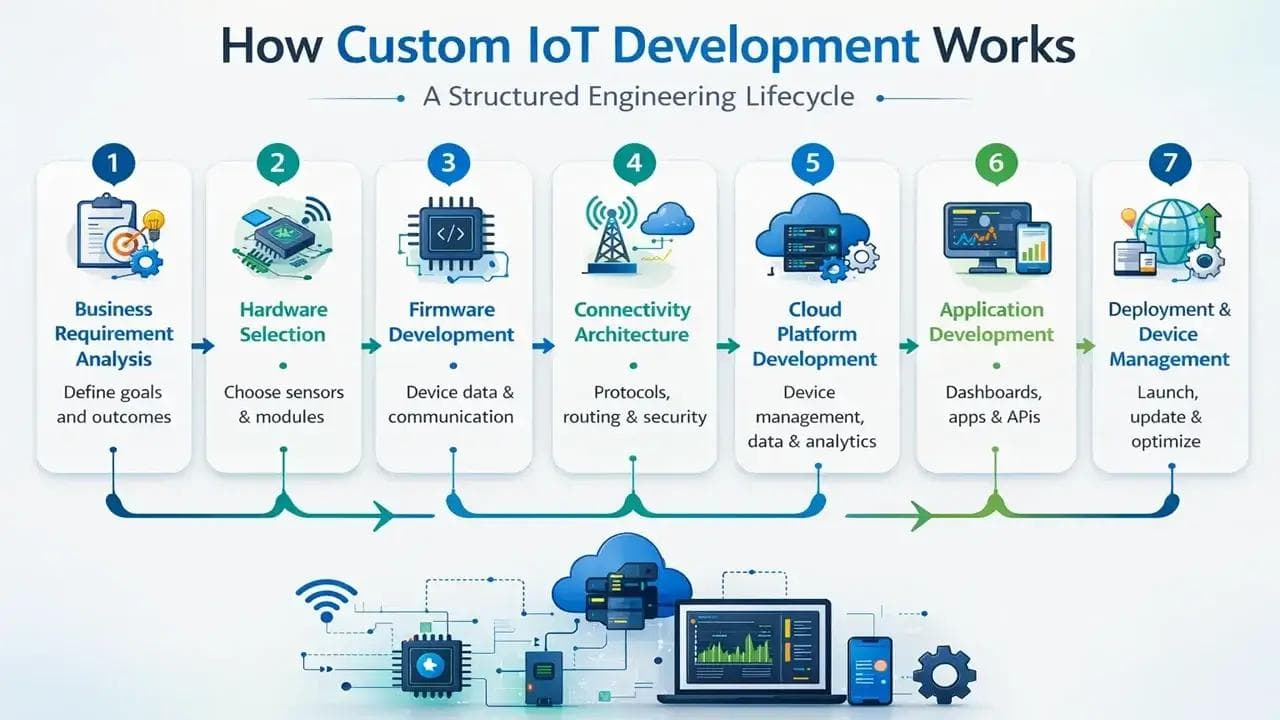
Developing a custom IoT system follows a structured engineering lifecycle.
Step 1: Business Requirement Analysis
The process begins with clear business objectives.
Engineers define the operational problems the system must solve, and the outcomes the platform must deliver.
Step 2: Hardware Selection
Sensors, microcontrollers, and communication modules are selected based on device functionality and deployment conditions.
Step 3: Firmware Development
Embedded firmware controls how devices collect data, communicate with cloud systems, and execute commands.
Step 4: Connectivity Architecture
Engineers design networking protocols, message routing, and security mechanisms for reliable data transmission.
Step 5: Cloud Platform Development
Developers build the backend infrastructure responsible for device management, data pipelines, and analytics processing.
Step 6: Application Development
Teams build dashboards, mobile applications, and APIs that allow users to interact with device data.
Step 7: Deployment and Device Management
Devices are provisioned and deployed in the field. Ongoing operations include firmware updates, system monitoring, and performance optimization.
Custom IoT Development in Practice (Examples):
Understanding custom IoT development becomes easier by looking at how it works in real industries. When companies build IoT platforms around their devices and operations, the system delivers more accurate insights and better automation.
Precision Agriculture
Soil sensors, weather stations, and crop monitoring devices connect to a custom IoT platform that manages irrigation automatically.
The platform analyzes soil conditions and weather forecasts to adjust watering schedules across different fields. This approach helps farmers reduce water usage while maintaining crop yield.
Industrial Predictive Maintenance
Sensors placed on machines track vibration, temperature, and electrical activity.
A custom IoT platform analyzes this data and identifies early signs of equipment failure. Maintenance teams receive alerts before breakdowns occur, helping reduce downtime and extend equipment life.
Remote Patient Monitoring
Wearable medical devices collect patient vitals such as heart rate and oxygen levels.
These readings are sent to a secure healthcare platform where doctors monitor patients remotely and receive alerts when readings move outside safe ranges.
Smart Energy Monitoring
Solar panels and energy systems transmit performance data to a custom monitoring platform.
Operators track energy production, identify underperforming equipment, and improve system efficiency using real-time insights.
Fleet Tracking and Logistics
Vehicle tracking devices collect location, fuel usage, and driver behavior data.
A custom fleet management platform provides real-time dashboards for dispatchers, helping optimize routes, monitor vehicles, and manage fleet operations efficiently.
Benefits of Custom IoT Development
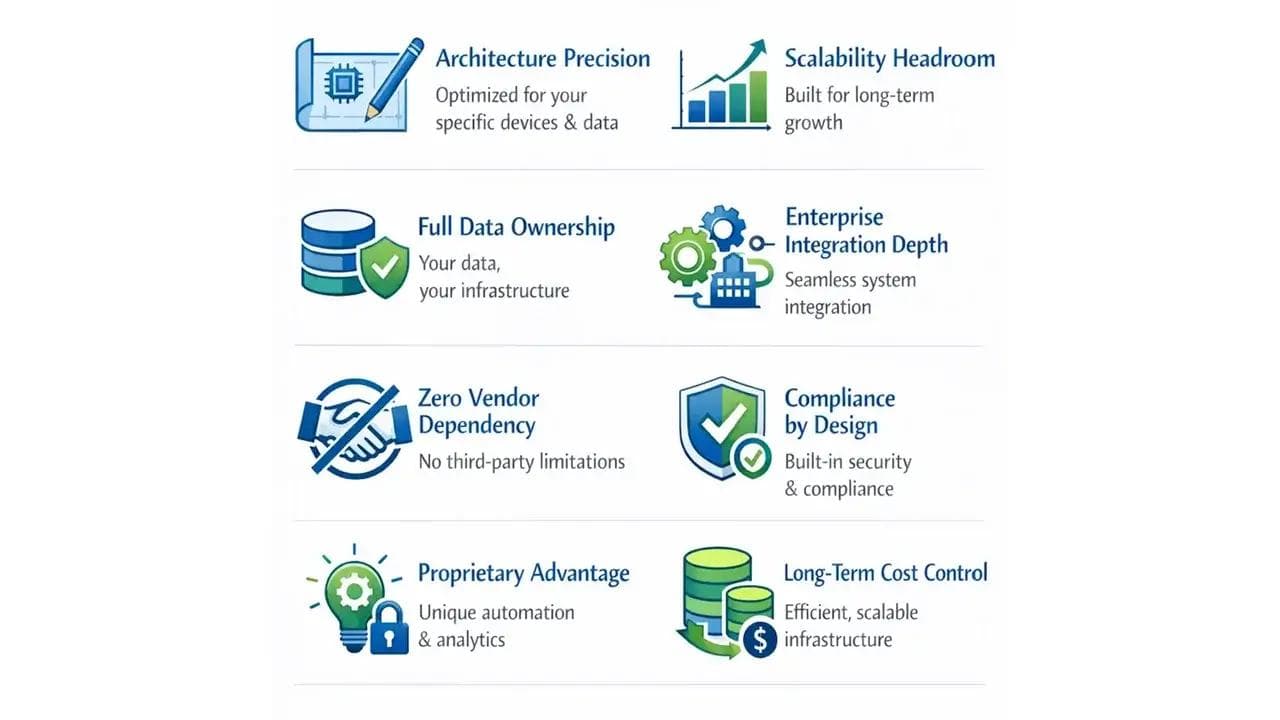
For companies where IoT is a core product or operational capability, the returns compound over time:
Architecture precision - every design choice optimized for your specific devices, data volumes, and business outcomes.
Scalability headroom - built to support your long-term growth, not just your current device fleet.
Full data ownership - your data, infrastructure, and policies for storage, retention, and access.
Enterprise integration depth - native connections with your actual business systems, rather than relying on generic connectors.
Zero vendor dependency - no pricing surprises, no roadmap uncertainty, and no reliance on third-party platform decisions.
Compliance by design - security and regulatory controls built directly into the architecture.
Proprietary competitiveadvantage - automation logic, analytics models, and user experiences designed specifically for your product.
Long-term cost control - infrastructure costs scale based on your architecture decisions rather than vendor pricing models.
The Future of Custom IoT Development
IoT technology continues to evolve rapidly.
Key trends shaping the next generation of IoT systems include:
- AI-powered IoT analytics
- edge intelligence
- digital twins for physical assets
- 5G connectivity
- autonomous device ecosystems
These innovations increase the importance of custom platform architectures designed for long-term scalability.
Closing Thoughts
As IoT adoption expands, companies that succeed are the ones that own their platform architecture rather than relying entirely on generic tools.
Custom IoT development creates systems designed specifically for your product, your devices, and your operations. It requires more upfront investment and engineering effort, but it delivers long-term advantages such as full data ownership, scalable infrastructure, and product capabilities that competitors cannot easily replicate.
For businesses where IoT plays a central role, custom development becomes the foundation for building reliable, scalable connected products.
Promeraki helps companies design and build custom IoT platforms end-to-end, from device firmware and connectivity to cloud architecture, integrations, and device management.