Types of IoT Networks: Complete Classification Guide
Not every IoT device needs the same kind of connection. A smartwatch talking to your phone works fine over Bluetooth. A gas pipeline sensor reporting data 40 kilometers away needs something completely different.
IoT networks are the communication infrastructure that connects smart devices, and they come in several distinct types, each built for different ranges, power requirements, and use cases. Picking the wrong one means poor battery life, unreliable data, and a system that falls apart at scale.
This guide covers every major type of IoT network, how each works, where it fits, and how to choose the right one for your project.
What Are IoT Networks?
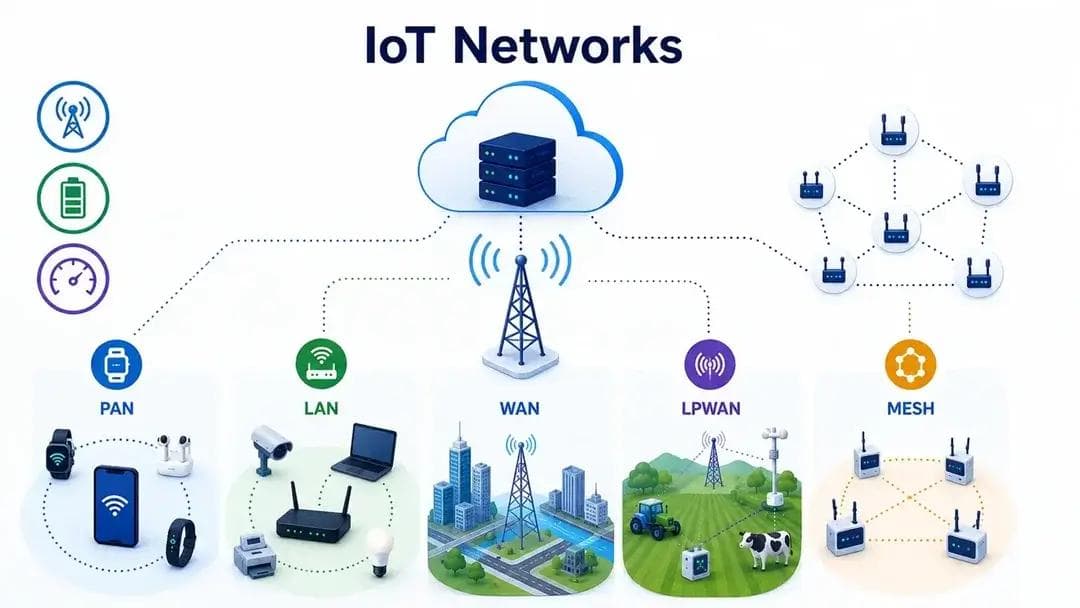
An IoT network is the communication layer that connects devices to each other or to a central platform. Every connected device, from a smart meter to a livestock tracker, needs a network to send and receive data.
IoT networks differ on three key factors:
- Range: How far the signal travels (coverage range)
- Power: How much power the device needs to stay connected (power consumption)
- Data rate: How much data can move per second (throughput)
Most IoT networks fall into four coverage-based categories: PAN, LAN, WAN, and LPWAN. Mesh networks sit across these categories and are defined by their topology rather than range. Knowing these categories is the starting point for any IoT connectivity decision.
The Core Decision
- IoT network selection comes down to balancing coverage, power efficiency, and data needs based on where your devices operate and how they scale.
4 Main Types of IoT Networks by Coverage
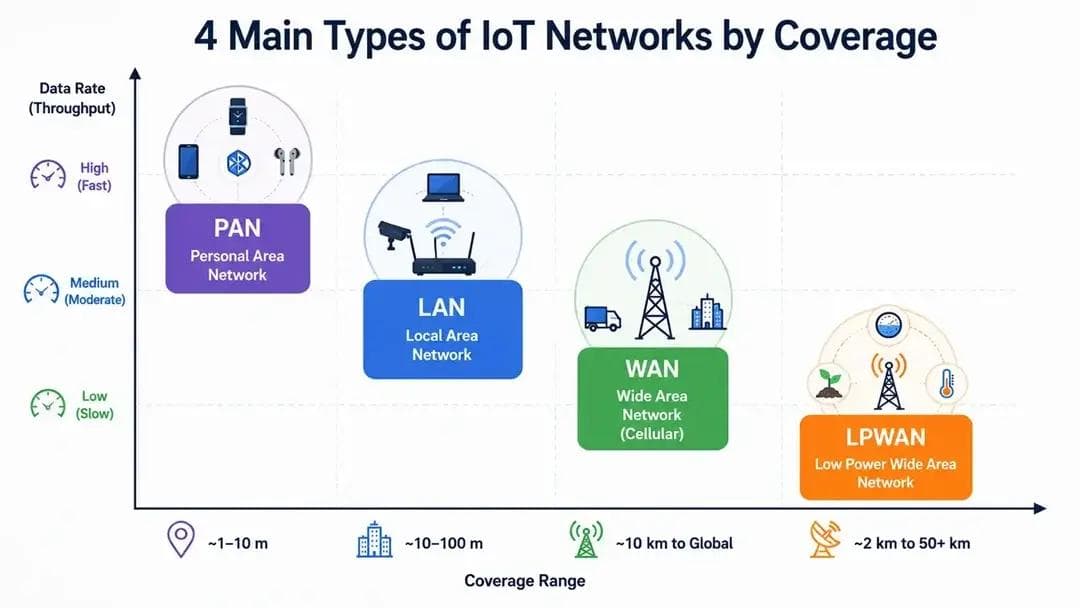
The simplest way to classify IoT networks is by how far they reach. Here is a breakdown of each category and the protocols that belong to it.
1. PAN: Personal Area Network
PANs cover short distances, usually under 10 meters. They are designed for device-to-device communication in a personal or localized space.
Common PAN protocols in IoT:
- Bluetooth Low Energy (BLE) - ideal for wearables, beacons, and medical sensors. Extremely low power.
- RFID - used for asset tagging, inventory management, and access control.
- NFC - operates under 20 cm; used for contactless payments and quick device pairing.
PANs are not built for remote data collection. Their strength is local, low-latency, and low-power communication between nearby devices.
2. LAN: Local Area Network
LANs cover building or campus-scale distances up to around 100 meters for wireless. In IoT, two technologies dominate this category.
WiFi is the obvious choice for devices inside a building that need fast data uploads, such as IP cameras, smart displays, and industrial machines on a factory floor. It supports high data rates but consumes significantly more power than BLE, which limits its use in battery-powered devices.
Ethernet offers even higher reliability and throughput for stationary, wired devices for industrial controllers, servers, and high-bandwidth edge systems.
LANs are great for fixed, indoor deployments where power is available. They are a poor fit for remote, battery-operated field sensors.
3. WAN: Wide Area Network (Cellular)
WANs cover regional and global distances. They are the right choice when devices are mobile, spread across large geographies, or need to work far from fixed infrastructure.
Key cellular IoT network types under WAN:
- 4G LTE - the current workhorse of IoT WAN. Supports fleet telematics, remote monitoring, and real-time video.
- 5G - adds ultra-low latency for time-critical applications like autonomous vehicles and smart grid management.
- Satellite - reaches areas with zero cellular coverage: remote pipelines, maritime vessels, polar stations.
Cellular IoT devices typically use an IoT SIM card (also called an M2M SIM), which is built for long-term unattended deployment, multi-network roaming, and remote provisioning, very different from a consumer SIM.
4. LPWAN: Low Power Wide Area Network
LPWAN sits at an interesting intersection with wide coverage AND ultra-low power consumption. The trade-off is data rate: LPWAN protocols are designed for small, infrequent data packets.
This makes LPWAN ideal for:
- Water or gas meters reporting daily usage readings
- Cold chain sensors logging temperature every 15 minutes
- Smart parking sensors detecting vehicle presence
- Agricultural soil sensors in remote fields
Major LPWAN protocols include LoRaWAN, Sigfox, NB-IoT, and LTE-M. These power many large-scale smart cities and precision agriculture IoT deployments worldwide.
The Connectivity Landscape
- From ultra-short-range wearables to remote industrial sensors, each IoT network category exists to solve a specific balance of coverage, power efficiency, and data transmission needs.
Cellular IoT Networks and M2M Connectivity
Cellular IoT, often called Machine-to-Machine (M2M) networking, uses the same towers as consumer mobile networks but is optimized for devices, not smartphones. It is the right fit when devices are mobile, spread over wide geographies, or need reliable real-time transmission.
2G, 3G, 4G, and 5G for IoT
Each generation of cellular has shaped how IoT connectivity has evolved:
- 2G (GPRS/EDGE) - being phased out globally, but legacy IoT devices still run on it in slower-sunset regions.
- 3G - added packet data speeds that enable more complex telemetry applications.
- 4G LTE - fast enough for video, reliable enough for asset tracking, and available across most urban and suburban areas worldwide.
- 5G - opens two new IoT modes: ultra-reliable low-latency (URLLC) for mission-critical systems and massive machine-type (mMTC) for high-density device deployments.
NB-IoT (Narrowband IoT)
NB-IoT is a 3GPP-standardized protocol built directly into cellular infrastructure. It runs on a licensed spectrum, which gives it interference protection that unlicensed protocols cannot match.
Why NB-IoT stands out:
- Penetrates building walls and underground installations better than most other IoT protocols
- Battery life routinely exceeds 10 years in low-frequency reporting scenarios
- Data rates up to 200 kbps enough for sensor readings, alarms, and config commands
- Guaranteed QoS through licensed spectrum, managed by cellular operators
LTE-M (LTE Cat-M1)
LTE-M sits between NB-IoT and full 4G LTE. It supports higher data rates (up to 1 Mbps), adds voice capability, and critically supports handover between towers. This means a device can move across coverage areas without dropping its connection.
Best use cases for LTE-M:
- Asset trackers and GPS devices that move across regions
- Connected vehicles and fleet management systems
- Wearable health monitors that need mobility plus reliability
IoT SIM Cards for Cellular Connectivity
Both NB-IoT and LTE-M require IoT SIM cards provisioned for those specific bands. An IoT SIM card also called an M2M SIM is fundamentally different from a consumer SIM in how it is built and what it supports.
Key differences of an IoT SIM card:
- Remote provisioning - operator profiles can be updated over the air without physical access to the device
- Multi-network roaming - the SIM can switch between operators automatically to maintain coverage
- Extended durability - rated for extreme temperatures, vibration, and deployment lifespans of 10+ years
- eUICC / eSIM support - allows global operator roaming without physical SIM swaps
For any international IoT deployment, an IoT SIM card with eUICC capability is not optional; it is the only practical way to manage connectivity across borders at scale.
LPWAN Technologies: LoRaWAN, Sigfox, and How to Compare Them
LPWAN is a category, not a single technology. The main protocols each take a different approach to coverage, network ownership, and cost.
LoRaWAN
LoRaWAN uses LoRa modulation to achieve 2–15 km coverage in open terrain and 1–5 km in urban areas. It operates on an unlicensed spectrum, so anyone can deploy a gateway without spectrum licensing fees.
Key advantages of LoRaWAN:
- No recurring per-device connectivity fees on private networks
- Full control over infrastructure and data
- Strong ecosystem public networks like The Things Network (TTN) cover many cities
- Preferred for agriculture, smart buildings, and campus deployments
The trade-off: network management, coverage planning, and gateway maintenance fall entirely on the deploying organization.
Sigfox
Sigfox operates as a managed service. Devices connect to Sigfox-operated base stations, and the operator charges per device per year. No gateway to manage a simpler setup, but dependent on Sigfox's network coverage in your region.
Sigfox constraints to know before choosing it:
- Maximum 12 bytes per uplink message, 8 bytes downlink
- Limited to 140 messages per device per day
- Coverage is geographically uneven in some regions
Sigfox suits extremely sparse data applications: parking sensors, simple asset tags, and tamper alerts. Anything requiring a higher message frequency needs a different protocol.
NB-IoT vs LoRaWAN: Which One Should You Choose?
These two are the most compared LPWAN options. Here is a direct breakdown:
- Licensed vs unlicensed spectrum - NB-IoT uses operator-managed licensed bands; LoRaWAN uses unlicensed spectrum you control.
- Indoor penetration - NB-IoT wins here, especially for underground or dense urban deployments.
- Cost at scale - LoRaWAN private networks have lower recurring per-device costs once gateways are deployed.
- Deployment speed - NB-IoT is faster where cellular coverage already exists. LoRaWAN requires gateway planning.
A simple rule: choose NB-IoT for challenging RF environments and guaranteed delivery. Choose LoRaWAN for private networks, rural areas, or when per-device cost must stay low on a large scale.
Mesh Networks in IoT
Mesh networks are defined by topology, not range. In a mesh, every device acts as both an endpoint and a relay, passing data node to node until it reaches a gateway. This removes single points of failure and extends coverage without running new wiring or adding new infrastructure.
The most deployed IoT mesh protocols:
- Zigbee - widely used in smart home automation, commercial building management, and industrial sensor networks. Supports up to 65,000 nodes in a single network.
- Z-Wave - purpose-built for smart home devices (908 MHz in US), with a certification program that ensures cross-brand interoperability.
- Thread - backed by Google and the OpenThread consortium, growing as the mesh backbone for Matter-compatible smart home ecosystems.
A practical example: in a large warehouse, the Zigbee mesh allows hundreds of inventory sensors to communicate without running cable to each one. Each sensor hops data through neighboring nodes until it reaches the gateway at the edge of the floor. Adding more sensors actually improves network reliability rather than straining it.
Mesh networks are excellent for indoor environments with walls, floors, and obstructions. The engineering trade-off is complexity; commissioning, routing, and troubleshooting take more effort than simpler hub-and-spoke topologies. But for large indoor deployments, that trade-off is almost always worth it.
How to Choose the Right IoT Network
No single IoT network type wins across all use cases. Match these four variables to make the right call:
- Coverage - Where are the devices? Indoors with power available, WiFi, or Ethernet. Mobile assets across regions, LTE-M or 4G. Remote battery-powered field sensors and LPWAN.
- Data rate - How much data? High-frequency or large payloads, WiFi or cellular. Small infrequent packets LoRaWAN, NB-IoT, or Sigfox.
- Power budget - Is there a power source? If replacing batteries annually is not practical, limit choices to BLE, LoRaWAN, NB-IoT, or LTE-M.
- Scale and cost - How many devices? At 10,000+ devices, cellular SIM costs add up fast. Private LoRaWAN has a higher upfront cost but near zero recurring per-device fees.
Many enterprise IoT platforms support multiple network types and let selection happen at the device level, which is useful when a single deployment spans mixed environments like indoor factories connected to outdoor field sensors.
IoT Network Comparison Table
| PAN | < 10m | Very Low | Low–Med | Wearables, smart home | Bluetooth, NFC, RFID |
|---|---|---|---|---|---|
| LAN | < 100m | Medium | High | Industrial, office IoT | WiFi, Ethernet |
| WAN / Cellular | Global | High | High | Fleet, logistics, mobile | 4G LTE, 5G |
| LPWAN | 2–50 km | Very Low | Very Low | Smart city, agriculture | LoRaWAN, Sigfox, NB-IoT |
| NB-IoT | City-wide | Very Low | Very Low | Meters, buried sensors | NB-IoT (3GPP) |
| LTE-M | Wide area | Low | Moderate | Asset tracking, healthcare | LTE Cat-M1 |
| Mesh | Variable | Low | Low–Med | Building automation | Zigbee, Z-Wave, Thread |
Conclusion
Choosing the right IoT network comes down to four things coverage, power, data rate, and cost at scale. Get those right, and everything else falls into place.
Every network type covered in this guide has its place. The real skill is knowing which one fits your use case and building a platform that uses each layer where it performs best.
If you need help making that call, Promeraki is here. Our IoT platform engineering service helps OEM manufacturers and product teams design and scale connected device platforms that work reliably in the real world. Talk to our team and let us help you build it right.